Caption
Include court or agency name, case number, and a concise title such as 'Affidavit of [Name]' so the document is properly filed and indexed.
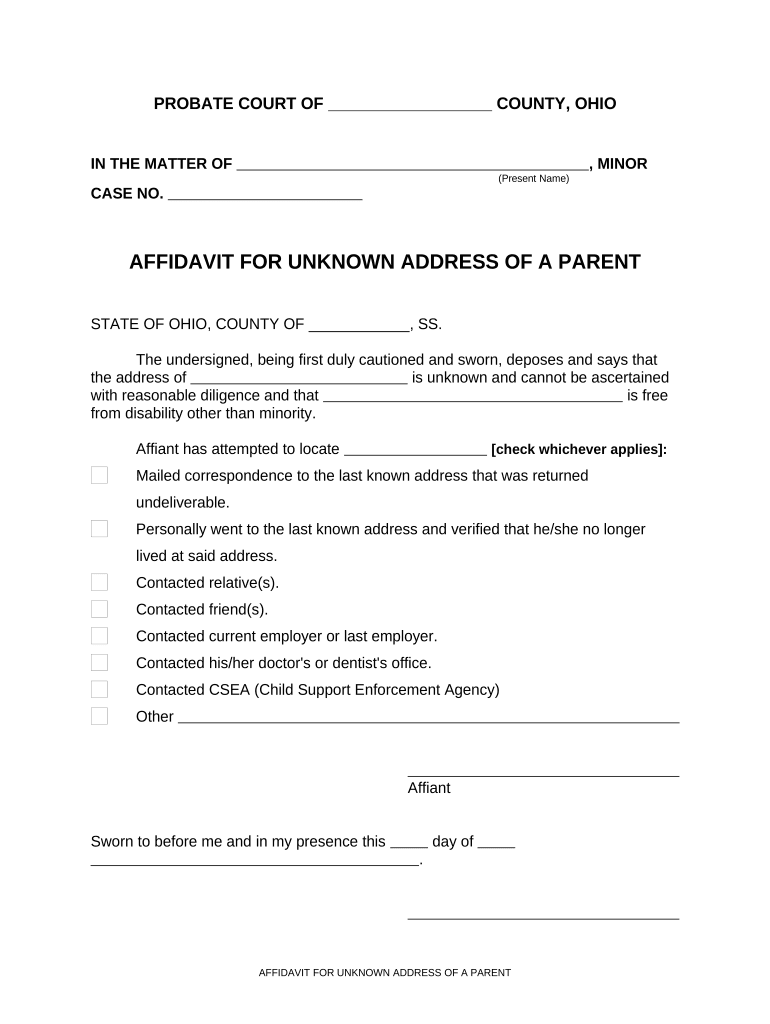
An affidavit provides a sworn, written record of facts that supports legal claims, agency applications, title examinations, or administrative reviews. Because it is made under oath, an affidavit typically carries greater evidentiary weight than unsworn statements and may accelerate procedural steps or satisfy statutory proof requirements when properly executed.

Common users who prepare and request affidavits include legal counsel, title officers, government agencies, and individuals providing sworn testimony.
Include court or agency name, case number, and a concise title such as 'Affidavit of [Name]' so the document is properly filed and indexed.
Provide full legal name, residence address, occupation, and relation to the matter to enable verification and reduce authenticity challenges.
Number each factual assertion; write concise first‑person factual paragraphs, avoid opinions, and cite specific dates, places, and persons where relevant.
Reference supporting documents in the text and attach labeled exhibits. Use certified copies when possible to strengthen evidentiary value.
Leave a jurat for the notary to complete, showing the oath or affirmation, date, and official seal. RON may be acceptable where permitted.
The affiant must sign in the notary's presence (unless RON is used). Record execution date and place in MM/DD/YYYY format.
Affidavits can be created, signed, notarized remotely, and stored using compliant eSignature platforms and RON providers.
| Field | Configuration |
|---|---|
| Signature Field | Require signer signature; lock fields after completion |
| Notary Block | Place jurat with notary name, stamp, and date |
| Authentication | Enable SMS code or RON identity proofing |
| Attachments | Allow PDF exhibit uploads; label attachments clearly |