Independent Contractor Clause
State explicitly that the worker is an independent contractor, not an employee, and explain tax and benefit implications, with responsibility for self-employment taxes and no employer withholding.
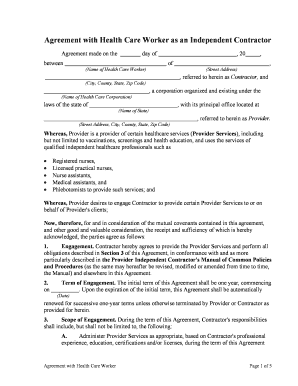
A written agreement reduces classification risk, documents HIPAA and confidentiality obligations, and fixes payment and liability terms. It also supports compliance with ESIGN (15 U.S.C. ch. 96) and UETA for electronic execution and preserves evidence of consent and record retention.

Organizations and individual practitioners use this agreement to set expectations before services start.
Authorized contracting officer, HR director, or operations manager who verifies credentialing, insurance, and scope of engagement; responsible for imposing HIPAA controls and documenting business reasons for contractor classification.
Licensed clinician, therapist, or technical specialist who provides services under the agreement; responsible for maintaining professional licenses, carrying required insurance, paying self-employment taxes, and adhering to confidentiality and practice standards.
State explicitly that the worker is an independent contractor, not an employee, and explain tax and benefit implications, with responsibility for self-employment taxes and no employer withholding.
Describe duties, deliverables, hours or availability expectations, locations of service, and any deliverable acceptance criteria to avoid ambiguity about job responsibilities.
Specify rates, invoicing frequency, payment terms, any holdbacks or reimbursement policies, and whether expenses require preapproval to ensure timely and auditable payments.
Require proof of professional licensure, malpractice or liability insurance limits, and ongoing credentialing obligations for the term of the contract.
Include confidentiality covenants and either reference or attach a Business Associate Agreement when the contractor will access protected health information (PHI).
Set termination for convenience and cause, notice periods, post-termination responsibilities, and indemnity or limitation of liability provisions tailored to clinical risks.
| Field | Configuration | Authentication method | Field behavior |
|---|---|
| Authentication Methods | Email link with optional SMS code; consider stronger MFA for PHI access |
| Field Types | Signature, initial, date, attachments, and conditional fields for variable clauses |
| Conditional Logic | Show indemnity or BAA fields only when contractor accesses PHI |
| Audit Trail | Capture IP, timestamps, and actions for chain-of-custody records |
Choose a platform that supports secure authentication, audit trails, and PHI protections.
Obtain a completed W-9 from contractor before first payment.
File and furnish 1099-NEC by January 31 for reportable payments.
Complete I-9 documentation per 8 CFR §274a.2 as required for payroll.
Execute BAA before sharing protected health information with contractor.
Verify active professional license prior to engagement start.
Agreement signed and dated; credentials attached and verified.
Access granted, HIPAA training completed, and systems permissions assigned.
Contractor submits initial invoice per agreed schedule for validation.
Credential and insurance recheck at defined intervals.
| signNow | DocuSign | Adobe Sign | PandaDoc | HelloSign | |
|---|---|---|---|---|---|
| Starting Price | $8/user/mo | $15/user/mo | $14/user/mo | $19/user/mo | $15/user/mo |
| Free Trial | 7-day free trial, no credit card | Varies by vendor | Varies by vendor | Varies by vendor | Varies by vendor |
| Bulk Send | Yes (Business Premium) | Yes | Yes | Yes | No |
| Audit Trail | Yes | Yes | Yes | Yes | Yes |
| HIPAA Compliant | Yes (BAA available) | Yes (BAA available) | Yes (BAA available) | No | No |
A regional clinic uses a standardized contractor agreement to onboard locum tenens quickly
A specialty practice requires strict PHI controls in contractor agreements