Establishing secure connection…Loading editor…Preparing document…

Agreement for Accord and Satisfaction

This template is fully customizable. Edit the text, fill out the fields, and send it for signature. Give it a try!
Agreement for Accord and Satisfaction

What an Agreement for Accord and Satisfaction Is and when it applies

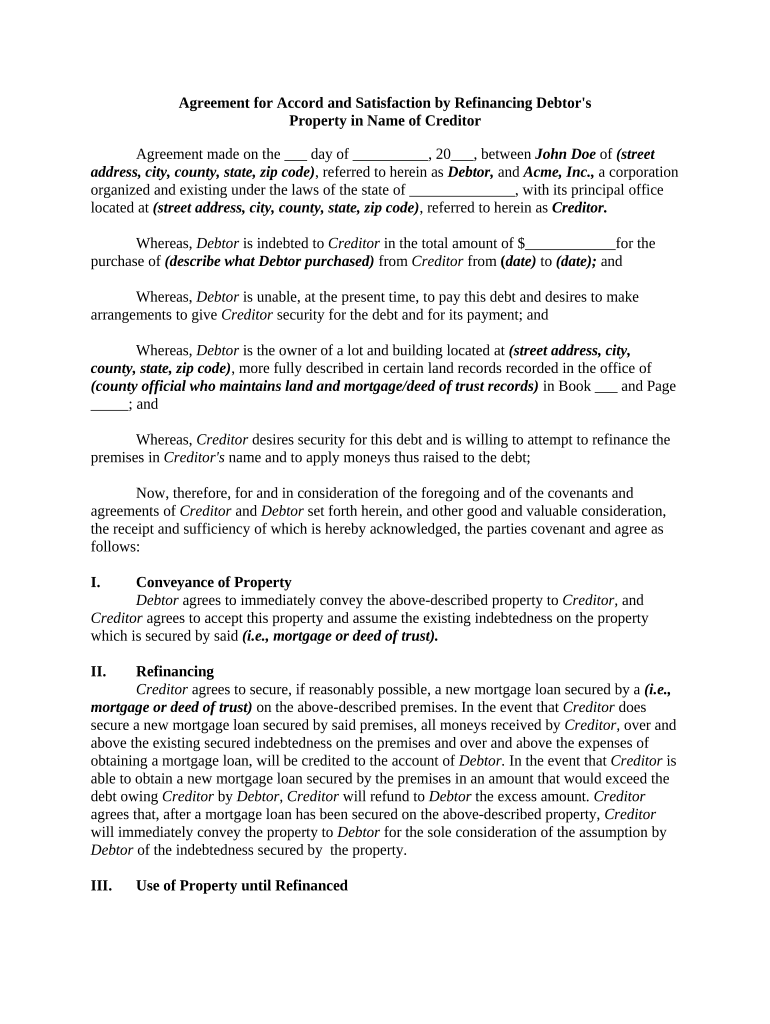
An Agreement for Accord and Satisfaction is a contract that resolves a disputed claim by substituting a new obligation (the accord) and then performing it (the satisfaction), commonly by payment or other agreed concession. Once fully executed, the agreement extinguishes the original claim and prevents further enforcement for that dispute. Parties use it to avoid litigation, lock in settlement terms, and create a clear record of release. For electronic execution, the document is enforceable under federal ESIGN (15 U.S.C. ch. 96) and state UETA laws when the parties demonstrate intent, consent, attribution, and retention.

Why a formal accord and satisfaction matters for dispute resolution

A written accord and satisfaction provides finality, reduces litigation risk, and creates enforceable terms for payment and release. It clarifies obligations, allocation of costs or taxes, and preserves evidence of settlement suitable for courts and regulators when properly executed and retained.

Why a formal accord and satisfaction matters for dispute resolution

Who typically prepares or signs an Agreement for Accord and Satisfaction

Businesses and individuals use this agreement to settle contested claims without court intervention; counsel often drafts settlement language to reduce ambiguity.

  • Creditors and collection agencies resolving disputed debts outside litigation.
  • Corporate finance or accounting teams finalizing disputed invoices and vendor claims.
  • Consumers or debtors accepting reduced payment terms in exchange for release of claims.

Drafting with clear consideration terms and signature blocks helps ensure enforceability and reduces the chance of future disputes about what was agreed.

Core components to include in a professional accord and satisfaction

A robust agreement contains specific sections that show the dispute context, the new obligation, the conditions for satisfaction, and a mutual release. Each part should be precise to avoid ambiguity and to support enforcement if a party later contests the settlement.

Parties

Identify each party by full legal name and entity type; list addresses and contact details to avoid mistaken identity.
Recitals

Briefly describe the disputed claim, relevant invoices or dates, and the factual basis for the settlement to provide context.

Accord Terms

Detail the substituted obligation (amount, payment schedule, or actions) and exact performance conditions that will constitute satisfaction.

Consideration

State the specific payment or concession being exchanged and whether any withholding or tax treatment applies to the amount.

Satisfaction Conditions

Explain how and when the accord becomes a satisfaction (for example, cleared funds, return of property, or executed releases).

Release Language

Include mutual release wording that extinguishes the prior claim and any future actions arising from the same facts, with scope carefully defined.

Step-by-step: completing an Agreement for Accord and Satisfaction

Follow a clear sequence to prepare, agree, and execute the settlement to ensure it becomes effective and enforceable.

  • 01
    Draft terms: Prepare precise accord and release language covering claims and consideration.
  • 02
    Review roles: Confirm signatory authority for each party before sending.
  • 03
    Offer acceptance: Obtain explicit acceptance and performance evidence.
  • 04
    Document retention: Save executed copies and audit trails for required retention periods.

Typical execution workflow for issuing and receiving the agreement

A reliable workflow reduces delays and ensures a clear record of acceptance and performance.

  • Prepare document: Assemble agreement and supporting exhibits for signature placement.
  • Add fields: Place signature, date, and defined data fields for all parties.
  • Send to signer: Use a tracked delivery method or eSignature platform to notify parties.
  • Confirm completion: Capture signed copies, timestamps, and any satisfying performance evidence.

Common e-signature workflow settings to configure

Configure authentication, routing, and retention settings to align with legal and business needs before sending the agreement for signature.

Field Configuration
Authentication Email link, SMS code, or knowledge-based verification
Routing Order Sequential or parallel signer order per settlement terms
Reminders Automated reminders and expiration settings to prompt signers
Retention Set document retention and export settings for audit trail preservation

Digital signing considerations and platform integration

Choose a platform that supports secure eSignatures, audit trails, and the file formats your parties use.

  • File formats: PDF and DOCX are widely compatible and preserve formatting
  • Integrations: Connectors for Salesforce, NetSuite, and Google Workspace improve workflows
  • Authentication: Options include email, SMS, KBA, or advanced signer authentication

Ensure the selected platform provides tamper-evident signed documents, exportable audit trails, and the ability to store executed agreements in your records system for the legally required retention period.

Timing: when to issue the agreement and expected processing windows

Set clear dates for offer, acceptance, performance, and any payment windows so parties know when the accord becomes a satisfaction.

Issue upon dispute:

Send the proposed settlement promptly after negotiation to avoid lapsing offers

Payment window:

Specify the number of days for payment and method for clearance

Effective date:

State when the release becomes operative (often upon cleared payment)

Statute impact:

Note that settlements can affect statute of limitations—check state law

Tax reporting:

Report settlement amounts per IRS rules; consult tax counsel for treatment

Common pitfalls to avoid when preparing an accord and satisfaction

  • Vague release language that fails to identify the specific claim or time period covered, leading to future disputes or litigation.
  • Not confirming signatory authority for corporate parties, which can render the agreement void or subject to challenge.
  • Failing to specify consideration with sufficient detail, such as whether fees, costs, or taxes are included or excluded.
  • Relying on informal acceptance (verbal or email) without clear evidence of intent and performance, risking enforceability issues.

Legal and financial risks from an incorrect agreement

Unenforceable: Ambiguous terms may be void
Duplicate claims: Incomplete release may permit repeated suits
Tax exposure: Settlement may create taxable income
Ineffective acceptance: Nonperformance can reopen dispute
Privacy breach: Improper PHI handling violates HIPAA
Recordkeeping: Missing retention risks regulatory fines

How an accord and satisfaction compares to a simple release

Comparing an accord and satisfaction with a release highlights practical and legal differences that affect enforceability and future remedies.

Criteria Release Only Accord and Satisfaction
Mutuality often one‑sided requires substituted obligation
Consideration required not always explicit explicit and defined
Effect on obligation extinguishes claim if accepted replaces then extinguishes
Typical use simple waivers settlements of disputed claims

eSignature vendor comparison for executing agreements like an accord and satisfaction

Platform selection affects cost, compliance (HIPAA, audit trail), and volume handling. The table lists starting prices and core capabilities for common vendors.

signNow DocuSign Adobe Sign PandaDoc HelloSign
Starting Price $8/user/mo $15/user/mo $14/user/mo $19/user/mo $15/user/mo
Free Trial 7-day free trial Varies Varies Varies Varies
Bulk Send Yes Yes Yes Yes No
Audit Trail Yes Yes Yes Yes Yes
HIPAA Compliant Yes Yes Yes No No

Frequently asked questions about Agreements for Accord and Satisfaction

Answers below cover enforceability, e-signature validity, tax consequences, revocation, notarization, and what to do when performance fails.


Need help? Contact support

be ready to get more
Join over 28 million airSlate SignNow users