Establishing secure connection…Loading editor…Preparing document…

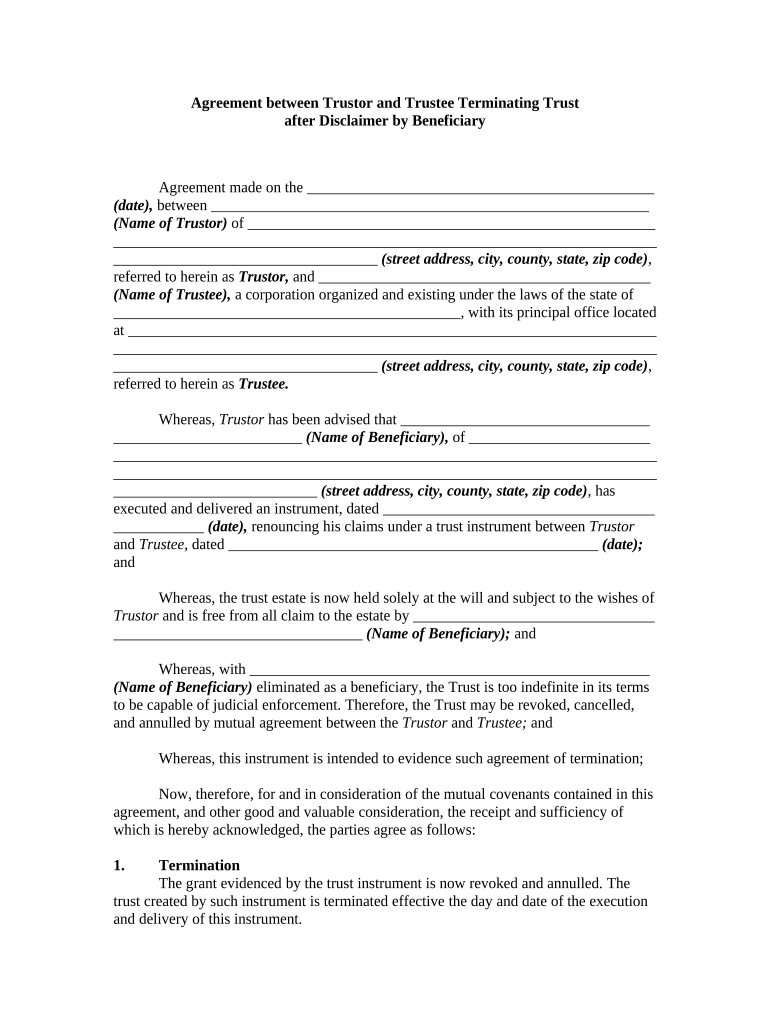
Agreement Terminating Trust

This template is fully customizable. Edit the text, fill out the fields, and send it for signature. Give it a try!
Agreement Terminating Trust

What an Agreement Terminating Trust Is and When it’s Used

An Agreement Terminating Trust is a written instrument by which trust parties agree to end a trust and distribute its assets according to the trust terms or a new agreement. It records the trustee’s actions, beneficiary consent (when required), accounting of assets and liabilities, and any conveyances such as deeds. Where property or recorded instruments are involved, termination often triggers recording steps at the county level. Electronic execution and storage are generally permitted under the ESIGN Act (15 U.S.C. ch. 96) and state UETA laws, subject to any narrow statutory exceptions.

Why a Formal Agreement Terminating Trust Matters

A formal terminating agreement creates clear evidence of distribution, preserves the trustee’s indemnities, documents tax and accounting steps, and reduces future disputes by recording how and when assets moved to beneficiaries.

Why a Formal Agreement Terminating Trust Matters

Who Typically Prepares and Signs a Termination Agreement

Trustees, beneficiaries, and their legal or fiduciary advisors commonly prepare the agreement to document final distributions and releases.

  • Individual trustees and co-trustees — Prepare and execute termination terms, provide final accounting to beneficiaries.
  • Corporate trustees and trust companies — Follow institutional procedures, obtain board approvals, and secure legal review.
  • Beneficiaries and heirs — Review distributions, give written consent when required, and receive executed release language.

Typical Signers and Their Roles

Trustee

Trustees (individual or corporate) sign to effect termination, provide the final accounting, and authorize distributions. Their signature documents discharge of duties and can limit future liability if properly drafted and accepted by beneficiaries.

Beneficiary

Beneficiaries sign to acknowledge receipt of distributions and to execute releases or waivers. Beneficiary signatures create evidence of consent and reduce the risk of later contesting the termination.

Core Elements to Include in a Professional Termination Agreement

A complete Agreement Terminating Trust should be concise but include the following six elements so it is enforceable, auditable, and transferable where property is affected.

Trust Identification

State the trust name, date of original instrument, and trust tax ID or grantor name so the agreement unambiguously identifies the subject trust and its records.
Recitals

Summarize the reason for termination, references to the trust instrument provisions permitting termination, and any prior amendments that affect distribution.

Termination Clause

A clear statement that the trust is terminated, with the effective date and the authority under which termination occurs (e.g., trust terms or unanimous beneficiary consent).

Distribution Schedule

Itemize assets and recipients, specifying cash amounts or asset descriptions, allocation percentages, and any conditions on distribution or withheld reserves.

Releases and Indemnities

Include beneficiary releases of trustee claims, and trustee indemnities for actions taken in good faith based on the termination agreement and accounting.

Execution and Recording

Signature blocks for trustee(s) and beneficiaries, notary or remote online notarization fields if required, plus instructions for recording deeds or other instruments.

Required Information and Data Points

Trust Name: Exact legal name
Trust Date: Original execution date
Trustee Names: All current trustees
Beneficiary List: Full legal names
Asset Descriptions: Real property, accounts, securities
Signatures: Signer name + date

Step-by-Step: Completing the Agreement Terminating Trust

Follow these steps to prepare, execute, and record the termination with clarity and legal defensibility.

  • 01
    Review Trust: Confirm termination authority in the trust document.
  • 02
    Draft Agreement: Prepare clear distribution and release language.
  • 03
    Obtain Consents: Get beneficiary signatures and notarization where required.
  • 04
    Record and Retain: Record deeds when needed and keep the signed original.

How to Configure an Online Workflow for Termination

Set up a digital workflow to collect signatures, notarization, and store an auditable record while preserving chain-of-custody.

Field Configuration
Authentication method Email link + SMS MFA where needed
Document template PDF with conditional and required fields
Notary option Choose RON or in-person notary field
Storage format PDF/A with audit trail

Where to Send and How the Process Flows

A clear routing plan reduces delay: prepare, route, verify identity, notarize if needed, then record and distribute copies.

  • Upload Document: Attach final draft to the signing platform
  • Place Fields: Add signature, date, and notary spots
  • Send to Signers: Route in order or via parallel invites
  • Store Copies: Save executed PDF and audit report

Distribution Methods and Platform Requirements

Choose delivery channels that match the signers’ needs and any statutory requirements for authentication and retention.

  • File Formats: PDF, DOCX accepted
  • Integrations: Salesforce, NetSuite, Google Workspace
  • Authentication: Email link, SMS code, KBA, RON

Use a platform that produces an auditable certificate of completion, supports RON where permitted, and stores signed PDFs with AES-256 encryption and TLS in transit.

Key Timing Considerations and Typical Timeframes

Timing depends on the trust terms and whether property transfers or court involvement are required; plan for notification, execution, and recording phases.

Effective Date:

Usually the date of last required signature

Beneficiary Notice:

Many trustees notify beneficiaries promptly; common practice is 30–60 days

Recording Deeds:

Record promptly after execution if real property is conveyed

Tax Reporting:

Report distributions in the tax year they occur (see IRS guidance)

Retention of Records:

Retain signed agreement per retention rules below

Common Mistakes to Avoid When Preparing Termination Agreements

  • Using inconsistent or abbreviated legal names for the trust or parties, which complicates recording and title transfers.
  • Failing to include a final accounting or holdback for unsettled liabilities, leaving unresolved creditor claims.
  • Omitting beneficiary consent or failing to document attempts to notify beneficiaries when consent is required.
  • Skipping notarization or using incorrect notary format when a county recorder or title company requires it for conveyances.

Potential Consequences of an Incorrect or Incomplete Agreement

Tax Consequences: Unexpected income or capital gains
Title Defects: Recording rejections or clouded title
Trustee Liability: Breach claims by beneficiaries
Probate Risk: Court challenges and delay
Regulatory Exposure: Failure to follow HIPAA or IRS rules
Enforceability Issues: Ambiguous wording may void provisions

Real-World Use Examples

These examples show how property and fiduciary practices shape termination workflows in practice.

Martin Properties (Tim Martin)

A property portfolio trust required multiple deed transfers and beneficiary consents

  • Used online signing and notarization for remote owners
  • The executed agreement, notarized remotely, was recorded at the county and stored with a complete audit trail for title evidence.

Optica Ventures (Brian Fitzgibbons)

A trust holding business interests needed clear distribution mechanics

  • Trustees obtained beneficiary releases and final accounting
  • The signed agreement documented distributions and released trustees, simplifying corporate transfer procedures.

Comparing eSignature Options for Executing and Storing Termination Agreements

Choose a solution that supports notarization workflows, preserves audit trails, and meets compliance needs; pricing and caps vary across vendors.

signNow DocuSign Adobe Sign PandaDoc HelloSign
Starting Price $8/user/mo $15/user/mo $14/user/mo $19/user/mo $15/user/mo
Free Trial 7-day free trial Varies by plan Varies by plan Varies by plan Varies by plan
Bulk Send Yes Yes Yes Yes No
Audit Trail Yes Yes Yes Yes Yes
HIPAA Compliant Yes Yes Yes No No
Envelope Cap No cap 100 env/user/yr Verify Verify Verify

FAQs: Execution, Notarization, and Legal Validity

Answers to common questions about enforceability, electronic signatures, notarization, and post-termination steps.


Need help? Contact support

be ready to get more
Join over 28 million airSlate SignNow users