Establishing secure connection…Loading editor…Preparing document…

Alaska Single-Member Operating Arrangement

This template is fully customizable. Edit the text, fill out the fields, and send it for signature. Give it a try!
Alaska Single-Member Operating Arrangement

What the Alaska Single-Member Operating Arrangement Is

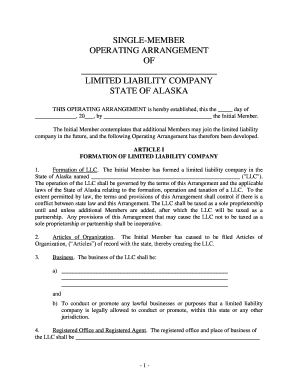
The Alaska Single-Member Operating Arrangement is a written operating agreement template tailored for single-member limited liability companies formed or operating in Alaska. It documents ownership, management authority, capital contributions, allocation of profits and losses, tax treatment, and procedures for admission, transfer, or withdrawal of members. Although operating agreements are generally internal records and typically need not be filed with the Alaska Division of Corporations, having a clear, signed arrangement helps protect limited liability status and clarifies economic and managerial rights. This document can be executed electronically in compliance with ESIGN and state e-signature laws when parties consent.

Why a Single-Member Arrangement Matters

A single-member operating arrangement reduces ambiguity about ownership and management, documents capital and tax choices, and strengthens the record supporting limited liability. It also provides clear procedures for succession, transfer, and dissolution, which simplifies internal governance and external due diligence.

Why a Single-Member Arrangement Matters

Who Commonly Uses This Arrangement

This arrangement is used by individuals who form single-member LLCs in Alaska or advisers preparing internal governance documents.

  • Sole owners who want to document rights, duties, and capital contributions.
  • Accountants and tax preparers confirming tax treatment and member distributions.
  • Attorneys drafting enforceable internal agreements to protect limited liability rights.

Primary Parties and Roles

Single Member

A single-member owner who controls management and capital. This person should record capital contributions, compensation policies, and tax classification (disregarded entity or corporate election). Clear, signed terms reduce personal liability risk and support consistent treatment by banks, courts, and tax authorities.

Designated Manager

An appointed manager (if different from the owner) responsible for day-to-day operations and contract signing authority. The arrangement should specify manager powers, limits, indemnification, and any required reporting to the member to prevent governance disputes.

Core Sections to Include in the Arrangement

Essential sections in the Alaska Single-Member Operating Arrangement define membership, management, capital, distributions, tax treatment, transfer restrictions, and dissolution procedures.

Formation

Identify LLC name, principal place of business in Alaska, formation date, and statutory agent. Confirm LLC type (single-member) and reference articles of organization filed with the Alaska Division of Corporations.
Capital

Describe member capital contributions (cash, property, services), capitalization schedule, and procedures for additional contributions or loans. State how contributions affect membership interest and deficit allocations.

Distributions

Specify distribution priorities, timing, and calculation method for profits and losses. Include tax distribution provisions to cover member tax liabilities and any mandatory minimum distributions.

Management

State whether the LLC is member-managed or manager-managed, list manager authority, signing limits, voting thresholds, and procedures for removing or appointing managers, including notice and quorum rules.

Transfer

Include transfer restrictions, right of first refusal, buyout formulas, valuation method, and procedures for admitting transferees to preserve single-member status or convert to multi-member ownership structure.

Dissolution

Describe events causing dissolution, winding-up procedures, priority of creditor payments, and distribution of remaining assets to the member consistent with Alaska law, including notice and recordkeeping requirements.

Step-by-Step: Complete and Execute the Arrangement

Follow these steps to complete and execute the Alaska Single-Member Operating Arrangement accurately and electronically.

  • 01
    Prepare Document: Confirm LLC details and fill all required fields.
  • 02
    Review Terms: Verify capital, tax, and management provisions with advisor.
  • 03
    Sign Electronically: Choose compliant eSignature method and authenticate signer.
  • 04
    Store Records: Save signed PDF and maintain secure retention copies.

Execution, Routing, and Recordkeeping Workflow

Routing and submission options for the executed arrangement, including e-execution, notary (if desired), and storage workflows.

  • Upload: Upload finalized PDF to signing platform.
  • Assign Signer: Add member email and set authentication.
  • Sign: Member completes signature; audit trail recorded.
  • Distribute: Provide copies to member, bank, and advisors.

Configure an Electronic Workflow for This Agreement

Configure an electronic workflow that matches signer roles, authentication, and document fields for the operating arrangement.

Field Configuration
Signer Type Single signer; member-only authentication via email or SMS code.
Authentication Email link, SMS code, or MFA depending on risk.
Fields Signature, date, initials, capital amount, tax election.
Notifications Send completed copies to member and retained parties.

Technical Requirements for eSigning and Storage

Choose a signing platform that supports secure storage, audit trails, and compliance with ESIGN, UETA, and HIPAA when applicable.

  • File Formats: PDF and DOCX supported.
  • Integrations: Connects to NetSuite, Google Workspace, Salesforce.
  • Authentication: Supports SMS, email, and SSO.

Best Practices to Reduce Risk and Maintain Clarity

Practical guidelines to prepare a clear, enforceable Alaska Single-Member Operating Arrangement and reduce future disputes.

Document capital contributions and recordkeeping
Record each capital contribution with date, fair market valuation, and supporting documentation. Maintain a capitalization schedule showing outstanding loans or member advances. Accurate records support tax positions, simplify distributions, and reduce challenges during audits or member transitions.
Set clear management, voting thresholds, and notice procedures
Specify whether the LLC is member-managed or manager-managed, detail voting thresholds for major decisions, and require written notice periods for meetings and approvals. Include tie-breaker rules and procedures for emergency actions to avoid paralysis during critical events.
Tax elections and distribution mechanics
Document the LLC's chosen federal tax classification, the timing of distributions, and whether tax distributions will be made to cover member tax liabilities. Clarify allocation methods and retain sufficient reserves to prevent forced liquidity events.
Plan for member transfer, buyouts, and succession
Include right of first refusal, valuation methodology, and buyout timelines. Address what happens upon incapacity or death, whether membership interest can be transferred to heirs, and any required approvals to admit a new member.

Common Pitfalls to Avoid

  • Failing to define capital contributions and valuation leads to disputes over ownership percentages, dilution, and member loans, especially when noncash property is involved.
  • Using ambiguous distribution language or omitting tax distributions can force members to cover tax liabilities out-of-pocket and create cash flow mismatches.
  • Not specifying management authority or voting thresholds can cause operational gridlock and increase litigation risk during disputes or member incapacity.
  • Failing to align the operating arrangement with tax elections or K-1 reporting often produces inconsistent tax filings and IRS inquiries.

Key Risks and Consequences of an Inadequate Arrangement

Piercing Risk: Poor records increase veil-piercing risk.
Tax Exposure: Inaccurate tax election affects returns.
Banking Delays: Banks may refuse accounts.
I.R.S. Scrutiny: Misalignment can trigger audits and penalties.
Contract Disputes: Ambiguity leads to litigation costs.
Transfer Problems: Unclear buyouts create valuation disputes.

Important Dates and Filing Timelines to Watch

Key dates and filing timelines related to formation, tax elections, and recordkeeping for single-member LLCs.

Formation Filing:

File Articles of Organization by chosen formation date.

Effective Date:

Set in agreement; controls rights and obligations.

Tax Election Deadline:

S-corp or corporate elections have time limits; file with IRS timely.

Annual Reports:

Alaska requires biennial or annual reports depending on entity; check state requirements.

Record Retention:

Retain executed agreement and tax records per applicable retention rules.

How Others Use This Agreement — Two Examples

Two concise examples showing how an Alaska Single-Member Operating Arrangement is used in practice across common scenarios.

Real Estate Investor

A sole investor forms a single-member Alaska LLC to hold rental property and wants clear procedures for distributions, capital calls, and management authority.

  • Require manager to obtain insurance and maintenance approvals.
  • The operating arrangement documents initial capital, sets a distribution waterfall, and includes a valuation formula for buyouts; lenders required an executed agreement to open LLC bank accounts and verify limited liability protections during financing.

Single-Member Business Owner

A contractor operating as a sole proprietor converts to an Alaska single-member LLC to separate personal assets and formalize payment and indemnity rules.

  • Specify insurance, indemnity, and subcontractor approval.
  • The agreement clarifies contractor authority, establishes invoice timing, and adds indemnity and indemnification provisions; when electronically executed and retained, it supported insurance underwriting and reduced ambiguity in client contracts and improved bank onboarding.

Essential Information to Record in the Agreement

Member Name: Full legal name as on ID
LLC Name: Exact name on Articles of Organization
Principal Address: Street, city, state, ZIP
Tax Classification: Disregarded entity or corporation
Capital Contribution: Amount, type, and date
Signatures: Member signature and execution date

eSignature Pricing and Feature Comparison

Comparable eSignature pricing and feature overview useful when choosing a platform to execute and retain operating agreements.

signNow DocuSign Adobe Sign PandaDoc HelloSign
Starting Price $8/user/mo $15/user/mo $14/user/mo $19/user/mo $15/user/mo
Free Trial 7-day free trial Varies by vendor Varies by vendor Varies by vendor Varies by vendor
Bulk Send Yes (Business Premium) Yes Yes Yes Limited
Audit Trail Yes Yes Yes Yes Yes
HIPAA Compliant Yes (BAA available) Varies by plan Varies by plan Varies by plan Varies by plan
Envelope Cap No cap 100 envelopes/user/year Varies by plan Varies by plan Varies by plan

Frequently Asked Questions and Troubleshooting

Answers to common questions about completing, signing, and maintaining the Alaska Single-Member Operating Arrangement and using electronic signatures.


Need help? Contact support

be ready to get more
Join over 28 million airSlate SignNow users