Establishing secure connection…Loading editor…Preparing document…

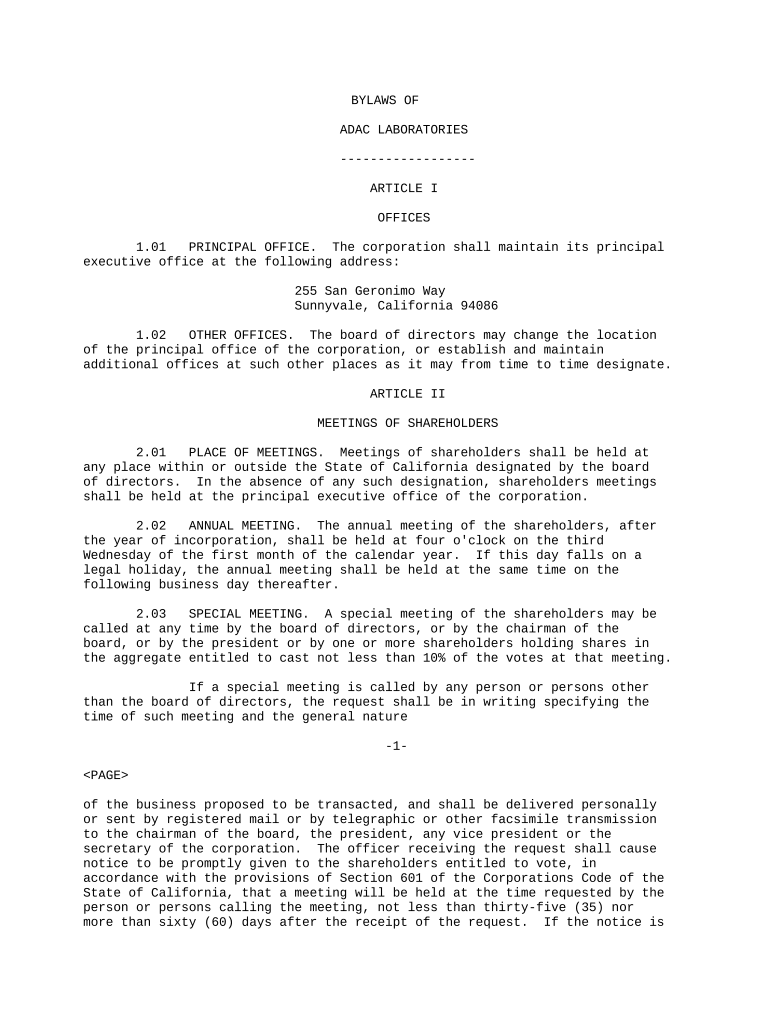
Bylaws of ADAC Laboratories

This template is fully customizable. Edit the text, fill out the fields, and send it for signature. Give it a try!
Bylaws of ADAC Laboratories

What the Bylaws of ADAC Laboratories Cover

The Bylaws of ADAC Laboratories are the internal governance rules that define the corporation's structure, decision-making processes, officer and director roles, meeting procedures, voting rules, and other operational protocols. These bylaws set membership of the board, terms of office, quorum requirements, committee authorities, conflict-of-interest procedures, and amendment mechanisms. They function alongside the articles of incorporation and applicable state corporate law to govern corporate actions, board conduct, and shareholder relations. Properly drafted bylaws create predictable procedures for routine and extraordinary corporate matters and support legal compliance and fiduciary oversight.

Why Clear Bylaws Matter for ADAC Laboratories

Adopting clear bylaws clarifies board authority, reduces governance disputes, and documents procedures for meetings, elections, and amendment. Well-constructed bylaws help meet state corporate law obligations, support fiduciary duties, and provide a defensible record during audits or legal review.

Why Clear Bylaws Matter for ADAC Laboratories

Who Drafts and Relies on These Bylaws

Corporate officers, board members, shareholders, and legal counsel commonly draft, review, or consult the Bylaws of ADAC Laboratories for governance.

  • Board of Directors — establishes meeting schedules, quorum rules, and voting thresholds.
  • Corporate Secretary — maintains records, minutes, and amendment logs for legal compliance.
  • Outside counsel — reviews provisions and aligns bylaws with state corporate statutes and case law.

Key Sections to Include in ADAC Laboratories' Bylaws

Core sections of corporate bylaws define board composition, officer duties, meeting protocols, voting procedures, committee authorities, and formal amendment processes.

Board Composition

Specify the number of directors, term lengths, staggered terms if used, procedures for filling vacancies, and any qualifications or disqualification standards for board membership and removal procedures.
Officer Roles

Describe officer positions (e.g., president, secretary, treasurer), their duties, appointment and removal processes, delegation limits, and any required officer qualifications or bond requirements for financial officers.

Meeting Procedures

Set notice requirements, annual and special meeting schedules, quorum thresholds, proxy and remote participation rules, recordkeeping expectations, and procedures for adjournment and reconvening meetings and minutes approval.

Voting Rules

Define voting rights of directors and shareholders, supermajority thresholds where applicable, proxy voting rules, tie-breaking procedures, and mechanisms for written consents and electronic votes and quorum impact.

Committees

Identify standing and special committees, appointment authority, committee membership rules, delegated powers, reporting obligations to the board, and limits on committee decision-making authority and record retention requirements.

Amendment Process

Specify how bylaws may be amended, who may propose amendments, notice requirements for amendments, voting thresholds needed to adopt changes, and any required filing or shareholder notice obligations.

Step-by-Step: Preparing and Executing the Bylaws

Follow these steps to prepare, review, and execute the Bylaws of ADAC Laboratories accurately and in compliance with state law.

  • 01
    Draft: Draft bylaws using standard corporate governance language tailored to ADAC Laboratories' structure.
  • 02
    Review: Have legal counsel and key directors review for compliance and clarity.
  • 03
    Adopt: Hold a board meeting with quorum and vote to adopt bylaws. Record minutes.
  • 04
    File: Retain executed copy in corporate records; file any state-required notices.

Configuring an Online Workflow for Bylaws Execution

Configure an online workflow to collect signatures, route approvals, and retain execution records for the bylaws.

Field Configuration
Authentication Email link with optional SMS code or SSO for directors
Field Validation Use conditional required fields and format checks for dates and addresses
Routing Set role-based sequential approvals: board chair, corporate secretary, then filing
Audit Trail Enable full event log with IP, timestamp, and signer attribution

Where to Send and How Execution Typically Flows

Typical routing for bylaws execution uses sequential review, signature collection, notarization if required, and final archival in corporate records.

  • Prepare Document: Finalize text and attach exhibits.
  • Route for Signature: Send to directors in role order via secure link.
  • Notarize (if needed): Arrange RON or in-person notarization per state rules.
  • Archive: Store executed bylaws in corporate minute book and digital archive.

Platform Capabilities to Support Electronic Execution

Ensure the e-signature platform supports audit trails, secure authentication, and PDF export for corporate recordkeeping.

  • Supported Formats: PDF and Word DOCX exports supported.
  • Integrations: Connect with NetSuite, Salesforce, Google Workspace.
  • Authentication: Email OTP, SSO, or KBA available.

Required Information to Include and Preserve

Corporate Name: Exact legal name from articles.
Board Roster: List directors with term dates.
Officer Signatures: Officer names, titles, dated signatures.
Meeting Minutes: Adoption minutes showing quorum and vote.
Registered Agent: Name and physical street address.
Document Version: Revision date and amendment log.

Common Risks of Incomplete or Incorrect Bylaws

Ultra Vires Risk: Acts beyond authority invalid.
Board Disputes: Ambiguity leads to litigation.
Regulatory Noncompliance: State penalties or filings rejected.
Contract Vulnerability: Third-party contracts may be challenged.
Election Challenges: Unclear procedures invite contests.
Recordkeeping Failures: Missing minutes undermine defenses.

How Other Organizations Used Bylaws to Clarify Governance

Real-world examples illustrate how clear bylaws prevent governance disputes, establish decision paths, and streamline board operations.

Optica Ventures — COO

Optica Ventures revised corporate bylaws to clarify committee authorities, board succession, and meeting notice protocols, reducing procedural ambiguity across its portfolio companies.

  • Board process clarity improved meeting efficiency.
  • After adoption, the board reported fewer disputes over authority, faster committee decisions, and more consistent minute-taking; legal counsel noted reduced time required for corporate governance reviews and smoother investor audits.

Fertility Centers of Illinois — Founder

Fertility Centers of Illinois aligned its bylaws with operational workflows to allow electronic signatures and delegated authority for admissions and consent forms.

  • Adoption reduced approval delays across clinics.
  • The organization standardized officer roles and approval chains, enabling consistent compliance documentation, reducing administrative exceptions, and providing clear records for state health regulators and internal audits and smoother insurer credentialing processes.

Practical Drafting and Governance Practices

Adopt these practical drafting and governance practices to keep the bylaws effective, defensible, and aligned with state law.

Use clear, plain-language provisions for governance
Avoid ambiguous terms and cross-references. Define key concepts (e.g., quorum, notice, majority), specify default processes for unexpected events, and include examples where appropriate to reduce interpretive disputes and simplify board training and compliance reviews.
Align bylaws with articles and state law
Confirm bylaws do not conflict with the articles of incorporation or applicable state corporation codes. Where conflicts arise, amend the bylaws or seek shareholder approval to maintain legal enforceability and avoid voidable corporate acts.
Document adoption and amendments carefully
Record board minutes that show quorum, motions, votes, and outcomes. Maintain an amendment log showing proposed language, vote counts, effective dates, and any notices provided to shareholders or regulators to substantiate corporate actions.
Limit reliance on informal practices
Avoid treating unwritten customs as controlling governance. Incorporate recurring informal practices into the bylaws or board resolutions to ensure continuity after personnel changes and to reduce disputes over implicit authority or expectations.

Timing and Notice Considerations for Adoption and Amendments

Key timing considerations include adopting bylaws at incorporation, scheduling annual meetings, giving advance notice for amendments, and fulfilling state-specific notice or filing obligations when applicable.

Adopt at incorporation:

Adopt bylaws at the organizational meeting of the board.

Annual meeting schedule:

Set date or timing for annual shareholder and board meetings.

Amendment notice period:

Provide required advance notice before bylaw amendments are voted.

Record retention:

Retain executed bylaws and minutes per retention policy.

State filings:

Some states require bylaws availability or filings upon request.

eSignature Pricing and Feature Snapshot for Bylaws Execution

Compare common eSignature plan features and starting prices to assess cost and compliance suitability for executing corporate bylaws.

signNow DocuSign Adobe Sign PandaDoc HelloSign
Starting Price $8/user/mo $15/user/mo $14/user/mo $19/user/mo $15/user/mo
Free Trial 7-day free trial Varies Varies Varies Varies
Bulk Send Yes Yes Yes Yes No
Audit Trail Yes Yes Yes Yes Yes
HIPAA Compliant Yes Yes Yes No No

Who Typically Has Signing Authority

Board Chair

Typically has authority to call and preside over board meetings, propose agenda items, and sign official corporate documents as delegated by the board. Specific signing thresholds should be defined in the bylaws to avoid unilateral authority beyond approved limits.

Corporate Secretary

Maintains corporate records, certifies enacted bylaws, attests to board and shareholder minutes, and typically executes certified copies for filing or third-party verification. Bylaws should specify whether the secretary may affix corporate seal or require additional officer countersignatures.

Key Milestones from Formation through Amendment

Major milestones from incorporation to amendment ensure the bylaws are adopted, implemented, and periodically reviewed for compliance and operational relevance.

01

Incorporation Organizational Meeting

Adopt initial bylaws and elect directors.

02

Initial Filing & Records

Store bylaws in minute book and corporate records.

03

Annual Review

Review bylaws at least annually or after major events.

04

Amendment Adoption

Follow specified notice and voting thresholds to amend bylaws.

FAQs: Common Questions About the Bylaws of ADAC Laboratories

Answers to common questions about drafting, adopting, and enforcing the Bylaws of ADAC Laboratories, including signing, electronic execution, and recordkeeping.


Need help? Contact support

How Bylaws Differ from Other Governance Documents

Compare bylaws to similar governance documents to choose the correct instrument for ADAC Laboratories' entity type and internal controls.

Document Type Corporate Bylaws LLC Operating Agreement
Primary Purpose internal governance member governance
Filing Required
Governing Law state corporate code state llc statute
Signatories directors/officers members/managers
be ready to get more
Join over 28 million airSlate SignNow users