Establishing secure connection…Loading editor…Preparing document…

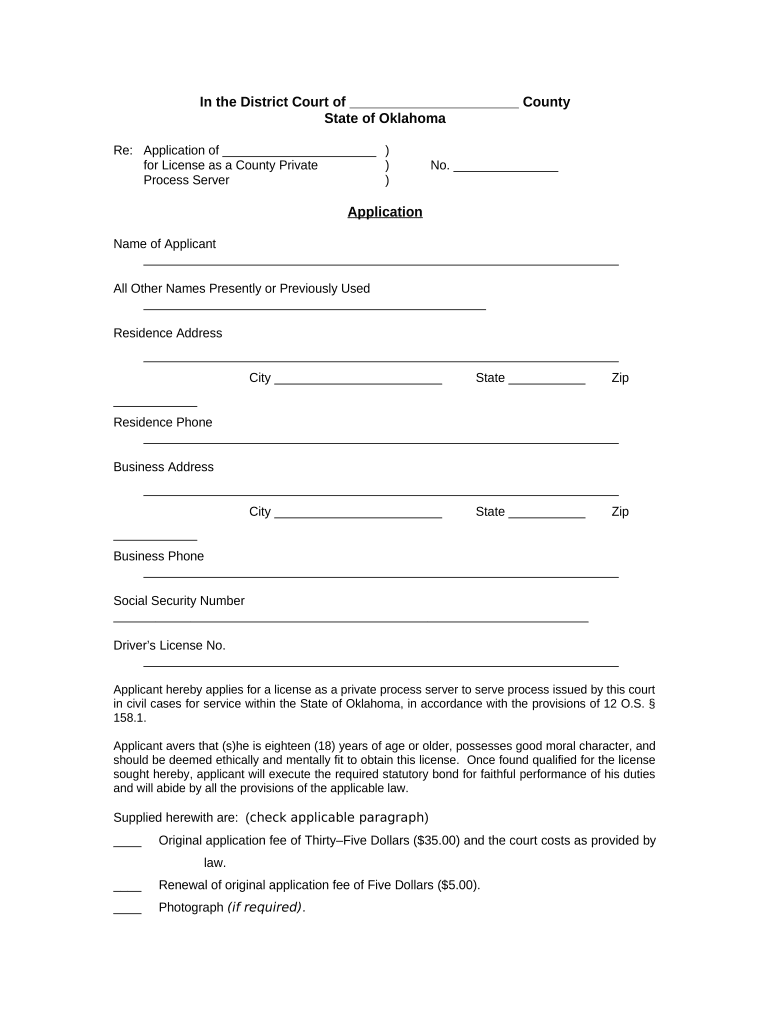
Oklahoma Application for County Private Process Server

This template is fully customizable. Edit the text, fill out the fields, and send it for signature. Give it a try!
Oklahoma Application for County Private Process Server

What the Oklahoma Application for County Private Process Server Is

The Oklahoma Application for County Private Process Server is the county-level application used to request authorization for a private individual to serve civil process within a given county. The form typically collects identifying information, consent for background checks, proof of bond or insurance if required, and a sworn statement or oath. Requirements and processing are set by each county; this guide explains common fields, filing options, timelines, and recordkeeping considerations to help applicants complete a compliant submission.

Why a Correct Application Matters

A complete, accurate application establishes legal authority to serve process and reduces the risk of rejected filings or delays. Proper documentation helps counties verify identity, criminal-history checks, and bond requirements, improving the likelihood of timely approval and minimizing later challenges to service.

Why a Correct Application Matters

Who Commonly Files or Relies on This Application

The application is used by individuals and organizations involved in civil process and court procedure.

  • Private process servers — independent contractors applying for county authorization to serve subpoenas, summonses, and other civil process within a county.
  • Law firms and litigation support teams — who register staff or contractors to ensure proper service of process for cases.
  • County clerk or sheriff offices — that receive, review, and approve applications or maintain registries of authorized servers.

Different users need different supporting documents; check the county clerk's checklist for exact submission requirements and acceptable proof.

Step-by-Step: How to Complete and Submit the Application

Follow these sequential steps to assemble a complete application package and reduce processing delays.

  • 01
    Gather Documents: Collect government ID, proof of residence, bond or insurance, and any required references.
  • 02
    Complete Form: Fill every required field, use MM/DD/YYYY for dates, and avoid abbreviating names.
  • 03
    Obtain Notarization: If the county requires notarization, sign before a licensed notary or use approved RON procedures.
  • 04
    Submit to County: File with the county clerk, sheriff, or online portal depending on county instructions and pay fees.

Customizing an Online Application Workflow

If using an online form or e-signature platform, configure fields, authentication, and attachments to match county expectations.

Field Configuration
Required Fields Mark name, DOB, address, and consent fields as mandatory to prevent incomplete submissions
Authentication Enable email or SMS verification; stronger options (KBA) where county requires identity proofing
Attachments Allow PDF uploads for ID, bond, and fingerprint receipt; restrict file types to PDF or DOCX
Notifications Set email confirmations for applicant and county clerk on successful submission

Where and How to File Your County Application

Counties offer multiple submission methods; choose the one accepted by your county clerk or sheriff's office.

  • In-Person Filing: Deliver your application to the county clerk or sheriff's office during business hours
  • Mail Submission: Mail the completed form with copies of supporting documents and a check for the filing fee
  • Online Portal: Use the county’s e-filing portal or authorized eSignature provider where accepted
  • Email Intake: Some counties accept scanned PDFs via designated administrative email addresses

Technical Considerations for Digital Filing and eSignature

Verify the county accepts electronically submitted forms and confirm required authentication and file formats before you file.

  • File Formats: PDF and DOCX accepted in most portals
  • Signer Authentication: Use email, SMS, or stronger identity checks per county rules
  • Integrations: Platforms commonly integrate with cloud storage and case management systems

If using a third-party eSignature provider, confirm it supports county requirements (notarization, audit trail, and secure storage) and can produce a verifiable audit log.

Typical Timelines and Processing Expectations

Processing times vary by county; plan ahead for background checks and administrative review to avoid service gaps.

Background Check Turnaround:

County averages range from 5 to 21 business days depending on method and backlog

Application Review:

Administrative review commonly takes 2–6 weeks in many counties

Notarization Window:

Sign immediately before notarization; some counties require a current notarization date

Renewal or Reapplication:

Check county rules — some require annual or biennial renewal

Expedited Options:

Some counties offer faster processing for an additional fee where available

Key Submission Milestones

Track these milestones from application start to final authorization to understand turnaround points.

01

Application Submitted

County receives application and fees; intake date is recorded

02

Background Check Ordered

Fingerprint or records checks are initiated by the county or vendor

03

Review and Decision

County reviews results, bond proof, and sworn statements

04

Authorization Issued

Approved applicants receive registration or certificate to serve process

Security and Compliance Considerations for Digital Submissions

Encryption in Transit: TLS 1.2/1.3
Encryption at Rest: AES-256
Audit Trail: Detailed timestamp and IP logging
HIPAA Support: BAA available when required
Regulatory Compliance: SOC 2 Type II certified
21 CFR Part 11: Supported for FDA-regulated workflows

Common Mistakes Applicants Make

  • Incomplete identification fields — omitting middle names or using nicknames causes mismatches in background checks and slows approval.
  • Failing to notarize when required — signing outside the notary presence invalidates the oath and may cause rejection.
  • Unknown county-specific requirements — assuming a single statewide form leads to missing county-only documents or bonds.
  • Uploading unreadable attachments — low-resolution ID scans or wrong file formats often trigger requests for resubmission.

Consequences of Incorrect or Fraudulent Applications

Application Denial: County may reject incomplete or inaccurate filings
Administrative Fines: Local fines or fee forfeiture where authorized
Civil Liability: Improper service can result in vacated service or legal challenges
Bond Forfeiture: Failure to comply may lead to bond claims where bond required
Perjury Risk: False statements on sworn applications can lead to criminal exposure
Operational Delay: Incomplete submissions cause service interruptions and missed deadlines

Comparing eSignature Pricing for Completing and Submitting the Application

eSignature platforms vary by price, bulk-send features, HIPAA support, and envelope or invite limits; signNow appears first for comparison as shown.

signNow DocuSign Adobe Sign PandaDoc HelloSign
Starting Price $8/user/mo $15/user/mo $14/user/mo $19/user/mo $15/user/mo
Free Trial 7-day free trial Varies by plan Varies by plan Varies by plan Varies by plan
Bulk Send Yes Yes Yes Yes No
Audit Trail Yes Yes Yes Yes Yes
HIPAA Compliant Yes Yes Yes No No
Envelope Cap No cap 100 envelopes/user/year Varies by plan Varies by plan Varies by plan

FAQs and Troubleshooting for the Application

Answers to common questions about eligibility, signing, filing, and correcting the application.


Need help? Contact support

be ready to get more
Join over 28 million airSlate SignNow users