Establishing secure connection…Loading editor…Preparing document…

Arizona Small Estate Affidavit

This template is fully customizable. Edit the text, fill out the fields, and send it for signature. Give it a try!
Arizona Small Estate Affidavit

What the Arizona Small Estate Affidavit Is

The Arizona Small Estate Affidavit is a sworn written statement used to transfer certain personal property of a decedent without full probate when statutory conditions are met. It identifies the decedent, describes the assets, states the value, and declares that no formal administration is pending or necessary. Courts and third parties (banks, title companies) accept the affidavit along with supporting documents such as a death certificate and proof of ownership to release property to heirs or beneficiaries.

Why the Affidavit Matters for Estate Administration

A properly completed small estate affidavit avoids lengthy probate for lower‑value estates, simplifies asset transfer, and reduces legal costs while preserving statutory safeguards for creditors and heirs.

Why the Affidavit Matters for Estate Administration

Who Typically Prepares and Uses This Affidavit

The affidavit is most often prepared by a surviving spouse, heir, close relative, or personal representative when estate values and circumstances fit state rules.

  • Surviving spouse or next of kin completing transfers of personal property
  • Heirs named informally who need to claim bank accounts or vehicles
  • Estate administrators and probate clerks verifying simplified transfers

Step-by-Step: How to Complete the Arizona Small Estate Affidavit

Follow these core steps in order to prepare an affidavit that third parties and probate clerks can accept.

  • 01
    Gather documents: Collect death certificate, ownership proofs, and any will or beneficiary forms
  • 02
    Fill the form: Enter decedent details, asset list, values, and claimant relationship
  • 03
    Sign and notarize: Sign under penalty of perjury; notarize per state rules
  • 04
    Submit with attachments: Deliver affidavit and supporting docs to custodian or probate clerk

How to Customize and Complete the Affidavit Online

Configure a digital workflow to reduce errors and track signatures while keeping required notarization steps intact.

Field Configuration
Required Fields Make decedent name, date of death, affiant name, and signature mandatory
Conditional Logic Show asset-detail fields only when asset type is selected
Document Attachments Require upload of death certificate and ownership proof
Authentication Use email or SMS code for signer verification

Digital Signing and eSubmission Considerations

Determine whether the receiving institution accepts electronic signatures or requires an original notarized paper affidavit.

  • PDF/Word Support: PDF and DOCX are widely accepted formats
  • Authentication: Email link, SMS code, or stronger KBA when required
  • Notary Options: In-person notary or RON where accepted

Where to File or Submit the Affidavit

Knowing the correct recipient prevents rejection: different custodians accept different document forms and authentication methods.

  • Probate Court Clerk: File if county requires recordation or to establish estate history
  • Banks and Financial Institutions: Submit affidavit plus death certificate to release account funds
  • Motor Vehicle Division: Provide affidavit and title documents to transfer vehicle title
  • Title Companies: Use affidavit for release of proceeds or personal property during closing

Timelines and Typical Processing Expectations

Processing times depend on the recipient: financial institutions and motor vehicle bureaus each follow their own review timelines.

Bank Release:

Often 5–15 business days after receipt; varies by institution

Motor Vehicle Transfer:

Usually 2–6 weeks for title processing

Probate Court Review:

If filed, court processing varies by county from days to months

Remote Notarization Window:

Retention of audio-video often 5–10 years where RON is used

Statute of Limitations Impact:

Effective date affects creditor claims timing; verify local law

Key Milestones From Preparation to Asset Release

Track these sequential milestones to monitor progress and avoid common delays.

01

Document Assembly

Collect death certificate, titles, account statements, and ID

02

Affidavit Execution

Affiant signs under penalty of perjury; notarize as required

03

Submission to Custodian

Deliver affidavit and attachments to the bank, DMV, or clerk

04

Release or Court Action

Custodian releases assets or requests additional documentation

Common Preparation Errors to Avoid

  • Using inconsistent names between affidavit and death certificate that lead to rejection
  • Failing to attach the death certificate or proof of ownership required by custodians
  • Underestimating institution-specific notarization or witness requirements
  • Listing vague asset descriptions that prevent custodians from matching accounts or titles

Risks and Legal Consequences of an Incorrect Affidavit

Rejection Delay: Missing information can delay asset release
Creditor Claims: Incorrect statements may affect creditor notice periods
Perjury Exposure: False statements may result in civil or criminal penalties
Title Defects: Poorly documented transfers can create future ownership disputes
Institution Liability: Custodian may refuse release to avoid liability
Court Sanctions: Improper filings can lead to court-ordered corrections

Core Elements to Include in a Professional Affidavit

A complete affidavit clearly identifies parties, lists assets, states values, includes a sworn declaration, and attaches supporting evidence to satisfy custodians and courts.

Title Block

Document title, county, case number if applicable, and identifying heading so recipients know the document's purpose
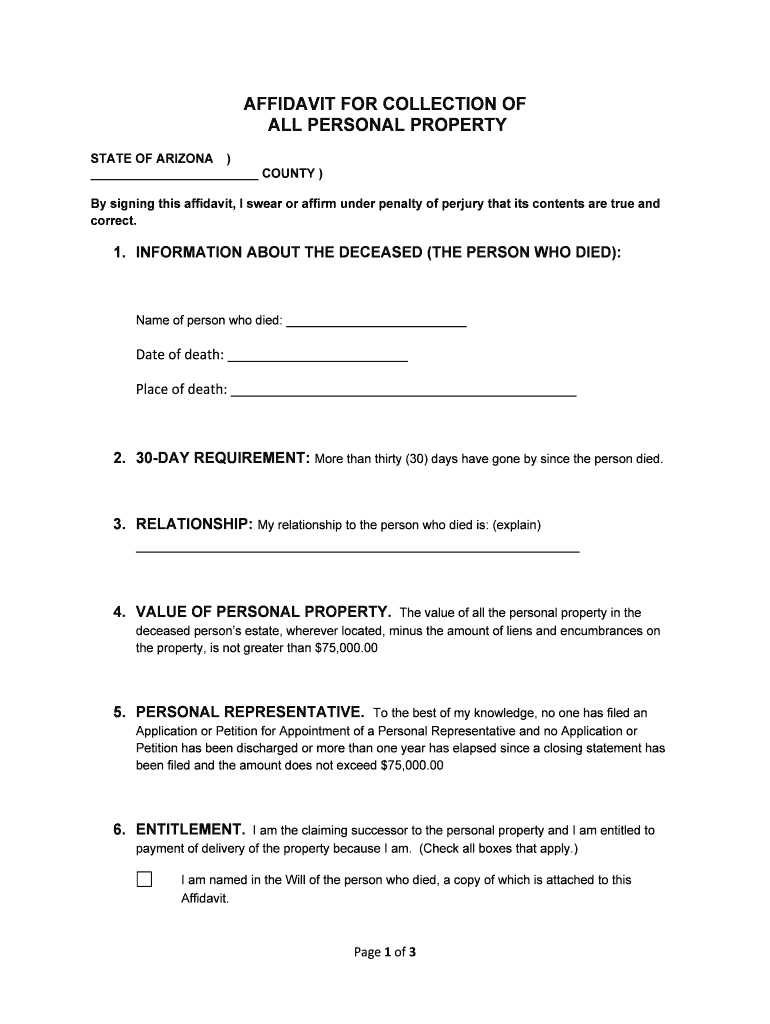
Decedent Details

Full legal name, last address, and date of death aligned with the death certificate

Affiant Statement

Name, address, relationship to decedent, and a sworn declaration under penalty of perjury

Asset Schedule

Itemized list of personal property and accounts with identifiers and estimated values

Supporting Documents

Death certificate, account statements, titles, beneficiary designations, and any relevant bills or receipts

Notary Block

Notary acknowledgment or jurat complying with in-person or RON requirements

Supporting Documents and Security Considerations

Death Certificate: Certified copy required
Proof of Ownership: Account statements, titles, or registration
Affiant ID: Government-issued photo ID
Will or Beneficiary Forms: If available, include for clarity
Notary Record: Jurat or acknowledgement retained
Audit Trail: If eSigned, include timestamp and signer authentication

Real-World Examples of Affidavit Use

Two concise examples show typical scenarios where a small estate affidavit resolves estate matters without full probate.

Bank Account Release

A surviving spouse needs access to a single checking account to pay final bills.

  • The bank accepts an affidavit plus death certificate.
  • The affidavit plus account statement enabled the bank to release funds within 10 business days without probate, preventing late fees and service interruptions.

Vehicle Title Transfer

An heir needs to transfer a vehicle title into their name after a parent’s death.

  • The motor vehicle office requires an affidavit and the original title.
  • After submitting the affidavit, certified death certificate, and title, the DMV issued a new title in the heir’s name in approximately three weeks.

Authorized Signers: Who Can Execute the Affidavit

Affiant — Heir

A named heir or person with a legal interest may sign as the affiant, declaring relationship and intent to collect specified property. They must sign under penalty of perjury and provide identification.

Personal Representative / Agent

A court-appointed personal representative or properly authorized agent may sign when authorized by statute or instrument; include proof of authority such as letters testamentary or power of attorney if required.

Tips for Accurate and Efficient Completion

Small procedural improvements reduce the risk of rejection and speed asset release.

Match Official Records
Use names and dates exactly as they appear on the death certificate and titles to avoid mismatches during custodian review.
Attach Clear Evidence
Include certified death certificate, current account statements, and vehicle titles as scanned or certified copies to satisfy custodians.
Confirm Custodian Policy
Call the bank, DMV, or title company ahead of submission to confirm accepted affidavit formats and notarization requirements.
Consider Legal Review
Obtain an attorney review when estate facts are complex, when competing claims exist, or when institutional requirements are unclear.

How the Small Estate Affidavit Differs From Similar Documents

Compare the affidavit with probate administration and a small claims petition to determine the correct path for asset transfer.

Document Type Affidavit Full Probate
Purpose transfer limited assets administer entire estate
Court Involvement minimal required
Typical Cost low higher
Processing Time days–weeks months

Comparing eSignature Options for Completing the Affidavit

Choose an eSignature solution that supports notarization workflows, secure recordkeeping, and HIPAA or other compliance needs where relevant.

signNow DocuSign Adobe Sign PandaDoc HelloSign
Starting Price $8/user/mo $15/user/mo $14/user/mo $19/user/mo $15/user/mo
Free Trial 7-day free trial Varies by plan Varies by plan Varies by plan Varies by plan
Bulk Send Yes (Premium) Yes Yes Yes Limited
Audit Trail Yes Yes Yes Yes Yes
HIPAA Compliant Yes Yes Yes No No

Frequently Asked Questions About the Arizona Small Estate Affidavit

Answers to common questions about acceptance, notarization, supporting documents, and alternatives to the affidavit.


Need help? Contact support

be ready to get more
Join over 28 million airSlate SignNow users