Establishing secure connection…Loading editor…Preparing document…

Assignment Account

This template is fully customizable. Edit the text, fill out the fields, and send it for signature. Give it a try!
Assignment Account

What an Assignment Account Is and when it’s used

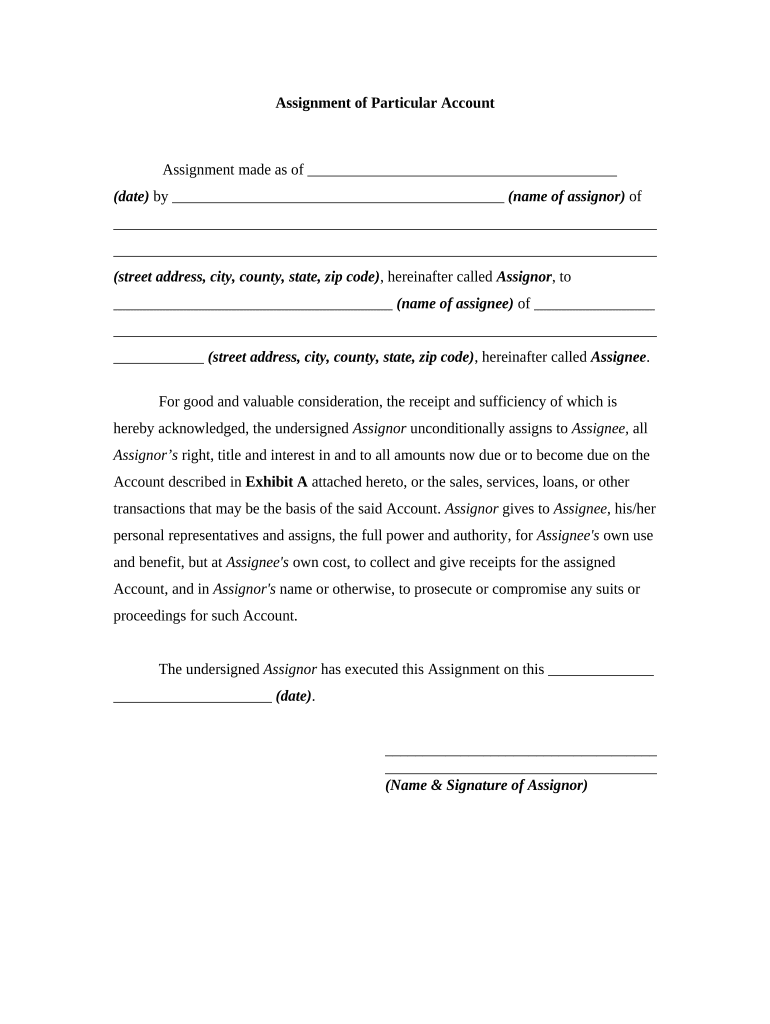
An Assignment Account documents the transfer of rights in an account receivable, contract right, or similar monetary entitlement from one party (the assignor) to another (the assignee). It records the identity of the parties, description of the account or obligation being assigned, the effective date, any consideration paid, and any conditions or limitations on collection or enforcement. Assignment Accounts are used in finance, sales, and business-to-business contracts to formalize transfers that affect payment routing, collection rights, and priority among creditors, and they may trigger filing or notice obligations under the UCC or industry-specific rules.

Why formalizing an Assignment Account matters

A written Assignment Account clarifies transfer timing, preserves priority against later claimants, and documents payment routing and notice to debtors.

Why formalizing an Assignment Account matters

Who typically prepares and signs an Assignment Account

Organizations and individuals preparing Assignment Accounts vary by role and purpose; the parties below are the most common.

  • Assignors (sellers of receivables) — finance teams, treasury, or contract managers who want to transfer collection rights.
  • Assignees (buyers) — lenders, factoring companies, or acquirers who will collect payments or hold the receivable.
  • Legal and compliance teams — in-house counsel or outside counsel that review assignment scope and notice provisions.

Core elements to include in a professional Assignment Account

A complete Assignment Account should define the parties, identify the accounts or contracts assigned, state consideration and effective date, record any conditions or exceptions, and include clear signature blocks and notice instructions.

Parties

Full legal names and entity types of assignor and assignee.
Assigned Assets

Clear description of account numbers, contract identifiers, or invoice ranges.

Consideration

Amount or description of value exchanged, if any.

Effective Date

Date when rights transfer and collection may begin.

Notice Instructions

How and when debtors or third parties will be notified.

Signatures

Authorized signatories, dates, and any witness or notarization blocks.

Step-by-step: completing an Assignment Account

Follow these steps to prepare, execute, and distribute a legally robust Assignment Account.

  • 01
    Draft: Describe parties, assets, consideration, and effective date clearly.
  • 02
    Review: Have legal and credit teams confirm scope and exceptions.
  • 03
    Sign: Collect authorized signatures and any required notarization or witness attestations.
  • 04
    Notify: Send notice to debtors and file UCC-1 if seeking public priority.

How to set up the online workflow for digital execution

Configure fields and routing to ensure each signer sees the correct sections and receives an audit trail upon completion.

Field Configuration
Authentication Method Email link or SMS code for signer verification
Required Fields Signature, date, typed name, and account ID fields
Routing Order Sequential or parallel signer order settings
Notifications Automated reminders and delivery of final PDF

Where to send and how notices should be delivered

Proper notification preserves collection rights and informs third parties of the transfer; select delivery channels carefully.

  • Debtor Notice: Send written notice to debtor physical or electronic address
  • Bank/Lockbox: Update deposit instructions with banking contacts promptly
  • UCC Filing: File a UCC-1 financing statement for public priority
  • Counterparty: Provide assignee with executed copy and payment routing details

Digital signing and technical requirements

Choose a signing platform that supports secure signatures, an audit trail, and the integrations your workflow needs.

  • File formats: PDF and DOCX accepted
  • Integrations: Salesforce, NetSuite, Microsoft 365 supported
  • Security: TLS in transit and AES-256 at rest

Key timing and filing expectations

Timelines depend on your business process, notice requirements, and any related filings such as UCC-1 notifications or tax reporting.

Effective Date:

Use MM/DD/YYYY; determines transfer start

Debtor Notice:

Send promptly after execution to avoid collection disputes

UCC-1 Filing:

File as soon as possible to preserve priority

Tax Forms:

Provide records to tax teams for reporting obligations

Record Retention:

Keep executed copy per retention schedule

Essential data fields required in the Assignment Account

Assignor: Legal name
Assignee: Legal name
Asset ID: Invoice or contract number
Effective Date: MM/DD/YYYY
Consideration: Dollar amount or 'none'
Signature: Name, title, date

Common preparation mistakes to avoid

  • Using informal names or abbreviations for parties that differ from formation documents, which can complicate bank acceptance and legal filings.
  • Failing to list specific invoice or contract identifiers, leaving the assignment ambiguous and open to dispute over scope.
  • Delaying debtor notice or UCC filings, which can allow subsequent creditors to obtain priority over the assignee.
  • Omitting signature capacity (title) or notarization when required by state law, risking challenge to enforceability.

Risks and legal consequences of an incorrect Assignment Account

Loss of Priority: Later creditors may gain priority
Collection Delays: Debtor disputes can stall payments
Tax Exposure: Incorrect reporting may trigger audits
Contract Breach: Violating anti-assignment clauses
Notarization Failure: Document may be rejected
Legal Fees: Costs for cure or litigation

Real-world examples of Assignment Accounts in use

Below are concise examples showing how organizations document account assignments in practice.

Martin Properties — Real Estate

Tim Martin, Founder, used an Assignment Account to transfer rent receivables after a portfolio sale.

  • The document named unit numbers and lease IDs.
  • The executed assignment plus prompt tenant notice allowed the buyer to receive payments without eviction or accounting disputes, and the record served as proof for lender underwriting.

Fertility Centers — Healthcare

John Butler, Founder, assigned patient billing rights to a billing vendor for collections.

  • The assignment included HIPAA-related notice language.
  • Executing a clear assignment and attaching a signed BAA protected patient data and enabled the vendor to bill and collect while maintaining compliance.

eSignature vendor comparison for executing Assignment Accounts

Cost and feature differences matter for high-volume assignment workflows; signNow is listed first for comparison purposes only.

signNow DocuSign Adobe Sign PandaDoc HelloSign
Starting Price $8/user/mo $15/user/mo $14/user/mo $19/user/mo $15/user/mo
Free Trial 7-day free trial No No Yes, limited Yes, limited
Bulk Send Yes Yes Yes Yes No
Audit Trail Yes Yes Yes Yes Yes
HIPAA Compliant Yes Yes Yes No No

Frequently asked questions about Assignment Accounts and eSigning

Answers address common legal and technical questions encountered when preparing and executing Assignment Accounts.


Need help? Contact support

be ready to get more
Join over 28 million airSlate SignNow users