Establishing secure connection…Loading editor…Preparing document…

Assumption Agreement

This template is fully customizable. Edit the text, fill out the fields, and send it for signature. Give it a try!
Assumption Agreement

What an Assumption Agreement Is and when it applies

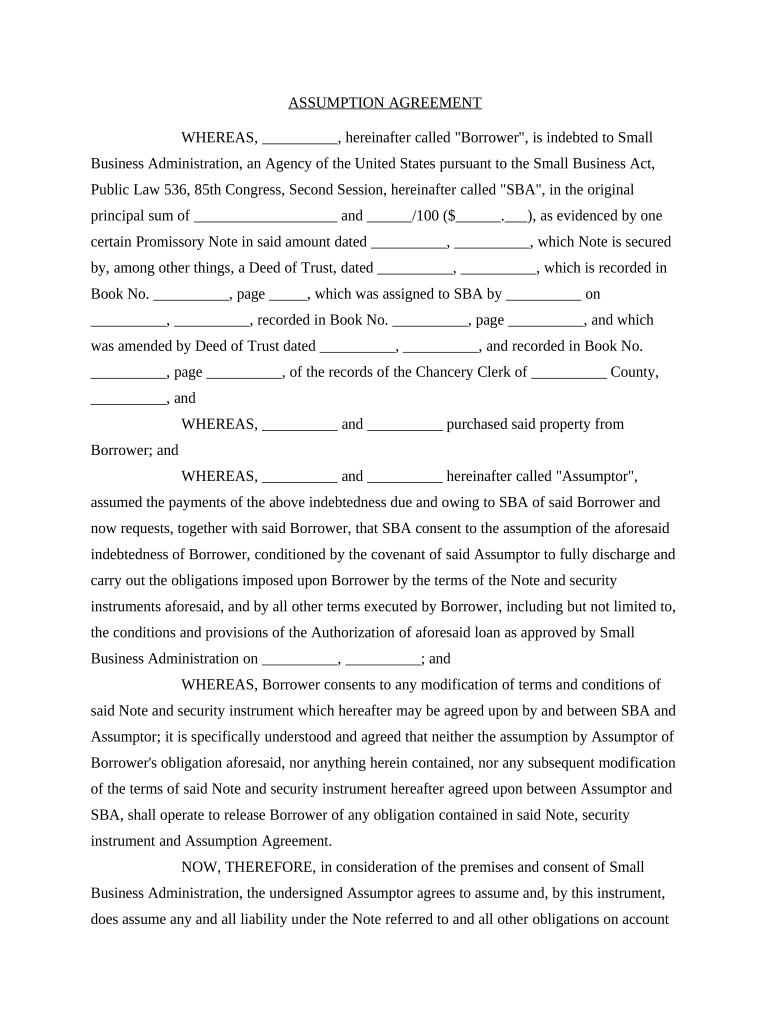
An Assumption Agreement is a legal contract by which an incoming party agrees to assume responsibility for specified obligations under an existing contract, loan, lease, or service relationship. The document identifies the original parties, the obligations being assumed, the effective date, and any conditions or approvals required by lenders or counterparties. It commonly addresses allocation of payments, indemnities, security interests, and procedures for resolving disputes. A clear Assumption Agreement reduces ambiguity about who holds continuing liabilities after a transfer of rights or responsibilities.

Why use an Assumption Agreement

An Assumption Agreement clarifies which party is responsible for future obligations, documents lender or counterparty consent, and allocates financial responsibility and risk. It reduces dispute risk and supports enforceability if obligations are breached.

Why use an Assumption Agreement

Typical parties and situations for using an Assumption Agreement

Organizations and individuals use Assumption Agreements when transferring ongoing obligations or rights under loans, leases, or service contracts.

  • Buyers of real property taking over existing mortgage or lease obligations.
  • Tenants assigning a commercial lease to a new tenant with landlord consent.
  • Companies transferring vendor contracts or assuming supplier payment obligations during acquisition.

Step-by-step: filling and finalizing the Assumption Agreement

Follow these steps to complete an Assumption Agreement accurately and reduce approval delays in commercial or consumer contexts.

  • 01
    Prepare Document: Identify original contract, obligations, and effective date.
  • 02
    Obtain Consent: Get written approval from lender or original contracting party.
  • 03
    Allocate Liabilities: Document which party pays ongoing costs, taxes, and indemnities.
  • 04
    Sign & Notarize: All parties sign; notarize if required by law or counterparty.

Key clauses to include in a professional Assumption Agreement

Well-drafted Assumption Agreements include precise clauses that define assumed obligations, consent procedures, indemnities, and remedies to ensure clarity and enforceability.

Assumed Obligations

List each obligation being assumed with sufficient detail — loan balance, payment schedule, lease term, or service responsibilities — so third parties can identify the exact liability transferred.
Consent Clause

Document required approvals from lenders or counterparties, including any conditions precedent, the form of consent, and timelines for acceptance to avoid contested transfers.

Indemnity

Allocate responsibility for pre- and post-assumption claims, specify caps and survival periods, and identify indemnification procedures to limit future exposure.

Security Interests

Address whether collateral, liens, or guarantees transfer with the obligations and require releases or subordination agreements where necessary to clear title.

Representations

Include warranties about defaults, payment history, and lien status. Use disclosure schedules to list known exceptions and material adverse facts.

Remedies

Specify remedies for breach including cure periods, acceleration, deficiency rights, and dispute resolution procedures to reduce litigation uncertainty.

Configure an online signing workflow for the Assumption Agreement

Configure a signing workflow to match approval order, authentication level, and document retention policies for corporate and consumer transactions.

Field Configuration
Signing Order Sequential or parallel routing
Authentication Email, SMS, or knowledge-based options
Notifications Automatic reminders and status alerts
Retention Export PDFs; retain audit trail

Typical eSignature flow for an Assumption Agreement

Typical routing for an Assumption Agreement when using eSignature includes upload, field placement, signer authentication, and completion with audit logs.

  • Upload Document: Add the agreement and any exhibits.
  • Place Fields: Insert signature, date, and initial fields.
  • Authenticate Signers: Choose email, SMS, or advanced ID verification.
  • Complete & Store: Finalize signatures; retain executed copy and audit trail.

Platform features to support digital completion and eSubmission

Use an eSignature platform that supports templates, conditional fields, and signer authentication to complete an Assumption Agreement online.

  • Integrations: Integrates with Salesforce, NetSuite, Google Workspace
  • Formats: PDF, DOCX, and HTML supported
  • Authentication: Email, SMS, KBA, or SSO

Security and compliance controls to consider

Encryption Transit: TLS 1.2 and TLS 1.3 in transit
Encryption Rest: AES-256 encryption for stored documents
Certifications: SOC 2 Type II and ISO 27001
HIPAA: BAA available for covered entities
21 CFR Compliance: Supports 21 CFR Part 11 controls
Audit Trail: Detailed timestamps, IP, and history

Common preparation mistakes to avoid

  • Failing to obtain written lender or contracting party consent is the most common issue and can lead to loan acceleration, defaults, or invalidation of the assumption.
  • Vague descriptions of obligations or incomplete schedules make it difficult to identify assumed liabilities and often result in disputes over payment responsibility.
  • Omitting indemnity clauses or survival periods leaves parties exposed to legacy claims; specify duration and monetary caps clearly to limit long-term risk.
  • Incorrectly formatted signatures, failure to notarize when required, or using informal acceptance methods can all undermine enforceability in courts or title records.

Consequences of an incorrect or incomplete Assumption Agreement

Loss of Rights: Assuming wrong obligations may forfeit protections.
Acceleration Risk: Lender may call loan due upon unauthorized assignment.
Tax Liability: Transfer may trigger reporting or taxable events.
Title Defects: Security interests may not transfer automatically.
Consent Failure: Missing counterparty consent can void assumption.
Signature Defects: Improper signing or missing notarization reduces enforceability.

Time-sensitive dates to track for the Assumption Agreement

Key dates affect enforceability and recording obligations; track consent deadlines, effective date, recording, and filing obligations to stay compliant.

Effective Date:

Date obligations are assumed and performance begins.

Lender Consent Deadline:

Date by which lender must approve the assumption.

Recording Deadline:

Timeframe to record assignment or amendment if required by title.

Tax Reporting Window:

File any required transfer or tax forms within applicable deadlines.

Retention Start:

Start retention from effective date or closing date.

Key milestones from negotiation to recording

Milestones show the sequence from negotiation through execution and recordation when assuming obligations in commercial transactions.

01

Draft Agreement

Prepare draft and schedules for review.

02

Secure Consents

Obtain lender and counterparty written approvals.

03

Execute Documents

Parties sign; notarize and obtain corporate approvals.

04

Record and Archive

Record assignment if required; store executed originals.

Comparing eSignature vendor pricing and features for Assumption Agreements

Review pricing and feature differences among major eSignature vendors when selecting a solution for executing Assumption Agreements and related documents.

signNow DocuSign Adobe Sign PandaDoc HelloSign
Starting Price $8/user/mo $15/user/mo $14/user/mo $19/user/mo $15/user/mo
Free Plan 7-day free trial Varies by vendor Varies by vendor Varies by vendor Varies by vendor
Bulk Send Yes (Business Premium) Varies by vendor Varies by vendor Varies by vendor Varies by vendor
Audit Trail Yes Yes Yes Yes Yes
HIPAA Compliant Yes (BAA required) Yes Yes Varies Varies

Example scenarios showing Assumption Agreement use

Real-world examples show how Assumption Agreements resolve liability transfers in property, corporate acquisitions, and service contract transitions.

Commercial Lease Transfer

A retail buyer assumed an existing commercial lease to reopen a storefront quickly and maintain business continuity.

  • Landlord written consent required within 30 days.
  • The Assumption Agreement listed the rent schedule, security deposit allocation, and responsibility for repairs. It included an indemnity from the incoming tenant for pre-closing claims and required landlord acknowledgement to avoid acceleration. Both parties retained executed copies for records.

Loan Assumption in Acquisition

A company acquiring a subsidiary agreed to assume loan obligations to preserve vendor relationships and avoid refinancing costs.

  • Lender approval and amendment required.
  • The Assumption Agreement detailed outstanding principal, security interests, and guarantor status. Lender consent included conditions for collateral continuation and new guaranty instruments; the acquiring company obtained a recorded amendment to protect title and credit standing.

Practical best practices for accurate and efficient completion

Use these best practices to reduce risk and speed approval when preparing Assumption Agreements for corporate or property transactions.

Confirm Authority and Corporate Approvals
Verify signatory authority by obtaining board resolutions or officer certificates. For corporate parties, attach meeting minutes or resolutions confirming power to assume obligations to prevent later challenges to enforceability.
Obtain Written Lender and Counterparty Consents
Secure explicit written consents that specify any conditions or fees. Record the consent language in the agreement, including deadlines and form of acceptance, to prevent disputes and support recording or filing.
Use Clear Schedules and Exhibits
Attach detailed schedules listing each assumed obligation, account numbers, payment histories, and exceptions. Well-organized exhibits reduce ambiguity and simplify title or credit underwriting during post-closing review.
Preserve Execution Evidence and Audit Trail
Retain signed originals, notarizations, and electronic audit logs. Ensure electronic platforms produce tamper-evident PDFs, certificates of completion, and metadata to support admissibility and defend against later challenges.

Frequently asked questions about Assumption Agreements

Answers to common questions about Assumption Agreements, eSignature validity, consent, notarization, and record retention for U.S. transactions.


Need help? Contact support

be ready to get more
Join over 28 million airSlate SignNow users