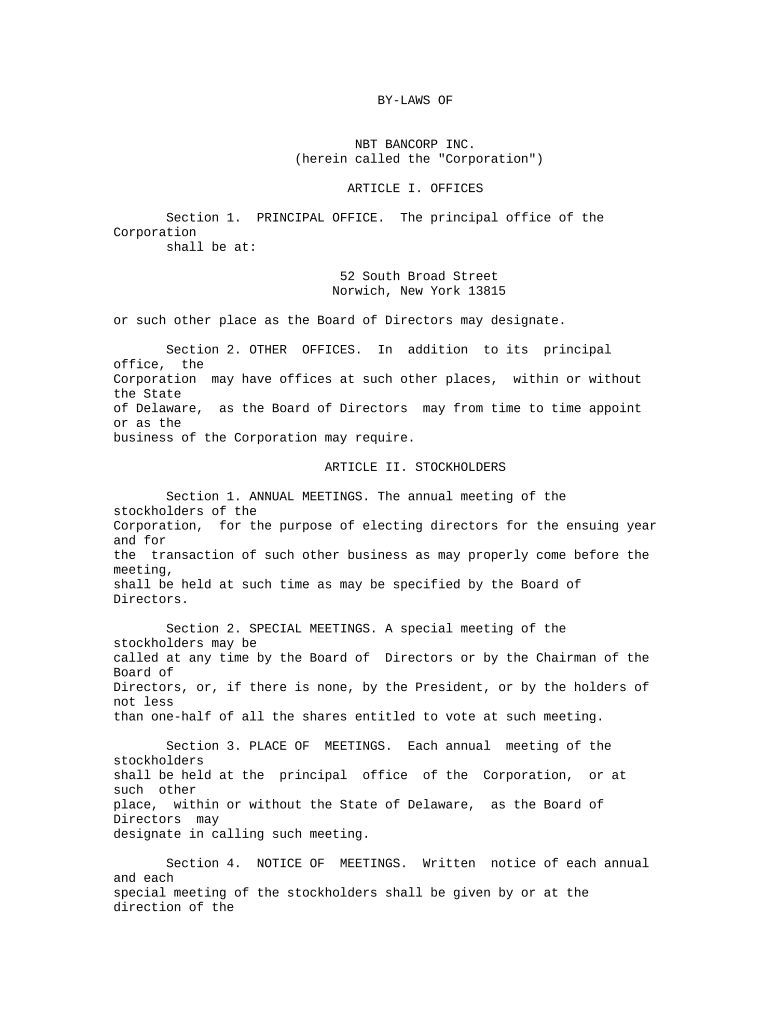
BY-LAWS OF
NBT BANCORP INC.
(herein called the "Corporation")
ARTICLE I. OFFICES
Section 1. PRINCIPAL OFFICE. The principal office of the
Corporation
shall be at:
52 South Broad Street
Norwich, New York 13815
or such other place as the Board of Directors may designate.
Section 2. OTHER OFFICES. In addition to its principal
office, the
Corporation may have offices at such other places, within or without
the State
of Delaware, as the Board of Directors may from time to time appoint
or as the
business of the Corporation may require.
ARTICLE II. STOCKHOLDERS
Section 1. ANNUAL MEETINGS. The annual meeting of the
stockholders of the
Corporation, for the purpose of electing directors for the ensuing year
and for
the transaction of such other business as may properly come before the
meeting,
shall be held at such time as may be specified by the Board of
Directors.
Section 2. SPECIAL MEETINGS. A special meeting of the
stockholders may be
called at any time by the Board of Directors or by the Chairman of the
Board of
Directors, or, if there is none, by the President, or by the holders of
not less
than one-half of all the shares entitled to vote at such meeting.
Section 3. PLACE OF MEETINGS. Each annual meeting of the
stockholders
shall be held at the principal office of the Corporation, or at
such other
place, within or without the State of Delaware, as the Board of
Directors may
designate in calling such meeting.
Section 4. NOTICE OF MEETINGS. Written notice of each annual
and each
special meeting of the stockholders shall be given by or at the
direction of the
officer or other person calling the meeting. Such notice shall state the
purpose
or purposes for which the meeting is called, the time when and the
place where
it is to be held, and such other information as may be required by law.
Except
as otherwise required by law, a copy thereof shall be delivered
personally,
mailed in a postage prepaid envelope or transmitted
electronically or by
telegraph, cable or wireless, not less than ten (10) days nor more
than sixty
(60) days before such meeting to each stockholder of record entitled to
vote at
such meeting; and if mailed, it shall be directed to such stockholder
at his
address as it appears on the stock transfer books of the Corporation,
unless he
shall have filed with the Secretary of the Corporation a written
request that
notices intended for him be mailed to the address designated in such
request.
Notwithstanding the foregoing, a waiver of any notice herein or by law
required,
if in writing and signed by the person entitled to such notice,
whether before
or after the time of the event for which notice was required to be
given, shall
be the equivalent of the giving of such notice. A stockholder who
attends shall
be deemed to have had timely and proper notice of the meeting, unless he
attends
for the express purpose of objecting to the transaction of any business
because
the meeting is not lawfully called or convened. Notice of any
adjourned or
recessed meeting need not be given if the time and place thereof are
announced
at the meeting at which the adjournment or recess is taken,
unless the
adjournment or recess is for more than 30 days, or if after the
adjournment or
recess a new record date is fixed for the adjourned or recessed meeting.
Section 5. QUORUM. Except as otherwise provided by law, at any
meeting of
the stockholders of the Corporation, the presence in person or by
proxy of the
holders of a majority of the total number of issued and outstanding
shares of
Common Stock of the Corporation shall constitute a quorum for the
transaction of
business. In the absence of a quorum, a majority in voting
power of the
stockholders present in person or represented by proxy and entitled to
vote may
adjourn the meeting from time to time and from place to place until a
quorum is
obtained. At any such adjourned meeting at which a quorum is
present any
business may be transacted which might have been transacted at the
meeting as
originally called.
Section 6. ORGANIZATION. At every meeting of the
stockholders, the
Chairman of the Board, or failing him the President, or, in the
absence of the
Chairman of the Board and the President, a person chosen by a majority
vote of
the stockholders present in person or by proxy and entitled to vote,
shall act
as Chairman of the meeting. The Secretary, or an Assistant Secretary,
or, in the
discretion of the Chairman, any person designated by him, shall
act as a
secretary of the meeting.
Section 7. INSPECTIONS. The directors, in advance of any
meeting, shall
appoint one or more inspectors of election to act at the meeting
or any
adjournment thereof. In case any person who may be appointed as an
inspector
fails to appear or act, the vacancy may be filled by appointment
made by the
directors in advance of the meeting or at the meeting by the person
presiding
thereat. Each inspector, before entering upon discharge of his
duties, shall
take and sign an oath to execute faithfully the duties of inspector
at such
meeting with strict impartiality and according to the best of his
ability. The
inspector or inspectors shall determine the number of shares
of stock
outstanding and the voting power of each, the shares of stock
represented at the
meeting, the existence of a quorum, the validity and effect of
proxies, and
shall receive and count votes, ballots or consents and hear and
determine all
challenges and questions arising in connection with the right to
vote. The
inspectors shall certify their determination of the number of shares
represented
at the meeting, and their count of all votes and ballots, and shall
make a
report in writing of any challenge, question or matter determined by him
or them
and execute a certificate of any fact found by him or them.
Section 8. BUSINESS AND ORDER OF BUSINESS. At each meeting
of the
stockholders such business may be transacted as may properly be brought
before
such meeting, whether or not such business is stated in the notice of
meeting or
in a waiver of notice thereof, except as expressly provided otherwise
by law or
by these By-Laws. The order of business at all meetings of stockholders
shall be
as follows:
1.Call to order.
2.Selection of secretary of the meeting.
2
3.Determination of quorum.
4.Appointment of voting inspectors.
5.Nomination and election of directors.
6.Other business.
Section 9. VOTING. Except as otherwise provided by law
or by the
Certificate of Incorporation, holders of Common Stock of the
Corporation shall
be entitled to vote upon matters to be voted upon by the stockholders.
At each
meeting of stockholders held for any purpose, each stockholder of
record of
stock entitled to vote thereat shall be entitled to vote the shares
of such
stock standing in his name on the books of the Corporation on
the date
determined in accordance with Section 11 of this Article II, each
such share
entitling him to one vote.
If a quorum is present, the affirmative vote of a majority of
the shares
present or represented at the meeting and entitled to vote on the
subject matter
shall be the act of the stockholders, unless the vote of a greater
number is
required by law or the Certificate of Incorporation.
The voting shall be by voice or by ballot as the Chairman may
decide,
except that upon demand for a vote by ballot on any question or
election, made
by any stockholder or his proxy present and entitled to vote on such
question or
election, such vote by ballot shall immediately be taken.
Section 10. VOTING LIST. The Secretary of the Corporation shall
make, at
least ten (10) days before each meeting of stockholders, a complete
list of the
stockholders entitled to vote at any such meeting or any adjournment
thereof,
with the address of and the number of shares held by each stockholder.
Such list
shall be opened to the examination of any stockholder, for any purpose
germane
to the meeting, during ordinary business hours, for a period of at
least ten
(10) days prior to the meeting, either at a place within the city
where the
meeting is to be held, which place shall be specified in the
notice of the
meeting, or, if not so specified, at the place where the meeting is to
be held.
Such list shall also be produced and kept open at the time and
place of the
meeting and shall be subject to inspection by any stockholder during
the whole
time of the meeting. The original stock transfer books shall be
prima facie
evidence as to who are the stockholders entitled to examine such
list or
transfer books or to vote at any meeting of stockholders.
If the requirements of this Section 10 have not been
substantially
complied with, the meeting shall, on the demand of any stockholder in
person or
by proxy, be adjourned until the requirements are complied with.
Section 11. RECORD DATES. (a) In order that the Corporation may
determine
the stockholders entitled to notice of or to vote at any meeting of
stockholders
or any adjournment thereof, or entitled to receive payment of any
dividend or
other distribution or allotment of any rights, or entitled to
exercise any
rights in respect of any change, conversion or exchange of stock or
for the
purpose of any other lawful action other than stockholder action by
written
consent, the Board of Directors may fix a record date, which shall not
precede
the date such record date is fixed and shall not be more than sixty
nor less
than ten days before the date of such meeting, nor more than sixty days
prior to
any such other action. If no record date is fixed, the record
date for
determining stockholders entitled to notice of or to vote at a
meeting of
stockholders shall be at the close of business on the day next preceding
the day
on which notice is given and the record date for any other purpose
other than
stockholder action by written consent shall be at the close of
business on the
day on which the Board of Directors adopts the resolution relating
thereto. A
3
determination of stockholders of record entitled to notice of or to
vote at a
meeting of stockholders shall apply to any adjournment of meeting;
provided,
however, that the Board of Directors may fix a new record date for the
adjourned
meeting.
(b) In order that the Corporation may determine the stockholders
entitled
to consent to corporate action in writing without a meeting, the
Board of
Directors may fix a record date, which record date shall not precede
the date
upon which the resolution fixing the record date is adopted by the
Board of
Directors, and which date shall not be more than 10 days after the
date upon
which the resolution fixing the record date is adopted by the
Board of
Directors. Any stockholder of record seeking to have the stockholders
authorize
or take corporate action by written consent shall, by written
notice to the
Secretary, request the Board of Directors to fix a record date. The
Board of
Directors shall promptly, but in all events within 10 days after the
date on
which such a request is received, adopt a resolution fixing the record
date. If
no record date has been fixed by the board of Directors within 10
days of the
date on which such a request is received, the record date for
determining
stockholders entitled to consent to corporate action in writing
without a
meeting, when no prior action by the Board of Directors is
required by
applicable law, shall be the first date on which a signed written
consent
setting forth the action taken or proposed to be taken is delivered
to the
Corporation by delivery to its registered office in the State of
Delaware, its
principal place of business, or any officer or agent of the Corporation
having
custody of the book in which proceedings of meetings of
stockholders are
recorded. Delivery made to the Corporation's registered office shall be
by hand
or by certified or registered mail, return receipt requested. If no
record date
has been fixed by the Board of Directors and prior action by the
Board of
Directors is required by applicable law, the record date for
determining
stockholders entitled to consent to corporate action in writing
without a
meeting shall be at the close of business on the date on which the
Board of
Directors adopts the resolution taking such prior action.
Section 12. ADJOURNMENT. Any meeting of stockholders, annual or
special,
may adjourn from time to time to reconvene at the same or some other
place, and
notice need not be given of any such adjourned meeting if the time
and place
thereof are announced at the meeting at which the adjournment is taken.
At the
adjourned meeting, the Corporation may transact any business which
might have
been transacted at the original meeting. If the adjournment is for
more than
thirty days, or if after the adjournment a new record date is fixed
for the
adjourned meeting, a notice of the adjourned meeting shall be given
to each
stockholder of record entitled to vote at the meeting.
Section 13. ACTION BY STOCKHOLDERS WITHOUT A MEETING. Any action
required
or permitted to be taken at any annual or special meeting of
stockholders of the
Corporation may be taken without a meeting, without prior notice and
without a
vote, if a consent or consents in writing, setting forth the action
so taken,
shall be signed by the holders of outstanding stock having not less
than the
minimum number of votes that would be necessary to authorize or take
such action
at a meeting at which all shares entitled to vote thereon were present
and voted
and shall be delivered to the Corporation by delivery to its registered
office
in the State of Delaware, its principal place of business or to an
officer or
agent of the Corporation having custody of the book in which
proceedings of
meetings of stockholders are recorded. Delivery made to the
Corporation's
registered office shall be by hand or by certified or registered mail,
return
receipt requested. Prompt notice of the taking of any action by written
consent
shall be given to stockholders who have not consented in writing and
who, if the
action had been taken at a meeting, would have been entitled to
notice of the
meeting if the record date for such meeting had been the date that
written
consents signed by a sufficient number of stockholders to take the
action were
delivered to the Corporation as provided herein.
Section 14. PROXIES. At any meeting of the stockholders, each
stockholder
entitled to vote thereat may vote either in person or by proxy. Such
proxy shall
be in writing, subscribed by the stockholder or his duly authorized
attorney,
but need not be sealed, witnessed or acknowledged, and shall be filed
with the
Secretary at or before the meeting; provided, however, that no proxy
shall be
voted or acted upon after eleven months from its date, unless
said proxy
provides for a longer period.
4
ARTICLE III. DIRECTORS
Section 1. GENERAL POWERS. The business and affairs of the
Corporation
shall be managed by or under the direction of the Board of Directors,
and all
corporate powers shall be exercised by or under the direction of the
Board of
Directors, except as otherwise expressly required by these By-Laws,
by the
Certificate of Incorporation or by law.
Section 2. QUALIFICATION, NUMBER, CLASSIFICATION AND TERM OF
OFFICE.
Every director must be a citizen of the United States and have
resided in the
State of New York, or within two hundred miles of the location of the
principal
office of the Corporation, for at least one year immediately
preceding his
election, and must own $1,000.00 aggregate book value of Corporate
Stock. The
number of directors shall be not less than five nor more than twenty-
five. A
Board of Directors shall be elected in the manner provided in these
By-Laws.
Each director shall have one vote at any directors' meeting.
The Board of Directors shall be divided into three classes:
Class 1,
Class 2 and Class 3, which shall be as nearly equal in number as
possible. Each
director shall serve for a term ending on the date of the third Annual
Meeting
of Shareowners following the Annual Meeting at which such director was
elected;
provided, however, that each initial director in Class 1 shall hold
office until
the Annual Meeting of Shareowners in 1987; each initial director in
Class 2
shall hold office until the Annual Meeting of Shareowners in 1988;
and each
initial director in Class 3 shall hold office until the Annual
Meeting of
Shareowners in 1989.
In the event of any increase or decrease in the authorized
number of
directors, (1) each director then serving as such shall nevertheless
continue as
a director of the class of which he is a member until the expiration
of his
current term, or his earlier resignation, removal from office or death,
and (2)
the newly created or eliminated directorships resulting from such
increase or
decrease shall be apportioned by the Board of Directors among the three
classes
of directors so as to maintain such classes as nearly equal as possible.
Notwithstanding any of the foregoing provisions of this Section
2, each
director shall serve until his successor is elected and qualified or
until his
earlier resignation, removal from office or death.
This Article III, Section 2, shall not be altered, amended or
repealed
except by an affirmative vote of at least sixty-six and two-thirds
percent
(66-2/3%) of the total number of shareowners.
Section 3. ELECTION OF DIRECTORS. At each meeting of the
stockholders for
the election of directors, a quorum being present, as defined in
Section 5 of
Article II, the election shall proceed as provided in these By-Laws
and under
applicable Delaware law. No election need be by written ballot.
If the election of directors shall not be held on the day
designated for
any annual meeting or at any adjournment of such meeting, the Board of
Directors
shall cause the election to be held at a special meeting of the
stockholders as
soon thereafter as may be convenient.
Nominations of candidates for election as directors of the
Corporation
must be made in writing and delivered to or received by the President
of the
Corporation within ten days following the day on which public
disclosure of the
date of any shareholders' meeting called for the election of directors
is first
given. Such notification shall contain the name and address of the
proposed
nominee, the principal occupation of the proposed nominee, the number
of shares
of Common Stock that will be voted for the proposed nominee by the
notifying
shareowner, including shares to be voted by proxy, the name and
residence of the
5
notifying shareowner and the number of shares of Common Stock
beneficially owned
by the notifying shareowner.
No person except Everett A. Gilmour shall be eligible for
election or
re-election as a director if he or she shall have attained the age of
72 years.
Everett A. Gilmour shall not be eligible for election or re-election as
director
if he shall have attained the age of 78 years.
Nominations not made in accordance herewith may be disregarded
by the
Chairman of the meeting.
Section 4. REMOVAL OF DIRECTORS. Any director may be removed at
any time,
but only for cause, by the affirmative vote of a majority in voting
power of the
stockholders of record entitled to elect a successor, and present in
person or
by proxy at a special meeting of such stockholders for which express
notice of
the intention to transact such business was given and at which a quorum
shall be
present.
Section 5. ORGANIZATION. The Board of Directors, by majority
vote, may
from time to time appoint a Chairman of the Board who shall preside
over its
meetings. The period and terms of the appointment shall be
determined by the
Board of Directors. The Secretary of the Corporation, or an Assistant
Secretary,
or, in the discretion of the Chairman, any person appointed by him,
shall act as
secretary of the meeting.
Section 6. PLACE OF MEETING, ETC. The Board of Directors may
hold its
meetings at such place or places within or without the State of
Delaware as the
Board of Directors may from time to time, by resolution determine, or
(unless
contrary to resolution of the Board of Directors), at such place as
shall be
specified in the respective notices or waivers of notice thereof.
Unless
otherwise restricted by law or by the Certificate of Incorporation,
members of
the Board of Directors or any committee thereof may participate in a
meeting of
the Board of Directors such committee by means of a conference
telephone or
similar communications equipment by means of which all persons
participating in
the meeting can hear each other, and participation in a meeting pursuant
to this
Section 6 shall constitute presence at such meeting. The Chairman or
any person
appointed by him shall act as secretary of the meeting.
Section 7. ANNUAL MEETING. The Board of Directors may meet,
without
notice of such meeting, for the purpose of organization, the
election of
officers and the transaction of other business, on the same day as, at
the place
at which, and as soon as practicable after each annual meeting of
stockholders
is held. Such annual meeting of directors may be held at any other time
or place
specified in a notice given as hereinafter provided for special
meetings of the
Board of Directors, or in a waiver of notice thereof.
Section 8. REGULAR MEETINGS. Regular meetings of the Board of
Directors
may be held at such times and places as may be fixed from time to time
by action
of the Board of Directors. Unless required by resolution of the
Board of
Directors, notice of any such meeting need not be given.
Section 9. SPECIAL MEETINGS. Special meetings of the Board of
Directors
shall be held whenever called by the Chief Executive Officer, or by any
three or
more directors, or, at the direction of any of the foregoing, by the
Secretary.
Notice of each such meeting shall be mailed to each director,
addressed to him
at his residence or usual place of business, not less than three (3)
days before
the date on which the meeting is to be held; or such notice shall be
sent to
each director at such place by telegraph, cable, telephone or wireless,
not less
than twenty-four (24) hours before the time at which the meeting is to
be held.
Every such notice shall state the time and place of the meeting.
Notice of any
adjourned or recessed meeting of the directors need not be given.
6
Section 10. WAIVERS OF NOTICE OF MEETINGS. Anything in these
By-Laws or
in any resolution adopted by the Board of Directors to the
contrary
notwithstanding, proper notice of any meeting of the Board of Directors
shall be
deemed to have been given to any director if such notice shall be
waived by him
in writing (including telegraph, cable or wireless) before or after the
meeting.
A director who attends a meeting shall be deemed to have had timely
and proper
notice thereof, unless he attends for the express purpose of
objecting to the
transaction of any business because the meeting is not lawfully called.
Section 11. QUORUM AND MANNER OF ACTING. A majority of the
directors
shall constitute a quorum for the transaction of business. Except
as may
otherwise be expressly provided by these By-Laws, the act of a
majority of the
directors present at any meeting at which a quorum is present, shall be
the act
of the Board of Directors. In the absence of a quorum, a majority
of the
directors present may adjourn the meeting from time to time until a
quorum be
had. The directors shall act only as a Board and the individual
directors shall
have no power as such.
Section 12. RESIGNATIONS. Any director of the Corporation may
resign at
any time, in writing, by notifying the Chief Executive Officer, or the
President
or the Secretary of the Corporation. Such resignation shall take
effect at the
time therein specified; and, unless otherwise specified, the acceptance
of such
resignation shall not be necessary to make it effective.
Section 13. MANNER OF FIXING THE NUMBER OF DIRECTORS; VACANCIES.
The number of directors authorized to serve until the next annual
meeting
of stockholders of the Corporation shall be the number designated, at
the annual
meeting and prior to the election of directors, by the stockholders
entitled to
vote for the election of directors, by the stockholders entitled to vote
for the
election of directors at that meeting. Between annual meetings
of the
stockholders of the Corporation, the Board of Directors shall have the
power to
increase, by not more than three (3), the number of directors
of the
Corporation.
Any vacancy in the Board of Directors, caused by death,
resignation,
removal, disqualification, increase in the number of directors, or
any other
cause (other than an increase by more than three (3) in the
number of
directors), may be filled by the majority vote of the remaining
directors then
in office, though less than a quorum, at any regular meeting of the
Board of
Directors. If, at the time of the next election of directors
by the
stockholders, the term of office of any vacancy filled by the
remaining
directors has not expired, then the stockholders shall fill such vacancy
for the
remainder of the unexpired term. Any vacancy, including one
caused by an
increase in the number of directors, may be filled at a meeting called
for such
purpose, by vote of the stockholders.
Section 14. COMMITTEES. The Board of Directors may designate one
or more
Committees, each Committee to consist of one or more of the
Directors of the
Corporation, which to the extent provided in said resolution or
resolutions,
shall have and may exercise the powers of the Board of Directors
in the
management of the business and affairs of the Corporation to the
fullest extent
permitted by law and shall have power to authorize the seal of the
Corporation
to be affixed to all papers which may require it. Such Committee or
Committees
shall have such name or names as may be determined from time to
time by
resolution adopted by the Board of Directors.
In the absence or disqualification of any member of any
Committee
appointed by the Board, the member or members thereof present at any
meeting and
not disqualified from voting, whether or not he or they constitute a
quorum, may
unanimously appoint another member of the Board to act at a meeting in
the place
of any such absent or disqualified member, subject, however, to the
right of the
Board of Directors to designate one or more alternate members of such
Committee,
which alternate members all have power to serve, subject to such
conditions as
the Board may prescribe, as a member or members of said Committee
during the
absence or inability to act of any one or more members of said
Committee. The
7
Board of Directors shall have the power at any time to change the
membership of
any Committee, to fill vacancies in it, or to dissolve it. A Committee
may make
rules for the conduct of its business and shall act in accordance
therewith,
except as otherwise provided herein or required by law. A majority
of the
members of the Committee shall constitute a quorum. A Committee
shall keep
regular minutes of its proceedings and report the same to the
Board when
required.
The Chief Executive Officer, if he is a director, shall be
a voting
member of all Committees of the Board of Directors, except the Audit
Committee
and the Compensation and Benefits Committee.
Section 15. DIRECTORS' ACTION WITHOUT A MEETING. Unless
otherwise
provided by the Certificate of Incorporation, any action required to be
taken at
a meeting of the directors, or any action which may be taken at a
meeting of the
directors or of a committee, may be taken without a meeting if a
consent in
writing, setting forth the action so taken, shall be signed before
such action
by all the directors, or all the members of the committee, as the case
may be.
Such consent shall have the same force and effect as a unanimous vote.
Section 16. COMPENSATION. Directors, as such, shall not
receive any
stated compensation for their services, but by resolution of the
Board of
Directors a fixed sum and expenses of attendance, if any, may be
allowed for
attendance at each meeting of the Board. Nothing in this section
shall be
construed to preclude a Director from serving the Corporation in
any other
capacity and receiving compensation therefor.
ARTICLE IV. OFFICERS
Section 1. OFFICERS. The officers of the Corporation shall be a
Chairman
of the Board of Directors, one or more Vice Chairmen of the Board of
Directors,
a President, a Treasurer and a Secretary, and where elected, one
or more
Vice-Presidents, and the holders of such other offices as may be
established in
accordance with the provisions of Section 3 of this Article. Any two
or more
offices may be held by the same person; provided only, that the
same person
shall not hold the offices of Chairman and Secretary.
Section 2. ELECTION, TERM OF OFFICE AND QUALIFICATIONS. The
officers
shall be elected annually by the Board of Directors, as soon as
practicable
after the annual election of directors in each year. Each officer
shall hold
office until his successor shall have been duly chosen and shall
qualify, or
until his death, resignation or removal in the manner hereinafter
provided.
Section 3. SUBORDINATE OFFICERS. The Board of Directors may from
time to
time establish offices in addition to those designated in Section 1
of this
Article IV with such duties as are provided in these By-Laws, or as
they may
from time to time determine.
Section 4. REMOVAL. Any officer may be removed, either with or
without
cause, by resolution declaring such removal to be in the best
interests of the
Corporation and adopted at any regular or special meeting of the
Board of
Directors by a majority of the directors then in office. Any such
removal shall
be without prejudice to the recovery of damages for breach of contract
rights,
if any, of the person removed. Election of appointment of an officer
or agent
shall not of itself, however, create contract rights.
Section 5. RESIGNATIONS. Any officer may resign at any time
by giving
written notice to the Board of Directors or the Chairman of the
Board of
Directors, the President or the Secretary of the Corporation.
Any such
resignation shall take effect at the date of receipt of such notice
or at any
later time therein specified; and, unless otherwise specified, the
acceptance of
8
such resignation shall not be necessary to make it effective.
However, no
resignation hereunder, or the acceptance thereof by the Board of
Directors,
shall prejudice the contract or other rights, if any, of the
Corporation with
respect to the person resigning.
Section 6. VACANCIES. A vacancy in any office because of death,
resignation, removal, disqualification or any other cause shall be
filled for
the unexpired portion of the term by the Board of Directors.
Section 7. COMPENSATION. Salaries or other compensation of the
officers
may be fixed from time to time by the Board of Directors or in such
manner as it
shall determine. No officer shall be prevented from receiving his
salary by
reason of the fact that he is also a director of the Corporation.
Section 8. CHAIRMAN OF THE BOARD OF DIRECTORS. Where there is a
Chairman
of the Board of Directors he shall be an officer and a director; and
he may be
the Chief Executive Officer of the Corporation and as such may have
general
supervision of the business of the Corporation, subject, however, to the
control
of the Board of Directors and of any duly authorized committee of
directors. The
Chief Executive Officer shall have full power and authority to cast
any votes
which the Corporation is entitled to cast as a shareholder of
another
corporation. Where there is no Chairman of the Board, or he is
unable to
discharge his duties, the powers of the Chairman shall be vested
in the
President. The Chairman of the Board shall preside at all
meetings of
stockholders and of the Board of Directors at which he is present.
Section 9. VICE CHAIRMAN OF THE BOARD OF DIRECTORS. The Vice
Chairman
shall be a director of the Corporation. In general, he shall perform
all duties
incident to the office of Vice Chairman and such other duties as may
from time
to time be designated to him by the Board of Directors or by any duly
authorized
committee of directors, and shall have such other powers and
authorities as are
conferred upon him elsewhere in these By-Laws.
Section 10. PRESIDENT. The President shall be a director and
may be the
Chief Executive Officer or the Chief Operating Officer of the
Corporation. In
general, he shall perform all duties incident to the office of the
President and
such other duties as may from time to time be designated to him by the
Board of
Directors or by any duly authorized committee of directors, and shall
have such
other powers and authorities as are conferred upon him elsewhere
in these
By-Laws.
Section 11. THE VICE PRESIDENTS. The Vice Presidents shall
perform such
duties as from time to time may be assigned to them by the Board of
Directors,
or by any duly authorized committee of directors or by the President,
and shall
have such other powers and authorities as are conferred upon them
elsewhere in
these By-Laws.
Section 12. TREASURER. Except as may otherwise be specifically
provided
by the Board of Directors or any duly authorized committee
thereof, the
Treasurer shall have the custody of, and be responsible for, all
funds and
securities of the Corporation; receive and receipt for money
paid to the
Corporation from any source whatsoever; deposit all such monies in the
name of
the Corporation in such banks, trust companies, or other depositories
as shall
be selected in accordance with the provisions of these By-Laws;
against proper
vouchers, cause such funds to be disbursed by check or draft on the
authorized
depositories of the Corporation signed in such manner as shall be
determined in
accordance with the provisions of these By-Laws; regularly enter or
cause to be
entered in books to be kept by him or under his direction, full and
adequate
accounts of all money received and paid by him for account of the
Corporation;
in general, perform all duties incident to the office of Treasurer
and such
other duties as from time to time may be assigned to him by the
Board of
Directors, or by any duly authorized committee of directors, or by
the Chief
Executive Officer, and have such other powers and authorities as are
conferred
upon him elsewhere in these By-Laws.
9
Section 13. SECRETARY. The Secretary shall act as Secretary
of all
meetings of the stockholders and of the Board of Directors of the
Corporation;
shall keep the minutes thereof in the proper books to be provided
for that
purpose; shall see that all notices required to be given by the
Corporation are
duly given and served; shall be the custodian of the seal of the
Corporation and
shall affix the seal or cause it to be affixed to all documents the
execution of
which on behalf of the Corporation under its seal is duly
authorized in
accordance with the provisions of these By-Laws; shall have charge of
the books,
records and papers of the Corporation relating to its
organization and
management as a corporation, and shall see that any reports or
statements
relating thereto, required by law or otherwise, are properly kept
and filed;
shall, in general, perform all the duties incident to the office of
Secretary
and such other duties as from time to time may be assigned to him by
the Board
of Directors, or by any duly authorized committee of directors or by
the Chief
Executive Officer, and shall have such other powers and authorities
as are
conferred upon him elsewhere in these By-Laws.
Section 14. ASSISTANT TREASURERS AND ASSISTANT SECRETARIES. The
Assistant
Treasurers and Assistant Secretaries shall perform such duties as
shall be
assigned to them by the Treasurer and by the Secretary, respectively,
or by the
Board of Directors, or by any duly authorized committee of directors,
or by the
Chief Executive Officer, and shall have such other powers and
authorities as are
conferred upon them elsewhere in these By-Laws.
ARTICLE V. SHARES OF STOCK
Section 1. REGULATION. Subject to the terms of any contract
of the
Corporation, the Board of Directors may make such rules and
regulations as it
may deem expedient concerning the issue, transfer, and
registration of
certificates for shares of the stock of the Corporation, including the
issue of
new certificates for lost, stolen or destroyed certificates and
including the
appointment of transfer agents and registrars.
Section 2. STOCK CERTIFICATES. Certificates for shares of the
stock of
the Corporation shall be respectively numbered serially for each
class of
shares, or series thereof and, as they are issued, shall be impressed
with the
corporate seal or a facsimile thereof, and shall be signed by the
Chairman of
the Board, the Vice Chairman, the President or any Vice President
and by the
Secretary or any Assistant Secretary, or any two officers of the
Corporation
designated by the Board of Directors, provided that such signatures
may be
facsimiles on any certificate countersigned by a transfer agent other
than the
Corporation or its employee or by a registrar other than the
Corporation or its
employee. Each certificate shall exhibit the name of the Corporation,
the class
(or series of any class) and number of shares represented thereby and
the name
of the holder. Each certificate shall be otherwise in such form
as may be
prescribed by the Board of Directors.
ARTICLE VI. INDEMNIFICATION OF DIRECTORS AND OFFICERS
Section 1. Each person who was or is made a party or is
threatened to be
made a party to or is otherwise involved in any action, suit or
proceeding,
whether civil, criminal, administrative or investigative
(hereinafter a
"proceeding"), by reason of the fact that he or she is or was a
director or an
officer of the Corporation or is or was serving at the request
of the
Corporation as a director of another corporation or of a
partnership, joint
venture, trust or other enterprise, or as a plan fiduciary with
respect to an
employee benefit plan (hereinafter an "indemnitee"), whether the basis
of such
proceeding is alleged action in an official capacity as a Director,
officer, or
plan fiduciary or in any other capacity while serving as a Director,
officer or
plan fiduciary, shall be indemnified and held harmless by the
Corporation to the
fullest extent authorized by the Delaware General Corporation Law, as
the same
exists or may hereafter by amended, against all expense, liability
and loss
(including attorneys' fees, judgments, fines, ERISA excise taxes or
penalties
and amounts paid in settlement) reasonably incurred or suffered
by such
indemnitee in connection therewith; provided, however, that, except as
provided
in Section 3 of this Article VI with respect to proceedings to enforce
rights to
10
indemnification, the Corporation shall indemnify any such
indemnitee in
connection with a proceeding (or part thereof) initiated by such
indemnitee only
if such proceeding (or part thereof) was authorized by the Board of
Directors of
the Corporation.
Section 2. The right to indemnification conferred in Section 1
of this
Article VI shall include the right to be paid by the Corporation the
expenses
(including attorney's fees) incurred in defending any such proceeding in
advance
of its final disposition (hereinafter an "advancement of expenses");
provided,
however, that, if the Delaware General Corporation Law requires, an
advancement
of expenses incurred by an indemnitee in his or her capacity as a
director or
officer (and not in any other capacity in which service was or is
rendered by
such indemnitee, including, without limitation, service to an employee
benefit
plan) shall be made only upon delivery to the Corporation of an
undertaking
(hereinafter an "undertaking"), by or on behalf of such indemnitee, to
repay all
amounts so advanced if it shall ultimately by determined by final
judicial
decision from which there is no further right to appeal (hereinafter
a "final
adjudication") that such indemnitee is not entitled to be indemnified
for such
expenses under this Section 2 or otherwise. The rights to
indemnification and to
the advancement of expenses conferred in Section 1 and 2 of this
Article VI
shall be contract rights and such rights shall continue as to an
indemnitee who
has ceased to be a Director or officer and shall inure to the
benefit of the
indemnitee's heirs, executors and administrators.
Section 3. If a claim under Sections 1 or 2 of this Article
VI is not
paid in full by the Corporation within sixty (60) days after a written
claim has
been received by the Corporation, except in the case of a claim
for an
advancement of expenses, in which case the applicable period shall
be twenty
(20) days, the indemnitee may at any time thereafter bring suit
against the
Corporation to recover the unpaid amount of the claim. If successful in
whole or
in part in any such suit, or in a suit brought by the Corporation to
recover an
advancement of expenses pursuant to the terms of an undertaking, the
indemnitee
shall be entitled to be paid also the expense of prosecuting or
defending such
suit. In (i) any suit brought by the indemnitee to enforce a
right to
indemnification hereunder (but not in a suit brought by the
indemnitee to
enforce a right to an advancement of expenses) it shall be a defense
that, and
(ii) in any suit brought by the Corporation to recover an
advancement of
expenses pursuant to the terms of an undertaking, the Corporation
shall be
entitled to recover such expenses upon a final adjudication that, the
indemnitee
has not met any applicable standard for indemnification set forth
in the
Delaware General Corporation Law. Neither the failure of the
Corporation
(including its Board of Directors, independent legal counsel,
or its
stockholders) to have made a determination prior to the commencement
of such
suit that indemnification of the indemnitee is proper in the
circumstances
because the indemnitee has met the applicable standard of conduct set
forth in
the Delaware General Corporation Law, nor an actual determination
by the
Corporation (including its Board of Director, independent legal
counsel, or its
stockholders) that the indemnitee has not met such applicable
standard of
conduct, shall create a presumption that the indemnitee has not
met the
applicable standard of conduct or, in the case of such a suit
brought by the
indemnitee, be a defense to such suit. In any suit brought by the
indemnitee to
enforce a right to indemnification or to an advancement of expenses
hereunder,
or brought by the Corporation to recover an advancement of expenses
pursuant to
the terms of an undertaking, the burden of proving that the
indemnitee is not
entitled to be indemnified, or to such advancement of expenses,
under this
Section 15 or otherwise shall be on the Corporation.
Section 4. The rights to indemnification and to the
advancement of
expenses conferred in this Article VI shall not be exclusive of any
other right
which any person may have or hereafter acquire under any
statute, the
Corporation's Certificate of Incorporation, By-Laws, agreement,
vote of
stockholders or disinterested Directors or otherwise.
Section 5. The Corporation may maintain insurance, at its
expense, to
protect itself and any Director, officer, employee or agent of the
Corporation
or of another corporation, partnership, joint venture, trust or other
enterprise
against any expense, liability or loss, whether or not the
Corporation would
have the power to indemnify such person against such expense, liability
or loss
under the Delaware General Corporation Law.
11
Section 6. The Corporation may, to the extent authorized from
time to
time by the Board of Directors, grant rights to indemnification
and to the
advancement of expenses to any employee or agent of the Corporation,
or any
person serving at the request of the Corporation as an officer,
employee or
agent of another entity, to the fullest extent of the provisions of this
Section
with respect to the indemnification and advancement of expenses of
Directors and
officers of the Corporation.
ARTICLE VII. MISCELLANEOUS
Section 1. SEAL. The corporate seal of the Corporation shall
contain the
name of the Corporation, the year of its creation, and the words
"Corporate
Seal, Delaware," and shall be in such form as may be approved by the
Board of
Directors.
Section 2. FISCAL YEAR. The fiscal year of the Corporation
shall be as
set by the Board of Directors.
Section 3. LOANS. Any officer or officers or agent or
agents of the
Corporation thereunto authorized by the Board of Directors or by
any duly
authorized committee of directors may effect loans or advances at any
time for
the Corporation, in the ordinary course of the Corporation's business,
from any
bank, trust company or other institution or from any firm,
corporation or
individual, and for such loans and advances may make, execute and
deliver
promissory notes, bonds or other certificates or evidences of
indebtedness of
the Corporation, and when authorized to do so may pledge and
hypothecate or
transfer any securities or other property of the Corporation as security
for any
such loans or advances. Such authority conferred by the Board of
Directors or
any duly authorized committee of directors may be general or
confined to
specific instances.
Section 4. CHECKS, DRAFTS, WITHDRAWAL OF SECURITIES, SAFE
DEPOSIT BOXES,
ETC. All checks, drafts and other orders for payment of money out of
the funds
of the Corporation shall be signed on behalf of the Corporation in
such manner
as shall from time to time be determined by resolution of the Board of
Directors
or of any duly authorized committee of directors. The Corporation shall
furnish
to each depository, bank, custodian and entity providing safe deposit
boxes, a
certified copy of its resolution regarding the authorization of
disbursements
and the entry to safe deposit boxes or withdrawal of
securities from
safekeeping.
Section 5. DEPOSITS. The funds of the Corporation, not
otherwise
employed, shall be deposited from time to time to the order of the
Corporation
in such banks, trust companies or other depositories as the Board of
Directors
or any duly authorized committee of directors may from time to time
select, or
as may be selected by an officer or officers, or agent or agents,
of the
Corporation to whom such power may from time to time be delegated by
the Board
of Directors or any duly authorized committee of directors.
Section 6. CONTRACTS, ETC., HOW EXECUTED. The Chief Executive
Officer,
and those officers who are designated by resolution of the Board,
shall be
authorized to enter into any contract or execute and deliver any
instrument in
the name and on behalf of the Corporation, and such authority may be
delegated,
in specific instances to such other officers, employees or agents
as such
authorized officers may designate.
Section 7. VOTING OF STOCK OR OTHER SECURITIES HELD. Unless
otherwise
provided by resolution of the Board of Directors, the Chief Executive
Officer
may from time to time appoint an attorney or attorneys or agent or
agents of
this Corporation, in the name and on behalf of this Corporation to
cast the
votes which this Corporation may be entitled to cast as a
stockholder or
otherwise in any other corporation, any of whose stock or securities may
be held
by this Corporation, at meetings of the holders of the stock or other
securities
of such other corporations, or to consent in writing to any action by
any such
12
other corporation, and may instruct the person or persons so appointed
as to the
manner of casting such votes or giving such consent, and may execute or
cause to
be executed on behalf of this Corporation and under its corporate
seal, or
otherwise, such written proxies, consents, waivers or other
instruments that
they may deem necessary or proper in the premises; or the Chief
Executive
Officer may attend any meeting of the holders of stock or other
securities of
any such other corporation and thereat vote or exercise any or all
other powers
of this Corporation as the holder of such stock or other securities
of such
other corporation.
Section 8. WAIVERS OF NOTICE. Whenever any notice is required to
be given
under the provisions of the statutes or of the Certificate of
Incorporation, or
of these By-Laws, a waiver thereof in writing signed by the person or
persons
entitled to said notice, whether before or after the time stated
therein, shall
be deemed equivalent thereto.
ARTICLE VIII. AMENDMENTS
Section 1. BY THE DIRECTORS. The Board of Directors by a
majority vote
thereof shall have the power to make, alter, amend or repeal the By-
Laws of the
Corporation at any regular or special meeting of the Board of
Directors. This
power shall not be exercised by any committee of the Board of Directors.
Section 2. BY THE STOCKHOLDERS. All By-Laws shall be
subject to
amendment, alteration or repeal by the vote of a majority of the total
number of
issued and outstanding shares of Common Stock of the Corporation
entitled to
vote at any annual or special meeting. The stockholders, at any
annual or
special meeting, may provide that certain By-Laws by them adopted,
approved or
designated may not be amended, altered or repealed except by a certain
specified
percentage in interest of the stockholders or by a certain specified
percentage
in interest of a particular class of stockholders.