Establishing secure connection…Loading editor…Preparing document…

Bylaws

This template is fully customizable. Edit the text, fill out the fields, and send it for signature. Give it a try!
Bylaws

What corporate Bylaws are and why they matter

Bylaws are an internal governing document that sets rules for a corporation's management and operations. They typically define the board of directors' size and duties, officer roles, meeting procedures, voting rights, quorum and notice requirements, recordkeeping, and amendment processes. Bylaws are adopted by incorporators or the board and remain internal rather than filed with the state in most jurisdictions. Well-drafted Bylaws demonstrate corporate formalities, reduce disputes among stakeholders, and establish predictable governance practices that support legal and regulatory compliance.

Why clear Bylaws protect your organization

Clear Bylaws create operational consistency, reduce internal conflict, and help preserve limited liability by documenting governance steps and responsibilities under state corporate law.

Why clear Bylaws protect your organization

Who typically prepares and relies on Bylaws

Different stakeholders consult Bylaws for dispute resolution, decision-making authority, and to meet auditor or lender expectations.

  • Founders and incorporators who need initial governance rules for a new corporation and to record early board actions.
  • Boards of directors that adopt, amend, and enforce internal procedures for meetings, committees, and officer appointments.
  • Corporate secretaries and general counsel who maintain official records and ensure Bylaws align with state law and corporate minutes.

Who typically signs and manages Bylaws

Small Business Founder

A founder or incorporator normally adopts initial Bylaws at incorporation. They should ensure the document reflects ownership and voting arrangements and keep an executed copy with corporate records for future reference and lender review.

Corporate Secretary

A corporate secretary or general counsel maintains the executed Bylaws, records board resolutions and amendments, and ensures that meeting minutes and annual filings are consistent with the governance provisions.

Primary sections to include in professional Bylaws

Well-structured Bylaws cover a standard set of governance topics to ensure clarity and enforceability across the organization.

Purpose

Statement of corporate purpose and general powers, providing the foundational scope for governance and corporate actions.
Board Composition

Number, qualifications, term lengths, election process, and procedures for filling vacancies on the board of directors.

Officers and Duties

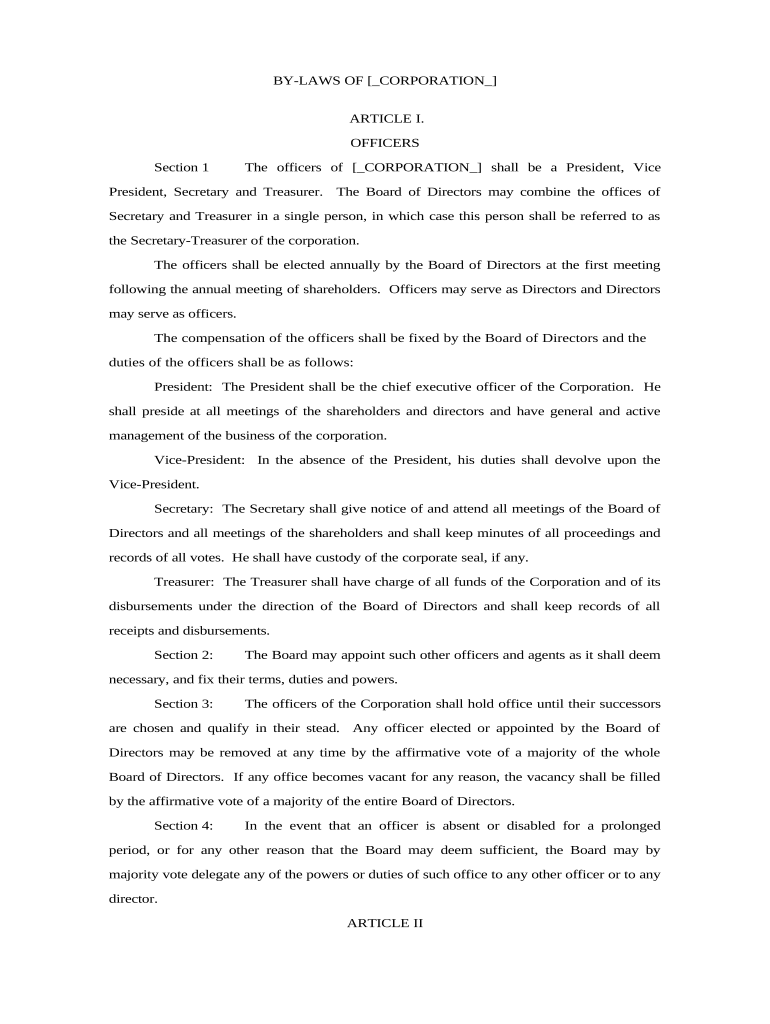
Titles, appointment/removal procedures, authority, and delegated responsibilities for officers such as CEO, CFO, and secretary.

Meetings and Voting

Notice requirements, quorum rules, proxy or remote participation policies, voting thresholds, and meeting minute expectations.

Amendment Process

Who may propose amendments, voting standards required to adopt changes, and how amendments are recorded in the corporate minute book.

Indemnification

Scope of indemnity for directors and officers, advancement of expenses, and any insurance or limitation provisions.

Essential fields and data to include

Entity name: Full legal name
Entity type: Corporation designation
Effective date: MM/DD/YYYY
Board size: Number of directors
Officer titles: List roles
Amendment rule: Voting threshold

Step-by-step: preparing and executing Bylaws

Follow these steps to draft, approve, sign, and store corporate Bylaws while preserving corporate formalities.

  • 01
    Drafting: Assemble standard sections and tailor to governance needs.
  • 02
    Board review: Present draft to board for discussion and edits.
  • 03
    Adoption: Board votes to adopt under prescribed quorum and voting rules.
  • 04
    Recordkeeping: File executed copy with corporate minutes and records.

Configuring a digital workflow for Bylaws review and signing

Set up a clear signer flow, authentication, and record retention rules before sending Bylaws for signature.

Field Configuration
Signer order Board chair then corporate secretary
Authentication Email + SMS code for directors
Document retention Keep signed copy in minute book
Audit trail Enable IP, timestamp, and signer certificate

Where to send or store finalized Bylaws

After adoption and signatures, route copies to key stakeholders and archive the official record.

  • Corporate minute book: Store original executed copy with minutes.
  • Board members: Provide signed PDF to all directors.
  • General counsel: Keep a legal review copy on file.
  • Corporate records repository: Archive in secure, access-controlled storage.

Technical considerations for e-signing and eSubmission

Ensure the provider meets your compliance needs (for example a HIPAA Business Associate Agreement where healthcare data is involved) and that audit logs are retained in a tamper-evident format for corporate records.

  • Authentication options: Email, SMS, KBA
  • Document formats: PDF/A, DOCX supported
  • Integrations: CRM, cloud storage

Risks and legal consequences of deficient Bylaws

Piercing the veil: Loss of limited liability
Invalid actions: Board resolutions challenged
Contract disputes: Ambiguity triggers litigation
Regulatory exposure: Noncompliance fines or remedies
Tax complications: IRS scrutiny possible
Recordkeeping gaps: Missing minutes or signatures

Common drafting and execution mistakes to avoid

  • Using vague or conflicting language about board authority that creates ambiguity about who can bind the corporation and when.
  • Failing to document adoption properly in minutes or to obtain the required vote, leaving the Bylaws vulnerable to legal challenge.
  • Not specifying notice, quorum, and voting thresholds clearly, which can invalidate key board or shareholder actions.
  • Storing only unsigned or draft copies digitally without an executed original in the corporate minute book and retention schedule.

Practical tips for accurate, defensible Bylaws

Use clear language, document approvals, and maintain a robust record-keeping process to support enforceability and corporate governance.

Align with articles of incorporation
Ensure every provision in the Bylaws is consistent with the articles of incorporation and applicable state corporation code. Conflicts can result in provisions being void or unenforceable and may invite legal challenges.
Record formal adoption
Document the board vote or incorporator action adopting the Bylaws in the corporate minutes, including date, attendees, vote counts, and any dissenting positions to preserve a clear administrative trail.
Specify amendment mechanics
Define who can propose and adopt amendments, required voting thresholds, and how amendments are recorded. Clear amendment procedures reduce later disputes over whether a change was validly made.
Maintain an approved master copy
Keep a single executed master Bylaws document in the corporate minute book and distribute signed PDFs to directors; record every amendment and retain older versions for the retention period.

Comparing common eSignature providers for signing Bylaws

Selected vendor criteria relevant to executing governance documents. signNow appears first per comparison format and includes both per-user and site-license pricing models.

signNow DocuSign Adobe Sign PandaDoc HelloSign
Starting Price $8/user/mo $15/user/mo $14/user/mo $19/user/mo $15/user/mo
Free Trial 7-day free trial No No Yes, limited Yes, limited
Bulk Send Yes Yes Yes Yes No
Audit Trail Yes Yes Yes Yes Yes
HIPAA Compliant Yes Yes Yes No No
Envelope Cap No envelope cap 100 envelopes/user/year Varies Varies Varies

Real-world examples of adopting governance documents online

Organizations increasingly manage and sign governance documents electronically to streamline adoption and recordkeeping.

Optica Ventures LLC

A small investment firm used online execution to adopt organizational Bylaws quickly

  • Board members approved remotely via a single workflow
  • 'The interface is simple and easy-to-use for our team; more importantly, it is just as easy for our customers.' — Brian Fitzgibbons, COO

Martin Properties

A regional real estate owner needed rapid signature collection across multiple owners

  • The team used a shared signing link for uniform execution
  • 'I can process and execute all of these documents online with 100% compliance and built-in security.' — Tim Martin, Founder

Frequently asked questions about Bylaws and electronic execution

Answers to common questions on whether Bylaws must be filed, who signs, and how eSignatures affect enforceability.


Need help? Contact support

be ready to get more
Join over 28 million airSlate SignNow users