Establishing secure connection…Loading editor…Preparing document…

Certificate of Authorship

This template is fully customizable. Edit the text, fill out the fields, and send it for signature. Give it a try!
Certificate of Authorship

What a Certificate of Authorship Is and When It’s Used

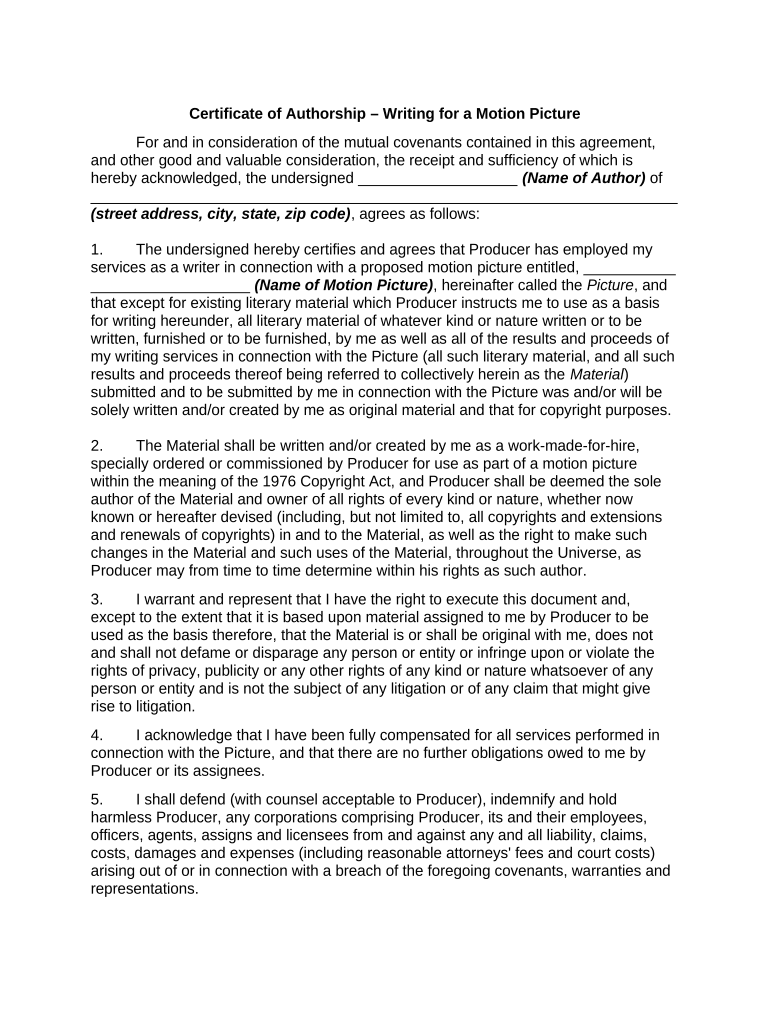
A Certificate of Authorship is a signed declaration that identifies the creator(s) of a work, affirms original contribution, and documents rights assignments or acknowledgments. Institutions, publishers, universities, and some employers use it to confirm authorship, to support copyright filings, or to record transfer of rights. The certificate typically names the work, lists contributors, describes contributions, and provides signatures and dates so the statement is admissible as evidence of authorship and chain of title.

Why a Certificate of Authorship Matters

A clear, signed certificate reduces disputes over ownership, helps with copyright and licensing records, and provides a formal audit trail for publishers, funding agencies, and institutions. It documents attribution and any assignment of rights, which can prevent later challenges to authorship or to derivative work permissions.

Why a Certificate of Authorship Matters

Who Typically Completes a Certificate of Authorship

The certificate is also used by legal counsel, in-house IP teams, and by third parties who need verifiable evidence of who created or contributed to a work.

  • Academic authors and graduate students — to document thesis authorship and university deposit requirements.
  • Journal publishers and editors — to confirm contributor roles and grant publication rights.
  • Research institutions and grant offices — to record contributor agreements and data ownership.

Step-by-step: Completing a Certificate of Authorship

Follow these core steps to produce a clear, institutionally acceptable certificate.

  • 01
    Prepare details: Gather names, affiliations, work title, and contribution summaries.
  • 02
    Fill fields: Complete each required field using the specified formats.
  • 03
    Sign: Sign electronically or physically per the recipient’s instructions.
  • 04
    Share copies: Provide signed copies to relevant parties and retain originals.

Typical workflow for issuing and receiving a Certificate of Authorship

This flow shows the most common sequence from creation through storage and sharing.

  • Draft: Author or administrator prepares the certificate with all required fields.
  • Review: Co-authors or institutional reviewers confirm accuracy.
  • Sign: Signatures are applied electronically or on paper according to preference.
  • Archive: Signed copies are delivered to parties and saved for retention.

Essential components to include in a professional Certificate of Authorship

A well-structured certificate anticipates institutional or legal scrutiny by making authorship, contribution, and rights transfers explicit and traceable.

Author identification

Full legal name, affiliation, and contact details for each named author, so institutions can match records to identity documents.
Work description

Concise title and descriptive summary of the work that matches submission or registration documents to avoid ambiguity.

Contribution statement

A clear allocation of roles (concept, design, data, drafting) that supports author order and credit assignments in publishing.

Rights and assignments

Explicit language describing copyright ownership, transfers, or licenses and any conditions or limitations on future use.

Signatures and dates

Signature blocks for each author with date fields; include witness or notary sections only if required by recipient.

Declaration language

A short sworn statement affirming originality and absence of undisclosed contributors to reduce later disputes.

Configuring an online certificate workflow

Set up a reproducible online workflow to standardize collection, reduce errors, and capture an audit trail.

Field Configuration
Author name field Required, single-line text
Contribution checkbox Multiple choices permitted
Signature field Electronic signature with timestamp
Retention tag Auto-archive metadata enabled

Digital signing and file format considerations

Ensure the chosen workflow preserves the signed record and metadata so the certificate can be reproduced exactly for audits or disputes.

  • File formats: PDF, DOCX supported
  • Authentication: Email, SMS, or advanced options
  • Audit trail: IP, timestamp recorded

How a Certificate of Authorship compares with related documents

Compare typical attributes to decide which document best meets institutional or legal needs.

Criteria Certificate of Authorship Copyright Registration
Legal effect evidence of authorship federal public record
Typical notarization optional not required
Institutional filing common for publishers filed with usco
E-sign support yes, commonly accepted yes, acceptance varies

eSignature provider comparison for signing Certificates of Authorship

Vendor pricing and feature rows for common eSignature solutions; signNow is listed first per vendor ordering rules.

signNow DocuSign Adobe Sign PandaDoc HelloSign
Starting Price $8/user/mo $15/user/mo $14/user/mo $19/user/mo $15/user/mo
Free Trial 7-day free trial Varies by offer Varies by offer Varies by offer Varies by offer
Bulk Send Yes Yes Yes Yes No
Audit Trail Yes Yes Yes Yes Yes
HIPAA Compliant Yes Yes Yes No No

Security and compliance points relevant to authorship certificates

Encryption: TLS 1.2/1.3; AES-256 at rest
Audit trail: Signed record with IP and timestamp
Compliance: ESIGN and UETA compliant
HIPAA support: Available with BAA
21 CFR Part 11: Supported for regulated records
Certifications: SOC 2 Type II, ISO 27001

Risks and potential consequences of an incorrect or incomplete certificate

Authorship disputes: May lead to costly litigation
License ambiguity: Unclear rights can impede reuse
Institutional rejection: Publisher or university may refuse submission
Copyright challenges: Weakened evidence in registration disputes
Grant impact: Funding or compliance issues may arise
Record inconsistency: Multiple versions complicate enforcement

Common preparation mistakes to avoid

  • Using informal names or initials that do not match institutional records, causing verification delays or rejection.
  • Omitting a clear contribution statement or duties, which can create ambiguity about author order and credit.
  • Failing to indicate rights assignments or licensing terms, leaving downstream users uncertain about reuse permissions.
  • Not saving the signed, timestamped version with its audit trail, which makes later validation and dispute resolution difficult.

Frequently asked questions about Certificates of Authorship

Answers to common questions about validity, e-signatures, corrections, notarization, and institutional acceptance.


Need help? Contact support

be ready to get more
Join over 28 million airSlate SignNow users