Establishing secure connection…Loading editor…Preparing document…

Certificate of Directors

This template is fully customizable. Edit the text, fill out the fields, and send it for signature. Give it a try!
Certificate of Directors

What a Certificate of Directors Is and Why It Matters

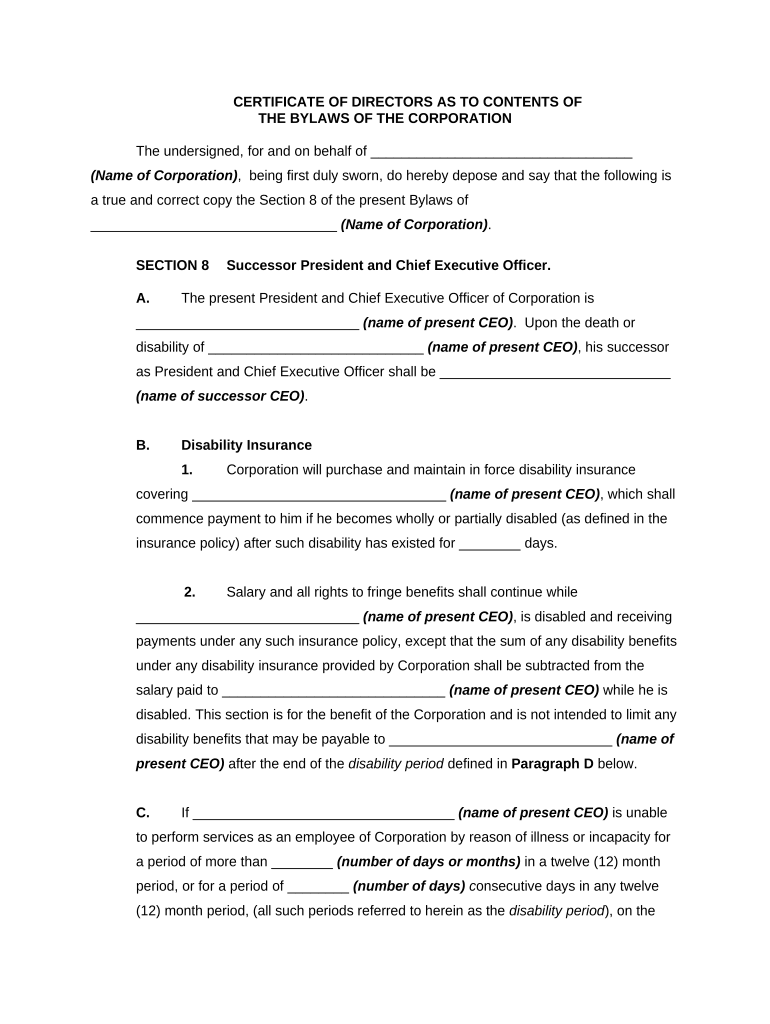
The Certificate of Directors is a formal corporate record that documents who sits on a company's board and any specific authority the board has delegated. Typical content includes the full legal names of directors, the date of the board meeting or resolution, the scope of delegated powers (for example, banking or signing authority), and references to supporting minutes or resolutions. Third parties such as banks, counterparties, and regulators commonly request this certificate to confirm who may act on behalf of the corporation.

Primary Purpose and Practical Benefits

A Certificate of Directors provides a concise, dated statement of board composition and delegated authority so third parties can verify corporate signatories without reviewing full minutes. It reduces friction with banks and counterparties, clarifies internal roles, and creates a reproducible record for compliance and corporate governance.

Primary Purpose and Practical Benefits

Who Typically Prepares, Signs, and Reviews It

The document serves internal governance and external verification roles; preparing a clear certificate minimizes follow-up requests and supports faster transaction processing.

  • Corporate secretaries and company officers who maintain minute books and issue certifications for routine business needs.
  • Bank compliance and operations teams verifying signatory authority for account opening, signature cards, and wire transfers.
  • Outside counsel and counterparty legal reviewers who require a compact record of board action for transactional due diligence.

Core Elements a Professional Certificate Should Include

A complete Certificate of Directors is concise but specific: identify directors, state the authorizing action, and provide authentication to allow third-party reliance.

Director List

Full legal names for each director, and business addresses or corporate roles to prevent ambiguity during verification by banks or counterparties.
Resolution Date

Clear statement of the date the board acted or the meeting occurred; ties authority to a discrete event and supports time-limited delegations.

Authority Scope

Precise description of delegated powers (e.g., open accounts, execute contracts, borrow funds), with limits, thresholds, and any required joint-signature rules.

Authentication

Method of authentication, such as notarization, witness language, or e-signature audit details, so recipients can determine reliance steps.

Supporting Records

Reference to minutes, corporate resolutions, bylaws citations, or exhibits that corroborate the board action and provide context for delegated authority.

Signatures & Titles

Printed name, typed job title, and dated signature of the certifying officer; include corporate seal where customary or required by recipient.

Essential Information to Include

Company Name: Enter the exact legal entity name.
Document Date: Use MM/DD/YYYY format.
Directors Listed: Full legal names only.
Scope of Authority: Be specific and include limits.
Reference Minutes: Cite meeting date and resolution number.
Authentication Type: Notary, witness, or e-sign audit trail.

How to Prepare a Standard Certificate of Directors

Follow a short, repeatable sequence to create a clear, verifiable certificate suitable for banks and third-party reliance.

  • 01
    Confirm authority: Review minutes or signed resolution authorizing the certification.
  • 02
    Draft content: List directors, action date, and precise delegation language.
  • 03
    Authenticate: Apply notary, witness language, or include e-sign audit details.
  • 04
    Distribute copies: Provide certified copies to banks, counsel, and corporate records.

Setting Up an Online Certificate Workflow

When digitizing the Certificate of Directors, configure fields and authentication to match recipient verification requirements and internal controls.

Field Configuration
Template Naming Use a standard name and versioning scheme for consistency.
Pre-fill company data Auto-fill registered entity name and address from your corporate profile.
Signer authentication Require email + SMS or stronger ID verification where needed.
Audit capture Retain timestamps, IP, and signer evidence for each action.

Where to Send or File the Certificate

The certificate is usually kept with corporate records and delivered to external parties that require proof of authority; destinations depend on use case.

  • Corporate Minute Book: Store the original certified copy for governance records.
  • Banks and Lenders: Provide certified copies for account or loan authority.
  • Counterparties: Share with vendors or buyers during due diligence.
  • Regulators or Counsel: Send copies when required for filings or legal review.

Digital Delivery and Compatibility Guidelines

Confirm recipient requirements before sending; provide a notarized or e-signed copy with audit details when external parties require demonstrable provenance.

  • File formats: PDF, DOCX accepted; PDF/A preferred.
  • Authentication: Email/SMS; KBA or government ID for high assurance.
  • Integrations: Connect to document storage or CRM systems.

Timing Considerations and Typical Processing Windows

Understand when to issue and how quickly recipients may require a current certificate; timelines vary by recipient type and transaction urgency.

Issuance on request:

Provide the certificate promptly when a bank or counterparty requests it.

Updating frequency:

Update after each board change or annually to avoid stale information.

Bank verification:

Banks may require a current certificate within 30–90 days.

Notarization timing:

Notarize at signing if recipient requires an acknowledgement.

Internal records:

File original certified copy immediately in the minute book.

Common Preparation Errors to Avoid

  • Using informal or abbreviated names instead of the entity's exact legal name, which creates identity mismatches during bank or legal verification.
  • Failing to reference the underlying board resolution or minutes, leaving recipients uncertain whether authority was properly granted.
  • Omitting the certifier's title or date, which can make the certificate unenforceable or unacceptable to third parties.
  • Applying the wrong authentication method—using a simple image signature where notarization or stronger identity proof is required by the recipient.

Risks and Consequences of an Incorrect or Incomplete Certificate

Bank Rejection: Delays in transactions.
Contract Invalidity: Third parties may refuse to accept agreements.
Fiduciary Liability: Directors risk personal exposure for unauthorized acts.
Regulatory Scrutiny: Regulators may request additional proof.
Notary Defects: Improper notarization can void authentication.
Fraud Allegations: Inaccurate certificates increase litigation risk.

Who Can Sign and Certify the Document

Corporate Secretary

The corporate secretary or other authorized recordkeeper typically certifies board lists and minutes; their signature confirms the minute book entry and vouches for procedural compliance.

Authorized Officer

An officer designated by the board (for example, CEO or CFO) may sign to confirm delegated powers; specify the officer's title and attach a copy of the authorizing resolution.

Frequently Asked Questions About Certificates of Directors

Answers to common questions about validity, signatures, e-signing, notarization, correcting errors, and recordkeeping for Certificates of Directors.


Need help? Contact support

be ready to get more
Join over 28 million airSlate SignNow users