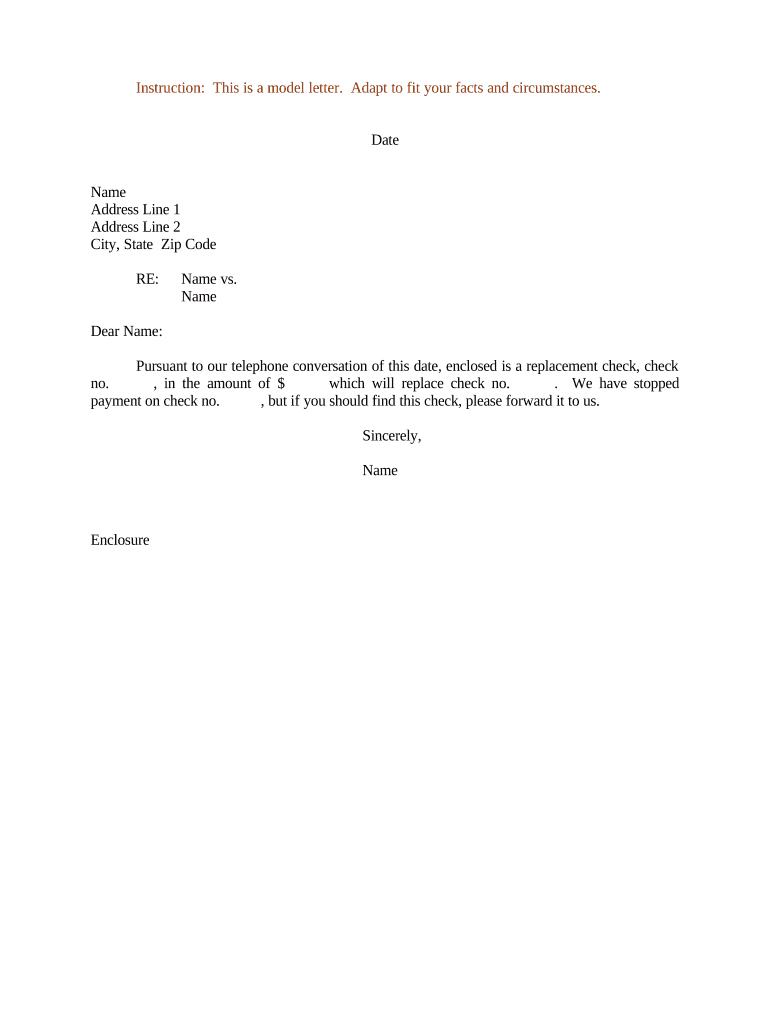
Cheque Replacement Letter
What a Cheque Replacement Letter Is and when it applies
Why a clear Cheque Replacement Letter matters
A properly structured Cheque Replacement Letter speeds verification, reduces the risk of duplicate payments, and creates an auditable record for both payer and payee. It clarifies responsibilities, supports stop-payment procedures, and documents evidence if further investigation or collection is required.
Who typically prepares or requests a Cheque Replacement Letter
Typical users complete or request Cheque Replacement Letters when reconciling payments, reporting missing checks, or initiating stop-payment and reissuance workflows.
- Accounts payable teams handling vendor payments and replacements during reconciliation.
- Payroll administrators replacing lost payroll checks or correcting distribution errors for employees.
- Individual payees requesting reissue after loss, theft, destruction, or non-delivery of a check.
Step-by-step: prepare and submit a Cheque Replacement Letter
-
01Gather Details: Collect check number, date, amount, and related invoice or deposit info.
-
02Draft Letter: State replacement reason, list original check details, and request stop-payment.
-
03Attach Proof: Include copy of canceled check, ID, invoice, or bank statement when available.
-
04Send & Follow: Deliver to payer and bank; record delivery method and follow up until resolved.
Typical routing and actions after you submit the letter
-
Payer Review: Payer verifies claim and authorizes stop-payment or reissue.
-
Bank Action: Bank processes stop-payment, investigates, and advises on reissue.
-
Accounting Update: AP posts interim holds and updates vendor ledger.
-
Replacement Issued: New check or electronic payment sent; confirm receipt with payee.
Digital submission and platform expectations
Use digital tools to create, sign, and track Cheque Replacement Letters while preserving audit trails and access logs.
- Supported Formats: PDF, DOCX, and HTML
- Integrations: Salesforce, NetSuite, Microsoft 365, Google Workspace
- Authentication: Email link, SMS code, or KBA
Key timing considerations for replacement requests
Report Immediately to Payer:
Notify issuer promptly to begin stop-payment and reissue procedures.
Contact Bank Quickly:
Banks have varying stop-payment windows; early action improves odds.
Document Submission Deadlines:
Submit completed letter within payer-specified timeframe to avoid denial.
Follow Up Cadence:
Confirm receipt within seven to fourteen days and escalate if needed.
Reconciliation Cutoffs:
Adjust accounting entries before month-end or per your close schedule.
Common mistakes that delay replacement and how they show up
- Failing to include exact check identifiers causes prolonged investigation and may require supplemental evidence from payer or bank, delaying replacement and increasing administrative workload.
- Submitting unverified or unsigned letters can lead banks to deny stop-payment requests, leaving payees to pursue recovery via claims or legal processes.
- Omitting contact or bank routing details forces back-and-forth, lengthens resolution time, and increases risk of duplicate reissuance.
- Relying on verbal notification without a written letter weakens audit trails and may prevent successful reimbursement if the original check is cashed.
Risks and potential consequences of an incorrect replacement request
eSignature vendor pricing comparison for document workflows
| signNow | DocuSign | Adobe Sign | PandaDoc | HelloSign | |
|---|---|---|---|---|---|
| Starting Price | $8/user/mo | $15/user/mo | $14/user/mo | $19/user/mo | $15/user/mo |
| Free Trial | 7-day free trial, no card | Varies by plan | Varies by plan | Varies by plan | Varies by plan |
| Bulk Send | Yes | Yes | Yes | Yes | No |
| Audit Trail | Yes | Yes | Yes | Yes | Yes |
| HIPAA Compliant | Yes | Yes | Yes | No | No |
Frequently asked questions about Cheque Replacement Letters
-
When should I send the letter?
Send the Cheque Replacement Letter as soon as you reasonably discover the check is missing, stolen, destroyed, or never received. Early notification gives the payer and bank the best opportunity to place stop-payment instructions and trace the original item.
-
Does a bank require notarization?
Many banks accept a signed letter and supporting documents, but some require a notarized affidavit before processing stop-payment or reissue. Check the payor or bank policy; requirements can vary by institution and state.
-
Can I sign the letter electronically?
Yes—electronic signatures are generally valid under the ESIGN Act (15 U.S.C. ch. 96) and UETA where adopted, provided intent, consent, attribution, and record retention requirements are met. Confirm the bank accepts e-signed affidavits if one is required.
-
What supporting documents should I attach?
Include any available evidence: a copy of the original check, invoice, deposit record, ID for the payee, and correspondence showing non-delivery. Attachments reduce investigation time and improve the chance of successful reissue.
-
How long will processing take?
Processing varies by payer and bank; expect initial acknowledgment within a few business days and resolution in one to several weeks depending on investigation complexity and whether the original check clears.
-
What if the original check is cashed?
If the original check was cashed, the bank or payer will typically provide claim procedures. Maintain your documentation and follow escalation channels; legal remedies may be required if evidence indicates fraud or improper endorsement.