Cover pleading
A clear complaint caption and concise statement of jurisdiction, parties, and relief so the court and defendants understand the claim.
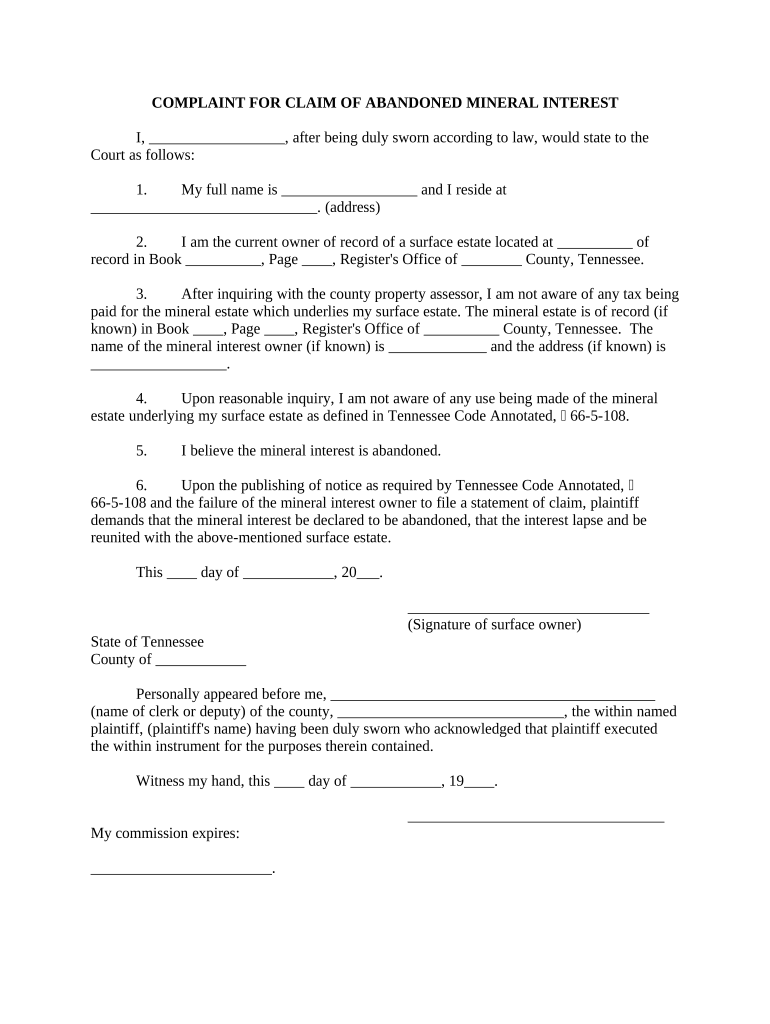
Filing a Complaint for Claim of Abandoned Mineral Interest lets an interested party seek a clear legal determination of ownership, remove clouded title, and secure exclusive rights to exploration or leasing. The process offers a judicial remedy where informal negotiation, title searches, or market-based transfers have failed, and it reduces future disputes by producing a court‑issued record.

These parties commonly prepare or initiate an abandoned mineral interest action in Tennessee.
Each participant has different responsibilities: owners prepare exhibits, purchasers secure title searches, and counsel handles pleadings, service, and court procedure.
| Field | Configuration |
|---|---|
| Signing Order | Sequential or parallel as needed for multiple claimants |
| Authentication | Email verification, optional SMS code or ID check |
| Document format | PDF/A for court filing and long-term preservation |
| Audit trail | Enable timestamps, IP logging, and signed certificate |
Use compatible file types and integration settings to produce court-ready PDFs and reliable audit records.
Preserve a complete audit trail and store signed PDFs with exhibit attachments for service and filing; ensure local court e‑filing rules accept electronically executed documents.
A clear complaint caption and concise statement of jurisdiction, parties, and relief so the court and defendants understand the claim.
Precise deed or metes-and-bounds description that ties the mineral interest to recorded property boundaries and parcel identifiers.
Chronological exhibit of recorded instruments, transfers, leases, and releases that demonstrates lapse or abandonment.
Recorded deeds, leases, assignments, production records, and maps authenticated to support factual allegations and remedies.
A detailed list with current addresses for each defendant, counsel, and interested party to document proper service attempts.
Draft vesting or quiet-title order tailored to the relief requested to assist the court's disposition of the claim.
Allow 2–6 weeks for comprehensive chain-of-title research
Defendants commonly have 30 days to answer after valid service
Expect initial responsive pleadings within 30 days of service
Discovery timelines vary; courts set schedules after initial case conference
Scheduling can range from months to over a year depending on complexity
Finalize complaint, exhibits, and service list before submission to the clerk.
Clerk assigns case number and issues initial scheduling orders.
Serve defendants and await answers or motions to dismiss.
Court resolves contested title issues by hearing, summary judgment, or trial.
I can process and execute all of these documents online with 100% compliance and built-in security.
The interface is simple and easy-to-use for our team; more importantly, it is just as easy for our customers.
| signNow | DocuSign | Adobe Sign | PandaDoc | HelloSign | |
|---|---|---|---|---|---|
| Starting Price | $8/user/mo | $15/user/mo | $14/user/mo | $19/user/mo | $15/user/mo |
| Free Trial | Yes, 7-day trial | Varies by vendor | Varies by vendor | Varies by vendor | Varies by vendor |
| Bulk Send | Yes | Yes | Yes | Yes | No |
| Audit Trail | Yes | Yes | Yes | Yes | Yes |
| HIPAA Compliant | Yes | Yes | Yes | No | No |