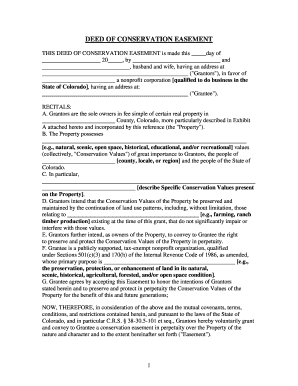
Colorado Easement
What a Colorado Easement Is and why it matters
Why a clear easement protects interests and reduces disputes
A well-drafted Colorado Easement establishes enforceable access or use rights, creates public notice through recording, and allocates maintenance and liability. Precise scope and duration reduce litigation risk, clarify responsibilities, and preserve property and lending value under Colorado property law.
Who typically prepares or signs a Colorado Easement
Typical parties who prepare or sign a Colorado Easement include landowners, utility companies, developers, and lenders.
- Private landowners seeking access rights, easement income, or conservation restrictions recorded against their parcels.
- Municipalities or utilities installing infrastructure, access corridors, or maintenance routes across private property.
- Real estate attorneys and title companies preparing enforceable easement terms and ensuring marketable title.
Step-by-step: complete and record a Colorado Easement
-
01Draft Terms: Define parties, purpose, limits, and maintenance.
-
02Include Legal Description: Insert metes and bounds or parcel ID.
-
03Notarize: Sign before a notary public to add acknowledgment.
-
04Record Document: File with county recorder and obtain stamped copy.
How the easement lifecycle typically works
-
Prepare Draft: Draft terms and legal description.
-
Sign & Notarize: All parties sign before notary public.
-
Record Deed: File with county recorder and pay fee.
-
Provide Copies: Distribute recorded copy to stakeholders.
Digital workflow settings for completing an easement online
| Signing Field and Recommended Configuration Settings | Signer Role | Authentication method | Notary required |
|---|---|
| Primary Signer | Grantor or grantee role; require email + SMS code authentication. |
| Notary Field | Place notarization block last; require notarization acknowledgment and date. |
| Conditional Fields | Show maintenance clauses only when multiple grantees identified. |
| Recording Route | Auto-send final PDF to title agent or recorder for manual filing. |
Platform capabilities to support eSigning and eSubmission for easements
For digital completion and eSubmission, ensure the platform supports PDF and DOCX formats, preserves audit trails, and accommodates notarization or RON workflows where permitted by the county.
- File Formats: PDF and Word DOCX supported.
- Integrations: Integrates with Salesforce, NetSuite, and Google Workspace.
- Authentication: Supports email, SMS, and enterprise SSO options.
Key timelines and recommended turnaround for easement processing
Drafting and Review Time:
Allow 7–14 business days for attorney and surveyor review.
Signing and Notarization:
Schedule notary and complete signatures within 30 days of final draft.
Recording Window:
Record promptly after signing to provide public notice and priority.
Correction Period:
File corrective instrument as soon as an error is discovered.
Dispute Limitation Period:
Statute of limitations for property claims varies; consult counsel early.
eSignature vendor pricing and feature snapshot for easement workflows
| signNow | DocuSign | Adobe Sign | PandaDoc | HelloSign | |
|---|---|---|---|---|---|
| Starting Price | $8/user/mo | $15/user/mo | $14/user/mo | $19/user/mo | $15/user/mo |
| Free Trial | 7-day free trial | Yes, 30-day trial | Yes, limited trial | Yes, limited trial | Yes, limited trial |
| Bulk Send | Yes | Yes | Yes | Yes | No |
| Audit Trail | Yes | Yes | Yes | Yes | Yes |
| HIPAA Compliant | Yes | Yes | Yes | No | No |
Best practices for accurate and efficient easement completion
Practical examples: easements in action
Martin Properties (Tim Martin)
A regional developer needed a permanent access easement to reach a new parcel
- The easement specified maintenance and cost-sharing obligations
- Tim Martin reports that processing, notarization, and recording enabled timely closings while preserving clear title and lender comfort.
Optica Ventures LLC (Brian Fitzgibbons)
A landowner granted a narrow conservation easement to limit subdivision and protect habitat
- Terms restricted development but allowed access for monitoring
- The recorded easement provided public notice, protected conservation objectives, and reduced future land use disputes.
Common risks and consequences of errors
Frequently asked questions about Colorado Easements
-
Can an easement be signed electronically?
Yes in many cases: the ESIGN Act (15 U.S.C. ch. 96) and UETA authorize electronic signatures, but county recorder acceptance and notary requirements vary; confirm recorder policy and, if notarization is needed, whether RON is permitted before relying solely on e-signatures.
-
What must the legal description include?
Use the recorded metes and bounds, subdivision, lot and block, or assessor parcel number exactly as in county records; relying only on street addresses can create ambiguity and title exceptions during closing or insurance underwriting.
-
Are witnesses required for recording?
Most Colorado counties require a notarized acknowledgment rather than extra witnesses for easements; witness requirements vary by state and document type, so verify county recorder rules before execution and recording.
-
How do I correct recording errors?
Common remedies include filing a corrective easement, corrective deed, or reformation instrument; consult counsel and record the corrective document promptly to minimize title risks and ensure the public record reflects the intended agreement.
-
Can an easement be revoked or terminated?
Termination depends on the easement terms—release by deed, merger of dominant and servient estates, abandonment, or court action; a recorded release or termination deed is normally required to clear the public record.
-
Will an easement affect title insurance?
Recorded easements typically appear as exceptions on title policies; notify the title insurer early and provide the recorded instrument to allow underwriting review and, where appropriate, seek removal or clarification of exceptions.