Establishing secure connection…Loading editor…Preparing document…

Complaint for Divorce Mississippi

This template is fully customizable. Edit the text, fill out the fields, and send it for signature. Give it a try!
Complaint for Divorce Mississippi

What the Complaint for Divorce Mississippi Is and When It’s Used

A Complaint for Divorce Mississippi is the initial pleading filed with a Mississippi court to start a divorce action. It identifies the parties, states residency and jurisdictional facts, and sets out the statutory grounds or factual basis for dissolution. The complaint asks the court to grant a divorce and may request interim orders for custody, support, or property preservation. Because divorce is a judicial proceeding, the complaint must conform to local rules, filing procedures, and service requirements managed by the chancery or county court in the appropriate county.

Why a Proper Complaint Matters

A correctly prepared complaint frames the legal issues the court will decide, establishes jurisdiction, and preserves parties’ rights. Accurate, complete pleadings reduce delays, minimize likely objections, and ensure the case proceeds on schedule before the assigned court.

Why a Proper Complaint Matters

Who Typically Files or Prepares This Complaint

The Complaint for Divorce Mississippi is used by individuals seeking judicial dissolution, attorneys representing parties, and court clerks who manage filings.

  • Self-represented litigants preparing initial pleadings and service documents to start a divorce case
  • Family law attorneys drafting jurisdictional facts, relief requests, and interim orders for clients
  • Court clerks and filing staff who accept pleadings and advise on local e-filing or paper requirements

Step-by-Step: Filing a Complaint for Divorce in Mississippi

Follow these core steps in sequence to begin a divorce action and move the case into the court system.

  • 01
    Prepare Complaint: Draft caption, parties, jurisdictional facts, grounds, and relief requested.
  • 02
    Attach Exhibits: Add financial affidavits, child information sheets, or other required exhibits.
  • 03
    File with Clerk: Submit to the chancery or appropriate county clerk per local rules.
  • 04
    Serve Defendant: Effect formal service by sheriff, process server, or court-approved method.

How to Customize and Complete the Complaint Online

When completing the complaint online, map each field to your jurisdiction’s requirements and configure document settings for filing or printing.

Template Fields Map caption, parties, dates, and relief fields to mandatory inputs
Validation Rules Enable required-field checks and date format MM/DD/YYYY
Conditional Sections Show child-related sections only if children are listed
Signature Options Set to printed signature or allowed e-sign method per court rules
Download Format Export as PDF/A or court-preferred PDF for e-filing or clerk submission

Where to File and How the Submission Flows

The typical submission path moves from preparation to filing to service and then to interim hearings or case management by the court.

  • Local Clerk: File original pleadings with the county chancery or circuit clerk per local practice
  • E-Filing Systems: If available, submit via the court’s electronic filing portal following formatting rules
  • Service Process: Arrange service through sheriff, private process server, or accepted alternative
  • Case Management: Court schedules initial appearance, temporary orders, and discovery deadlines

Methods to Share the Complaint and Acceptable Formats

Courts and clerks accept documents in specific formats; choose the delivery channel that matches local rules and proof-of-service requirements.

  • Accepted Formats: PDF, PDF/A, and sometimes DOCX for internal drafting
  • Electronic Filing: Use the county or statewide e-filing portal when available
  • Physical Submission: Paper filing accepted at clerk’s office with required copies

Required Information and Key Security Considerations

Party Names: Full legal names
Residency Details: County and state of residence
Grounds Statement: Stated legal basis
Relief Requested: Custody, support, property
Signatures: Original or allowed e-sign
Sensitive Data: Protect financial and health information

Risks of Incomplete or Incorrect Complaint Filings

Dismissal Risk: Case may be dismissed for lack of jurisdiction
Service Defects: Improper service can void proceedings
Delay in Relief: Temporary orders may be postponed
Financial Exposure: Failure to disclose assets harms property division
Enforcement Problems: Weak pleadings limit enforcement efficacy
Privacy Breach: Improper handling of sensitive records

Common Mistakes to Avoid When Preparing the Complaint

  • Using inconsistent party names between caption and signature
  • Omitting precise residency facts that establish jurisdiction
  • Failing to attach required financial affidavits or child information sheets
  • Assuming e-signatures are acceptable without checking local court rules

Key Elements to Include in a Professional Complaint for Divorce Mississippi

Include these structural elements to make the complaint complete and acceptable for filing in most Mississippi courts.

Caption

Court name, county, and case caption listing plaintiff and defendant as required by local rules and court forms.
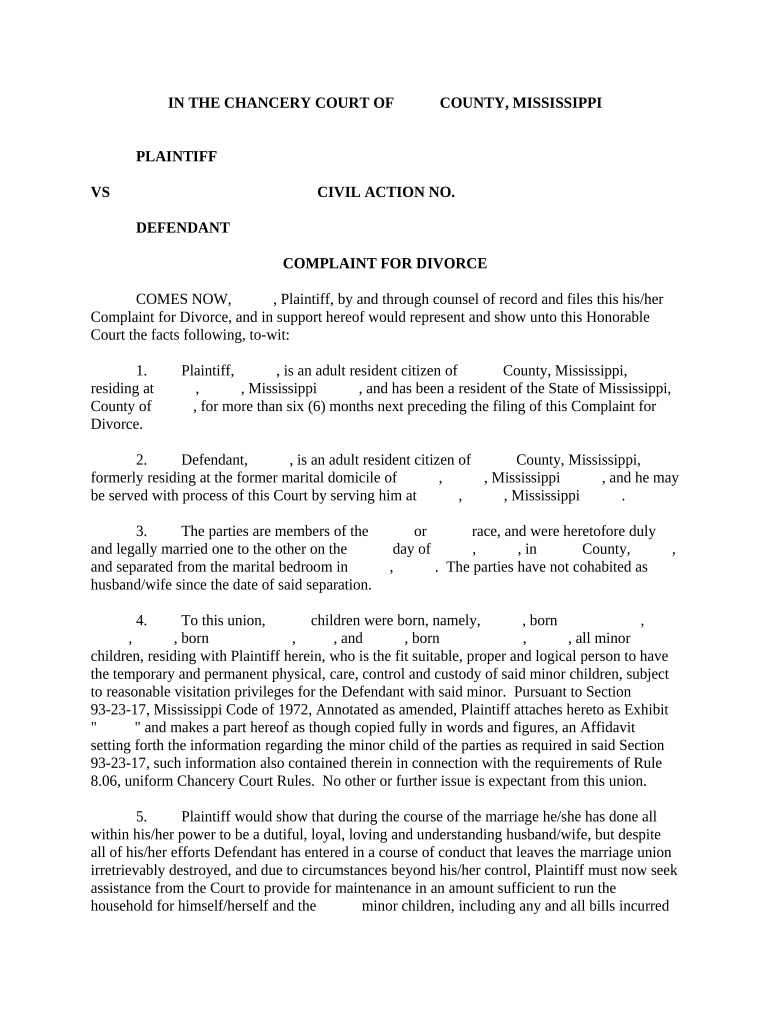
Jurisdictional Facts

Clear statements of residency and timing that establish the court’s authority over the divorce action.

Statement of Grounds

Concise factual or statutory grounds for divorce tailored to Mississippi requirements and local pleading practice.

Relief Claimed

Specific requests such as divorce decree, child custody, child support, spousal support, property division, and temporary relief.

Attachments

Financial affidavit, parenting plan, child information sheet, and other exhibits required by the local court.

Verification and Signature

Signed and dated verification or affidavit where required; note that some courts require original signatures or notarized verifications.

Supporting Documents and Download Options

Prepare companion documents and exports in formats the court accepts; saving multiple formats preserves accessibility and proof of filing.

Financial Affidavits

Detailed income and expense schedules supporting support and property claims; often mandatory.

Parenting Plan

Custody and visitation proposals for cases involving children; include proposed schedules and decision-making guidelines.

Service Forms

Summons and proof of service forms the clerk will require after filing the complaint.

Export Formats

Save the final filing as court-ready PDF/A and retain an editable DOCX copy for updates.

eSignature Vendor Pricing Snapshot for Document Workflows

Compare basic pricing and feature availability for common eSignature solutions used to prepare or sign legal pleadings. Confirm vendor plans and court acceptance before relying on e-signatures for court filings.

signNow DocuSign Adobe Sign PandaDoc HelloSign
Starting Price $8/user/mo $15/user/mo $14/user/mo $19/user/mo $15/user/mo
Free Trial 7-day free trial Varies by vendor Varies by vendor Varies by vendor Varies by vendor
Bulk Send Yes Yes Yes Yes No
Audit Trail Yes Yes Yes Yes Yes
HIPAA Compliant Yes Yes Yes No No

Practical Tips for Accurate and Efficient Complaint Preparation

Adopt consistent checks and templates to reduce errors and ensure the complaint meets court expectations.

Use Official Forms
Start with the court’s recommended complaint or local template to ensure required language and sections are present.
Verify Jurisdiction
Confirm county residency requirements and statutory grounds before filing to avoid jurisdictional dismissal.
Attach Required Exhibits
Collect financial affidavits and child information sheets before filing to prevent later continuances.
Confirm Signature Rules
Check whether the clerk accepts electronic signatures, requires notarization, or needs original wet-ink signatures.

Time-sensitive Steps and Typical Deadlines

Certain filings and procedural steps have standard timelines; missing a deadline can delay temporary relief or discovery.

Initial Filing:

File complaint when ready; court may set first appearance within weeks

Service Deadline:

Serve defendant according to local rules promptly after filing

Temporary Relief:

Motions for temporary orders are typically heard on short notice

Discovery Deadlines:

Court sets schedules; respond within ordered timeframes

Appeal Period:

Post-judgment appeal deadlines vary by statute and court rules

FAQs and Troubleshooting for the Complaint for Divorce Mississippi

Answers to common practical questions about preparing, filing, and authenticating a complaint in Mississippi courts.


Need help? Contact support

be ready to get more
Join over 28 million airSlate SignNow users