- 1 - Prepared by U.S. Legal Forms, Inc.Copyright 2016 - U.S. Legal Forms, Inc.
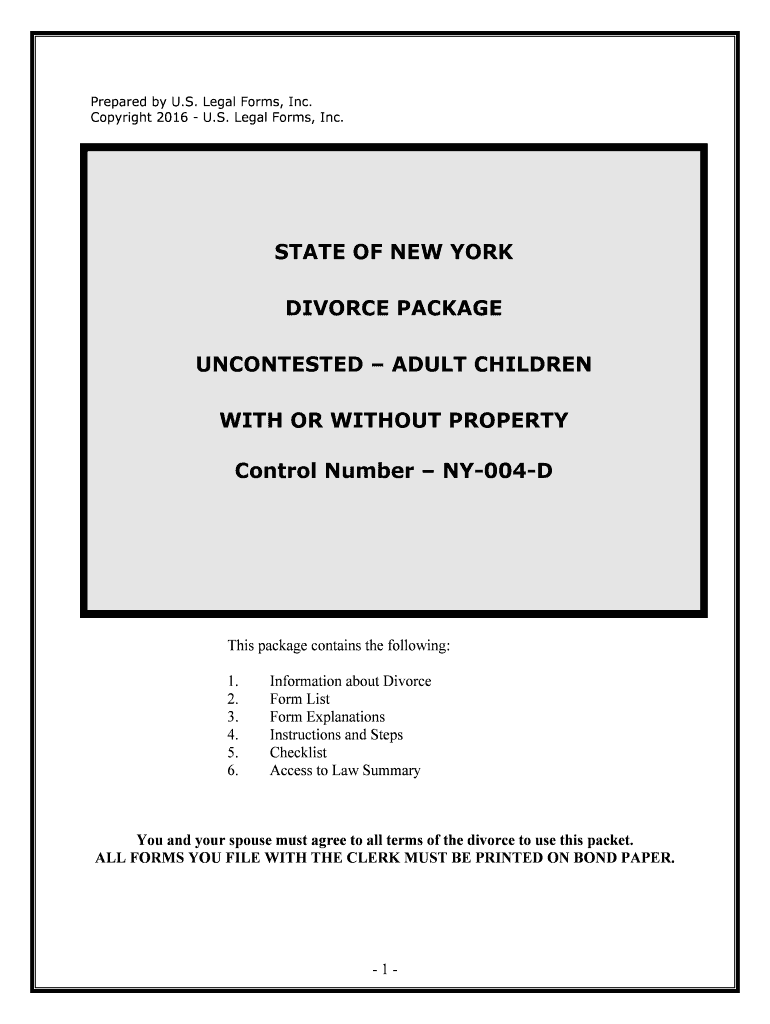
STATE OF NEW YORKDIVORCE PACKAGE UNCONTESTED – ADULT CHILDREN WITH OR WITHOUT PROPERTY
Control Number – NY-004-D This package contains the following:1. Information about Divorce2.Form List3. Form Explanations4. Instructions and Steps5.Checklist6.Access to Law Summary You and your spouse must agree to all terms of the divorce to use this packet. ALL FORMS YOU FILE WITH THE CLERK MUST BE PRINTED ON BOND PAPER.
- 2 -
INFORMATION ABOUT DIVORCE
1.WHO MAY USE THESE FORMS: You may use the forms in this package only when
all of the following facts are true:(a)You must meet the grounds for divorce and residency requirements; each
dealt with below in their respective sections.(b) There are no minor children of said marriage, and the wife is not now
pregnant. All children of the marriage have reached the age of twenty-one
(21), or are emancipated (no longer dependent on parents for support). 2.THE BASICS: You must agree with your spouse to dissolve the marriage, and agree to
all the terms of the dissolution of marriage in filling out the forms, including property
division. You will complete and file the forms (see detailed instructions, below) in the
Supreme Court for the county in which you choose to file the divorce papers (the county
of either your or your spouse’s residence).
3.RESIDENCY REQUIREMENTS:
To file for a divorce in New York you must satisfy one of the following residency
requirements:1) The marriage ceremony was performed in New York State and either spouse is a
resident of the state at the time of the commencement of the action for divorce and
resided in the state for a continuous period of one year immediately before the action
began; OR2) The couple lived as husband and wife in New York State and either spouse is a
resident of the state at the time of the commencement of the action for divorce and
resided in this state for a continuous period of one year immediately before the action
began; OR3) The grounds for divorce occurred in New York State and either spouse is a resident of
the state at the time of the commencement of the action for divorce and resided in this
state for a continuous period of one year immediately before the action began; OR4) The grounds for divorce occurred in New York State and both spouses are New York
residents at the time the action is commenced; OR5) If you and your spouse were married outside of New York State and you never lived
together as husband and wife in this state and the grounds for divorce did not occur in
this state -- either you or your spouse must presently be a resident of New York State and
have resided continuously in the state for at least two years prior to bringing this action
for divorce.
- 3 - 4.GROUNDS FOR DIVORCE: In order to file for a divorce in New York State you must have a ground (a legally
acceptable reason) for the granting of a divorce by the New York courts. The legally
acceptable reasons or grounds for divorce, in New York are described in Domestic
Relations Law §170 (see, New York Divorce Law Summary). They are: (1) cruel and
inhuman treatment; (2) abandonment; (3) imprisonment; (4) adultery; (5) living separate
and apart pursuant to a separation judgment or decree; and (6) living separate and apart
pursuant to a separation agreement; and (7) irretrievable breakdown in relationship
between husband and wife for a period at least six months (commonly know as “no-
fault”). Cruel and Inhuman Treatment: The treatment of the Plaintiff by the Defendant must rise
to the level that the physical or mental well being of the Plaintiff is endangered and
makes it unsafe or improper for the Plaintiff to continue living with the Defendant.
All acts must have happened within five (5) years of the date the summons is filed with
the County Clerk.In describing the specific acts of cruelty, you must be clear and to the point. You must
supply the court with details like dates and places. If you do not remember the exact date,
use the words "on or about [approximate date]".After describing the acts of cruelty you should conclude with the following language:
"The conduct of the Defendant was cruel and inhuman and so endangered the physical
or mental well being of the Plaintiff as to render it unsafe or improper for the Plaintiff to
cohabit with the Defendant."Abandonment: An action for divorce may be maintained where the Defendant abandons
the Plaintiff for a period of one year or longer prior to commencing the action and
continuing to the present.
Abandonment may take the form of your spouse physically departing your marital home
without any intention of returning for a period of one year or longer prior to commencing
the action, and continuing to the present, without any good reason for doing so and
without your consent.Imprisonment: An action for divorce may be maintained by Plaintiff only where the
Defendant is imprisoned for a period of at least three consecutive years. The
imprisonment must have commenced after the date of the marriage. If your spouse was
released more than five years ago and your spouse opposes the divorce, your case may be
dismissed.
- 4 - Adultery: An action for divorce may be maintained based on adultery, which is an act of
sexual or deviate sexual intercourse voluntarily performed by the Defendant with a
person other than his or her spouse during the course of the marriage.
The ground of adultery can be difficult and expensive to prove because the testimony of
the Plaintiff is not enough and other evidentiary requirements must be satisfied (the
Defendant’s admission is not enough). A corroborating affidavit of a 3rd
party witness or
other proof should be attached to the papers you submit to the court. You should keep in
mind that acts of adultery may qualify as acts of cruelty and entitle you to maintain a
divorce action on the grounds of cruel and inhuman treatment. If you found out about the
adultery more than five years ago and your spouse opposes the divorce, your case may be
dismissed.Living Separate and Apart Pursuant to a Separation Agreement: A Separation
Agreement is an agreement between the spouses that sets forth the terms and conditions
by which the parties will live apart. The agreement must be signed by the parties before a
notary and filed with the County Clerk in the county where one of the parties resides.
If you and your spouse have lived apart for more than one year according to the terms
and conditions of a properly executed separation agreement, you may begin an action for
divorce. It may be advisable to consult an attorney regarding this ground for divorce.Irretrievable Breakdown in Relationship (No-Fault) : To get a divorce on this ground,
your relationship with the Defendant must have been broken down irretrievably (so that
it is impossible to repair or reconcile) for a period of at least six months.
This type of divorce is not automatic even though it is commonly called “no-fault
divorce.” The court will not grant you a divorce based on this ground unless:a)one of the parties has sworn under oath that the relationship has broken down
irretrievably for a period of at least six months; ANDb)you and your spouse have either resolved all the economic issues of
distribution of property, spousal support, child support, and counsel and/or
experts fees and expenses, and the custody and visitation with any minor
children of the marriage OR these issues have been decided by the court and
incorporated into the final judgment of divorce. 5. DISTRIBUTION OF PROPERTY: In a divorce, the property (land, house, buildings,
and items of personal property) owned (and debts owed) by the couple is divided
between the parties. This is accomplished by means of a Separation Agreement. You
and your spouse must agree to the property and debt division and memorialize your
agreement in the Separation Agreement, which will be incorporated by reference into
the Decree of Divorce that ultimately ends your marriage. You may agree to divide the
property any way you like, as long as a basic fairness is maintained, and you both agree.
- 5 - If you cannot agree on any item of this division, the dissolution of marriage transforms
into a contested divorce. A contested divorce is outside the scope of this packet.6.FILING FEES: You will have to pay the following filing fees during your action for
divorce.(a)Index Number: $210(b)Note of Issue: (New York City) $125; (outside NYC) $30(c)Request for Judicial Intervention: (outside NYC only) $95(d)Certificate of Dissolution: Check with your local court clerk(e)Certified Copy of Judgment: Approx. $4 to $10.
- 6 - FORM LIST The following forms are included in this package:1.Summons (NY-UD-1A)2.Verified Complaint (NY-UD-2)3.Affidavit of Defendant (NY-UD-7)4.Affirmation (Affidavit) of Regularity (NY-UD-5)5.Affidavit of Service (NY-UD-3)6.Affidavit of Plaintiff (NY-UD-6)7.Sworn Statement of Removal of Barriers to Remarriage (NY-UD-4) and
Affidavit of Service of Sworn Statement (NY-UD-4a)8.Settlement Agreement (NY-DO-3A)9.Note of Issue (NY-UD-9)10.Findings of Fact/Conclusions of Law (NY-UD-10)11.Judgment of Divorce (NY-UD-11)12.Part 130 Certification (NY-UD-12)13.Request for Judicial Intervention ("RJI") (NY-UD-13) – used if filing
outside of New York City14. Notice of Entry (NY-UD-14)15.Certificate of Dissolution of Marriage (NY-DOH-2168)16.Self-Addressed and Stamped Postcard (NY-801D)
- 7 - SUPPLEMENTAL FORMS (you may or may not be required to use this form,
see below):
17. Notice of Settlement (NY-UD-20)18. Poor Person Order (NY-804D)19.Affidavit in Support of Application to Proceed as Poor Person (NY-805D)You may also need to check with your local court clerk to obtain additional forms to meet
the requirements of § 177 Dom. Rel that mandates notification to each party of health
insurance benefits and the effect a divorce will have on those benefits.
- 8 - FORM EXPLANATIONSAll forms included in this package are identified and described below.1.Summons (NY-UD-1A): Notifies your spouse of the divorce action.2.Verified Complaint (NY-UD-2): The document that begins the divorce process, and
includes the necessary legal details.
3.Affidavit of Defendant (NY-UD-7): Confirms that the Defendant (your spouse)
agrees to the divorce terms as set forth in your Verified Complaint, and agrees that
he/she has been served with the appropriate papers.
4. Affirmation (Affidavit) of Regularity (NY-UD-5): This is an affidavit to be filled
out by you confirming that the appropriate documents were served on your spouse.
You are to file this document along with the “Affidavit of Defendant” once your
spouse has returned the signed, notarized “Affidavit of Defendant” to you.
5.Affidavit of Service (NY-UD-3): This affidavit must be filled out by the person that
serves the summons and verified complaint on your spouse (the Defendant). You
need not file this form if Defendant executes the Affidavit of Defendant (Form UD-
7), which satisfies the proof of service requirement.
6.Affidavit of Plaintiff (NY-UD-6) : Confirms the basis for divorce and information
contained in your Verified Complaint.
7.Sworn Statement of Removal of Barriers to Remarriage (NY-UD-4) and
Affidavit of Service of Removal of Barriers to Remarriage (NY-UD-4A): This
form is used if the parties were married in a religious ceremony. The Plaintiff
completes the form and signs it before a notary public. The attached affidavit is
completed and signed by the server of process before a notary public, or it is signed
by the Defendant.
8.Separation and Property Settlement Agreement (NY-DO-3A): This document
memorialized you and your spouse’s agreements regarding division of property and
debts.
9. Note of Issue (NY-UD-9): Information sheet for use by Court.10.Findings of Fact/Conclusions of Law (NY-UD-10): This document describes the
facts and circumstances under which your divorce is granted. The judge fills in portions of this document.
11.Judgment of Divorce (NY-UD-11): The final statement of the terms of your divorce,
which incorporates your Settlement Agreement. Once this is signed by the Judge and
filed with the court, your divorce is complete. You must however mail a certified
copy of the signed, filed judgment to your spouse with the “Notice of Entry.”
12. Part 130 Certification (NY-UD-12): Confirmation by you that your divorce filings
are not frivolous.
- 9 - 13.Request for Judicial Intervention ("RJI") (NY-UD-13)- Outside of New York
City: You must file this document as part of your divorce case only if filing outside
the city of New York.
14.Notice of Entry (NY-UD-14) : Notice that your Judgment of Divorce has been
entered (filed) with the Clerk. Send with copy of Judgment to spouse.
15. Certificate of Dissolution of Marriage (NY-800D): A certificate showing the
relevant information related to the dissolution of your marriage. This form is required
by the Department of Health. You need not complete the section entitled
“Confidential.”
16. Self-Addressed and Stamped Postcard (NY-801D): Needed for the clerk to notify
you/send you information.
SUPPLEMENTAL FORMS (you may or may not need this):17.Notice of Settlement (NY-UD-20): This form may be required if your spouse must
approve the Judgment of Divorce before the Judge will sign it.
18.Poor Person Order (NY-804D): This form may be used in a divorce if the
individual does not have the financial resources to pay filing fees and court costs.
19. Affidavit in Support of Application to Proceed as Poor Person (NY-805D): This
form may be used in support of application to waive filing fees and court costs.
- 10 - FOLLOW STEPS 1-7 TO START THE DIVORCE ACTION
STEP 1: Prepare an original and two copies of the Summons and Verified Complaint (Form
UD-1a and Form UD-2).
STEP 2: Purchase an index number at the County Clerk's Office and file the original of the
Summons and Verified Complaint with the County Clerk. Unless you are granted a poor person's waiver, you will be required to pay $210 for the index number. Check with the County Clerk
regarding acceptable forms of payment. Many County Clerks also will require that you fill out an
Index Number Application Form at the time of filing, so be sure to bring with you the names,
addresses and telephone numbers of all of the attorneys or, if unrepresented, of the parties
themselves.STEP 3: Put the index number and the date of the filing on the two copies of the Summons
and Verified Complaint if this is not done by a clerk upon filing the papers.STEP 4: Have the Defendant served with one copy of the Summons and Verified Complaint by
being personally handed the papers.If your spouse lives in New York State: The server must be a resident of New York State, over eighteen years of age, and
cannot be a party to the action (this means you may not serve your spouse with the
Summons). If your spouse is presently residing outside of New York State: You must still ensure that he or she is personally served with the summons. If you use
a non-New York State resident to serve your spouse outside of New York State, the
server must be a person authorized to make service pursuant to the laws of that
jurisdiction or a duly qualified attorney in that jurisdiction, and you must submit a copy
of the authorization that allows that person to serve the summons. You are encouraged to
check with the local sheriff and, if necessary, with a country's Consulate or Embassy as to
any local requirements for service. Service upon the Defendant of the Summons and Verified Complaint must be made
within 120 days of their filing with the County Clerk's Office. If you do not know
where the Defendant is located, you may wish to delay filing the Summons and Verified
Complaint until he or she is located, so that the 120-day period does not begin running
while you search for your spouse.
- 11 - STEP 5: Where the Defendant agrees to the divorce, he or she will need to sign the Affidavit of
Defendant (Form UD-7). The Plaintiff may fill out the form and forward it to the Defendant for
signature or the Plaintiff may send the form to the Defendant with a copy of the instructions on
how to fill it out. This may be accomplished by submitting the form to the Defendant together
with the Summons and Verified Complaint. The Defendant must send the completed form back
to the Plaintiff prior to having the case placed on the calendar so that the form can be filed with
the other required forms.STEP 6: Where the Defendant will not agree to complete and return the Affidavit of Defendant,
the person that served the Defendant must prepare an "Affidavit of Service" (Form UD-3),
which attests to the service of the Summons and Verified Complaint. This affidavit must be
submitted along with the full set of divorce papers when you place your case on the court's
calendar. Keep in mind that there is a 40-day waiting period from when the summons is served
to place the matter on the court's calendar. When the Defendant does not sign the Affidavit of
Defendant, waiving the 40 days, you must wait the full 40 days before you can place the matter
on the court's calendar.STEP 7: If the parties were married in a religious ceremony, the Defendant must be served with
a copy of the Sworn Statement of Removal of Barriers to Remarriage (Form UD-4). The
Plaintiff must fill out the original and make a copy of the form. The copy then must be served on
the Defendant either by personal service along with the Summons and Verified Complaint, or by
mail. If you serve the form by mail, it must be done prior to your placing your action on the
court's calendar as described below, because you will need to file the original form with the other
required forms. Service by mail must be by someone other than the Plaintiff who is over the
age of 18 and not a party to the action. When you file this form, you must attach to the form
the Affidavit of Service (Form UD-4a). If the Defendant signs the Affidavit of Defendant
(Form UD-7), then you will not have to serve and file this form.If the Defendant appears and does not consent to this action: Then your matter is no longer an uncontested matrimonial and you will be unable to
obtain an uncontested divorce. You may want to consult an attorney at that point.
- 12 - STEPS FOR PLACING YOUR DIVORCE CASE ON THE COURT CALENDAR
After you have completed Steps 1-7, you are ready to place your case on the court's calendar. If
the Defendant consents to the action by signing the Affidavit of Defendant (Form UD-7), you
may place your case on the court's calendar immediately. Otherwise, you will have to wait until
40 days after the date of the service of the summons.
You must complete the following steps to place your case on the calendar:STEP 8: You must complete Forms 3-12 (include UD-7 only if signed by the Defendant). Form
UD-3 (Affidavit of Service) and Form UD-4 (Sworn Statement of Removal of Barriers to
Remarriage) need not be completed, or filed, if the Defendant has signed Form UD-7 (Affidavit
of Defendant). STEP 9: If you are filing your action outside of the City of New York, you also must complete
Form 13- Request for Judicial Intervention (NY-UD-13).STEP 10: You also must complete the Forms 14-16. STEP 11: You must file the completed forms, including a copy of the Summons and Verified
Complaint, with the County Clerk's Office. Include three (3) copies of the Note of Issue (Form
UD-9).STEP 12: Unless you are granted a poor person's waiver, you must pay a filing fee for filing the
Note of Issue (Form UD-9) and, if outside New York City, the Request for Judicial Intervention
(Form UD-13). See page 4 for the schedule of filing fees.All of the papers filed with the County Clerk's Office will be submitted to the judge. If the papers
are approved, the judge will sign the Judgment of Divorce (Form UD-11).If you are asking for maintenance, or distribution of property, the court may require a
hearing unless you have either a written agreement or prior court order. If you are asking for exclusive occupancy of the marital home, you must assert that your spouse is not living
in the marital home; otherwise a hearing may be ordered.
- 13 - SUPPLEMENTAL FORMS
This packet contains additional forms that you may be required to file depending upon the
special requirements in the county where you are bringing the action.
a. Notice of Settlement (Form UD-20)In some instances, the court will not sign the Judgment of Divorce until the Defendant is served
with a copy of the unsigned Judgment and any other proposed orders and is permitted an
opportunity to object to or comment on them. In that situation, the court will notify you that the
Judgment and the proposed orders are to be served upon the Defendant with a Notice of
Settlement.b. Poor Person Order (Form 804D)When financial resources are not available, the court can allow you to proceed as a Poor Person.
This will waive your filing fees and court costs. c. Affidavit in Support of Application to Proceed as a Poor Person (Form 805D)This form is used in support of the application to waive filing fees and court costs. File this
along with the Poor Person Order. This form is completed by the Plaintiff, and signed before a
notary public. AFTER THE PAPERS ARE APPROVED
After your papers have been reviewed and signed by a judge, you will be notified; the papers
may need to be re-filed, and the judgment entered, in the County Clerk's Office. The manner in
which this filing occurs depends upon the procedure of the county in which you brought the
action. Consult the Supreme Court Clerk's Office for information regarding your obligations for
the retrieval and/or entry of the signed judgment and supporting papers. A divorce is not
considered final until such time as the signed judgment is entered in the County Clerk's
Office. Should you receive notice that the papers have been filed on your behalf by the court, or
if you file the papers, you may go to the County Clerk's Office to obtain a certified copy of the
judgment. You must bring identification with you, because matrimonial files are confidential and
information will be released only to a party or his or her attorney. The certified copy will cost
between $4.00 and $10.00, but the fee will be waived if you obtained a poor person waiver.
A copy of the judgment of divorce must be served on the Defendant. To do this, you must mail
to the Defendant a copy of the signed and entered Judgment of Divorce (Form UD-11),
together with the completed Notice of Entry (Form UD-14).
- 14 - CHECKLIST Complete Forms 1-2. Complete Supplemental Forms 18- Poor Person Order (NY-804D)-26 and Form
19- Affidavit in Support (NY-805D) if you want to apply for a waiver of filing fees
and court costs.Purchase a court ‘index number’ unless you have been granted a poor person’s
waiver. Put the index number on the forms.
Have Forms 1-3 served on your spouse, with instructions to return Form 3-
Affidavit of Defendant (NY-UD-7).File Form 3- Affidavit of Defendant (NY-UD-7) and Form 4- Affirmation Affidavit
of Regularity (NY-UD-5) with court clerk.If the Defendant will not complete and sign the Form 3- Affidavit of Defendant
(NY-UD-7), the defendant must prepare and return Form 5- Affidavit of Service
(NY-UD-3).Complete and file Form 6- Affidavit of Plaintiff (NY-UD-6) and Form 7- Sworn
Statement of Removal of Barriers to Remarriage (NY-UD-4 and Affidavit of
Service of Removal of Barriers to Remarriage (NY-UD-4A).You and your spouse complete and file Forms 8-11. Complete and file Forms 12-16. (Only complete Form 13- Request for Judicial
Intervention (NY-UD-13) if applicable)
Check with clerk regarding final procedures. Obtain hearing date for final divorce
hearing (if necessary).Complete and file Form 17- Notice of Settlement (NY-UD-20) if applicable.Form 11- Judgment of Divorce (NY-UD-11) signed by the Judge.Signed Form 11- Judgment of Divorce (NY-UD-11) filed with the clerk of court,
with copies to you and your spouse. File and deliver Form 14- Notice of Entry
(NY-UD-14) with the Form 11- Judgment of Divorce (NY-UD-11)
- 15 - NOTE ABOUT COMPLETING THE FORMS The forms in this packet contain “form fields” created using Microsoft Word. “Form fields”
facilitate completion of the forms using your computer. They do not limit you ability to print the
form “in blank” and complete with a typewriter or by hand.
If you do not see the gray shaded form fields, go the View menu, click on Toolbars, and then
select Forms. This will open the forms toolbar. Look for the button on the forms toolbar that
resembles a shaded letter “a”. Click in this button and the form fields will be visible.
If you need to make any changes in the body of the form, it is necessary for you “unlock” or
“unprotect” the form. IF YOU INTEND TO MAKE CHANGES TO THE CONTENT, DO
SO BEFORE YOU BEGIN TO FILL IN THE FIELDS. IF YOU UNLOCK THE
DOCUMENT AFTER YOU HAVE BEGUN TO COMPLETE THE FIELDS, WHEN
YOU RELOCK, ALL INFORMATION YOU ENTERED WILL BE LOST. To unlock
click on “Tools” in the Menu bar and then selecting “unprotect document”. You may then be
prompted to enter a password. If so, the password is “uslf”. That is uslf in lower case letters
without the quotation marks. After you make the changes relock the document before you
begin to complete the fields.
After any required changes and re-protecting the document, click on the first form field and enter
the required information. You will be able to navigate through the document from form field to
form field using your tab key. Tab to a form field and insert your data. If you experience
problems, please let us know.
- 16 - LAW SUMMARY You may access the law summary for your State by using the link below:http://secure.uslegalforms.com/lawsummary/NY/NY-004-D.htm
- 17 -
DISCLAIMER
These materials were developed by U.S. Legal Forms, Inc. based upon statutes and forms for the
State of New York. All Information and Forms are subject to this Disclaimer: All forms in this
package are provided without any warranty, express or implied, as to their legal effect and
completeness. Please use at your own risk. If you have a serious legal problem we suggest that
you consult an attorney. U.S. Legal Forms, Inc. does not provide legal advice. The products
offered by U.S. Legal Forms (USLF) are not a substitute for the advice of an attorney.THESE MATERIALS ARE PROVIDED "AS IS" WITHOUT ANY EXPRESS OR IMPLIED
WARRANTY OF ANY KIND INCLUDING WARRANTIES OF MERCHANTABILITY,
NONINFRINGEMENT OF INTELLECTUAL PROPERTY, OR FITNESS FOR ANY
PARTICULAR PURPOSE. IN NO EVENT SHALL U. S. LEGAL FORMS, INC. OR ITS
AGENTS OR OFFICERS BE LIABLE FOR ANY DAMAGES WHATSOEVER
(INCLUDING, WITHOUT LIMITATION DAMAGES FOR LOSS OF PROFITS, BUSINESS
INTERRUPTION, LOSS OF INFORMATION) ARISING OUT OF THE USE OF OR
INABILITY TO USE THE MATERIALS, EVEN IF U.S. LEGAL FORMS, INC. HAS BEEN
ADVISED OF THE POSSIBILITY OF SUCH DAMAGES.THESE FORMS WERE PREPARED FOR STATEWIDE USE. HOWEVER, SOME
COUNTIES OR JUDGES MAY REQUIRE CERTAIN MODIFICATIONS TO THE FORMS
FOR USE IN YOUR PARTICULAR COUNTY AND MAY REQUIRE SPECIAL FORMS
NOT INCLUDED. CHANGES REQUIRED BY PARTICULAR JUDGES ARE NOT
UNCOMMON EVEN IF THE FORMS HAD BEEN PREPARED BY YOUR ATTORNEY.
REGARDLESS, YOU SHOULD BE ABLE TO USE THESE FORMS AND INSTRUCTIONS,
WITH ANY REQUIRED MODIFICATIONS, TO MAKE IT THROUGH THE PROCESS. IF
YOU NEED TO MAKE CHANGES, OR IF SPECIAL FORMS ARE REQUIRED IN YOUR
COUNTY, YOU CAN MAKE THE CHANGES AND REFILE, OR OBTAIN THE SPECIAL
FORMS EITHER FROM THE CLERK OR A CLOSED DIVORCE FILE WHICH YOU CAN
USE AS AN EXAMPLE.