Establishing secure connection…Loading editor…Preparing document…

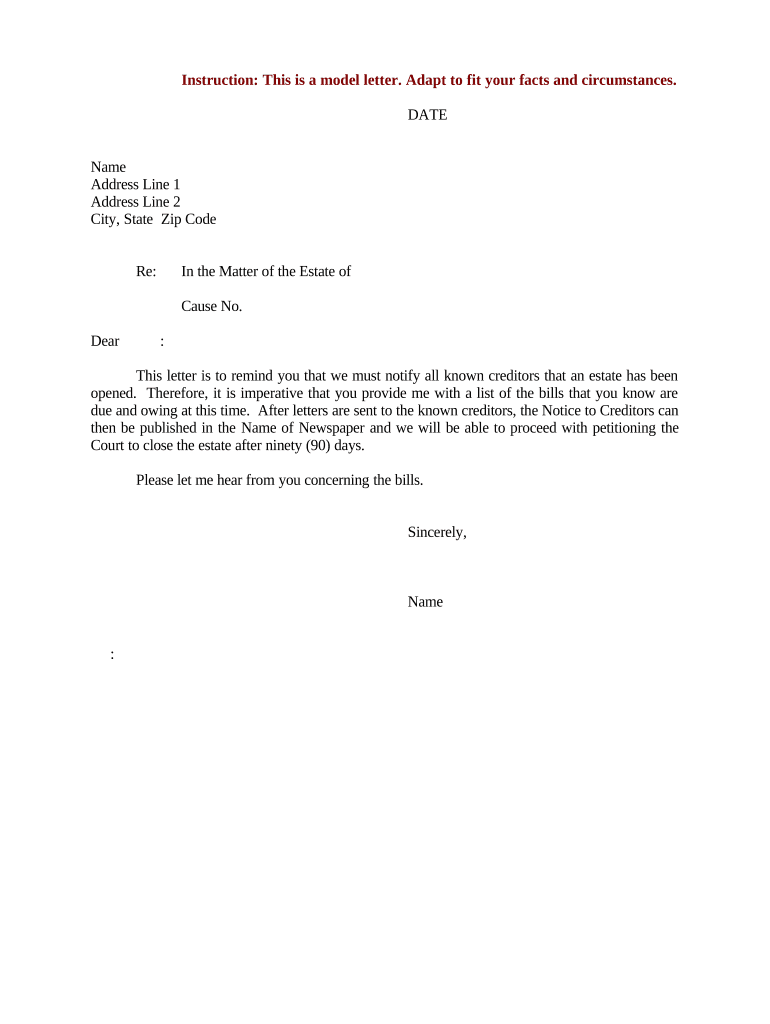
Letter Requesting Notification of Estate Creditors

This template is fully customizable. Edit the text, fill out the fields, and send it for signature. Give it a try!
Letter Requesting Notification of Estate Creditors

What this Letter Is and When it’s Used

A Letter Requesting Notification of Estate Creditors is a formal written request sent by an estate representative (executor, personal representative, or administrator) asking interested parties, potential creditors, and institutions to notify the estate if they have claims against the decedent. The letter helps the estate gather creditor claims, preserve rights to dispute or pay valid obligations, and supports orderly probate administration. It is typically used early in probate or when an estate is being administered outside formal probate to identify unknown claimants and limit future liability exposure.

Why Sending a Notification Request Matters

Sending a timely notification request reduces the risk of surprise claims, helps limit creditor recovery windows, supports accurate estate accounting, and demonstrates good-faith administration under probate rules and fiduciary duties.

Why Sending a Notification Request Matters

Who Typically Prepares and Receives This Letter

Estate representatives prepare the letter; a range of recipients may need to receive it depending on the estate's assets and known liabilities.

  • Banks and custodians — Request account holders to report loans, liens, or outstanding balances.
  • Known creditors and vendors — Ask for written claim details and supporting documentation.
  • Government and benefit providers — Notify Social Security, Medicare, VA, and tax authorities of possible claims.

Proper distribution supports accurate claim evaluation and helps the estate comply with notice requirements under state probate procedures.

Primary Roles and Who Signs

Executor / Administrator

The appointed estate representative who has authority under the will or court appointment to manage estate matters and send creditor notifications on behalf of the estate.

Estate Attorney

A licensed attorney may draft or review the letter to ensure compliance with state probate rules and to add claim-submission instructions and deadlines.

Core Elements to Include in a Professional Letter

A clear, complete letter reduces ambiguity and speeds creditor responses. Include identifying details, estate contact, claim instructions, required documentation, submission deadlines, and a statement of the estate representative’s authority.

Estate ID

Decedent full legal name, date of death, and probate case number if available to ensure claims attach to the correct estate.
Representative Details

Name, address, phone, and email for the executor or personal representative designated to receive creditor communications.

Demand for Notice

A clear request that recipients notify the estate if they assert a debt, claim, or lien, and provide claim details.

Submission Instructions

How to submit claim documentation (mail, email, or e-submission), required attachments, and any required verification of debt.

Claim Deadline

A stated deadline for submitting claims or a reference to applicable state claim periods to set expectations.

Authority Statement

A brief note identifying the sender’s role (executor, administrator) and any probate court appointment or will citation.

Step-by-Step: Preparing and Sending the Letter

Follow these steps to prepare a clear, compliant notification letter and track responses efficiently.

  • 01
    Identify recipients: Compile banks, known vendors, and likely creditors to include in the mailing list.
  • 02
    Draft the letter: Include decedent details, representative contact, submission instructions, and deadline.
  • 03
    Attach documentation: Attach the probate appointment or death certificate if required to prove authority.
  • 04
    Send and record: Deliver by tracked mail, email, or e-submission and log all sends and responses.

How Notification and Claim Intake Typically Flow

A consistent intake process helps estates triage valid claims and document responses for probate court or accounting.

  • Send Notice: Representative mails or emails the notification to identified parties.
  • Claim Submission: Creditors submit documentation and amounts requested per the instructions.
  • Record and Review: Representative logs each claim and reviews supporting evidence for validity.
  • Resolve or Dispute: Estate pays valid claims or disputesa are addressed through negotiation or court resolution.

Configuring an Online Workflow for Claim Responses

Set up a predictable routing and storage workflow so incoming claims are tracked and retrievable during estate administration.

Field Configuration
Email Routing Designate an estate email and set automatic forwarding to executor and counsel
Document Intake Accept PDFs and scanned attachments; require claim form upload
Acknowledgment Auto-send receipt confirmation with next steps within 48 hours
Recordkeeping Store claims in a dedicated folder with date-stamped filenames

Delivery Options and Technology Considerations

Choose delivery channels that preserve evidence (timestamps, delivery receipts) and are acceptable under probate practice.

  • Mail: Certified or tracked mail creates a delivery record accepted by courts.
  • Email: Email provides quick delivery; use read-receipts and require attachments in specified formats.
  • Secure eSubmission: A document portal preserves metadata and centralizes intake for counsel review.

Maintain an index of all outgoing notices and incoming responses so you can produce evidence of notice and timely claim handling if required by probate court.

Key Deadlines and Timing Expectations

Understand statutory and practical deadlines so the estate does not lose rights or incur penalties for late handling of creditor claims.

Statutory Claim Period:

Varies by state; many states impose a one-to-three year claim window against estates.

Response Time Goal:

Aim to acknowledge claims within 14–30 days of receipt to preserve procedural fairness.

Probate Filings:

File inventory and accounting per court schedule; missing filings can delay claim resolution.

Record Retention:

Keep notices and claims for the full retention period applicable to the estate.

Delayed Claims:

Be aware some states allow late claims under narrow equitable exceptions; document all efforts to notify potential creditors.

Milestones in the Notification and Claims Process

A sequential timeline helps you plan notice distribution, review, and final accounting steps for creditor claims.

01

Prepare Notice Packet

Draft letter, attach proof of authority, and compile recipient list for initial distribution.

02

Issue Notices

Send letters via chosen channels and log each dispatch with date and method.

03

Collect Claims

Accept and index incoming claims, verifying documentation and amounts claimed.

04

Finalize Accounting

Resolve valid claims and prepare final estate accounting for court or beneficiary review.

Common Pitfalls to Avoid

  • Incomplete identification — Omitting death date or case number confuses claim attribution.
  • Vague deadlines — Unclear timeframes create disputes over timeliness of claims.
  • Poor recordkeeping — Failing to log notices or responses weakens proof of notice.
  • Improper authority proof — Not attaching probate appointment or death certificate delays verification.

Consequences of Errors or Omitted Notifications

Delayed Administration: Court approval may be delayed, extending estate resolution time.
Unexpected Liability: Unknown creditors could assert late claims that increase estate liabilities.
Court Sanctions: Failing fiduciary duties can lead to surcharge or removal in some jurisdictions.
Increased Costs: Additional legal and administrative expenses to resolve disputed or late claims.
Tax Reporting Errors: Incorrect creditor handling can affect estate tax filings and audits.
Loss of Defenses: Missing statutory notice windows may forfeit the estate's time-based defenses.

Practical Examples of How the Letter Is Used

Two concise examples show common scenarios where a notification letter clarifies claims handling and prevents future disputes.

Probate Estate Example

An executor sends the letter to banks and known vendors to identify outstanding obligations.

  • The letter requests itemized claim details and proof.
  • This reduced surprise claims during accounting and supported the court-approved final distribution by documenting creditor notice and responses.

Small Estate Informal Handling

A personal representative uses the letter when distributing assets outside formal probate.

  • The letter invites creditors to submit claims within a stated timeframe.
  • Clear instructions allowed the representative to settle small debts quickly and limit delayed claims after distribution.

Information Elements to Protect and How

Decedent Identifiers: Full name, SSN last four
Representative Contact: Mailing address, email
Financial Account Details: Account numbers (mask where possible)
Medical Data: Limited PHI; HIPAA applies
Claim Amounts: Monetary figures and invoices
Supporting Documents: Death certificate, probate order

Practical Tips for Clear, Defensible Notices

Adopt consistent formatting and a central intake point to reduce administrative burden and preserve evidence for probate.

Use Clear Identification
Start with decedent name, date of death, and probate case number to avoid misrouting and to link claims to the estate record.
Provide Precise Instructions
Tell claimants exactly what to send, acceptable file formats, and where to deliver their documentation to prevent incomplete submissions.
Log Everything
Maintain a dated ledger of all notices sent and responses received, including method of service and copies of attachments.
Limit Sensitive Data
Share only necessary personal or medical information and use secure channels when transmitting PHI or financial account details.

eSignature Options for Sending and Receiving Claims (vendor comparison)

Compare common eSignature vendor dimensions relevant to sending notices and collecting creditor submissions; signNow is listed first per vendor comparison guidance.

signNow DocuSign Adobe Sign PandaDoc HelloSign
Starting Price $8/user/mo $15/user/mo $14/user/mo $19/user/mo $15/user/mo
Free Trial 7-day free trial Varies Varies Varies Varies
Bulk Send Yes (Premium) Varies Varies Varies Varies
Audit Trail Yes Yes Yes Yes Yes
Envelope Cap No cap 100 envelopes/user/year Varies Varies Varies

Frequently Asked Questions About Creditor Notification Letters

Answers to common operational and legal questions about drafting, sending, and handling responses to creditor notification letters.


Need help? Contact support

be ready to get more
Join over 28 million airSlate SignNow users