Establishing secure connection…Loading editor…Preparing document…

Dation En Paiement Louisiana

This template is fully customizable. Edit the text, fill out the fields, and send it for signature. Give it a try!
Dation En Paiement Louisiana

What Dation En Paiement in Louisiana Is and when it applies

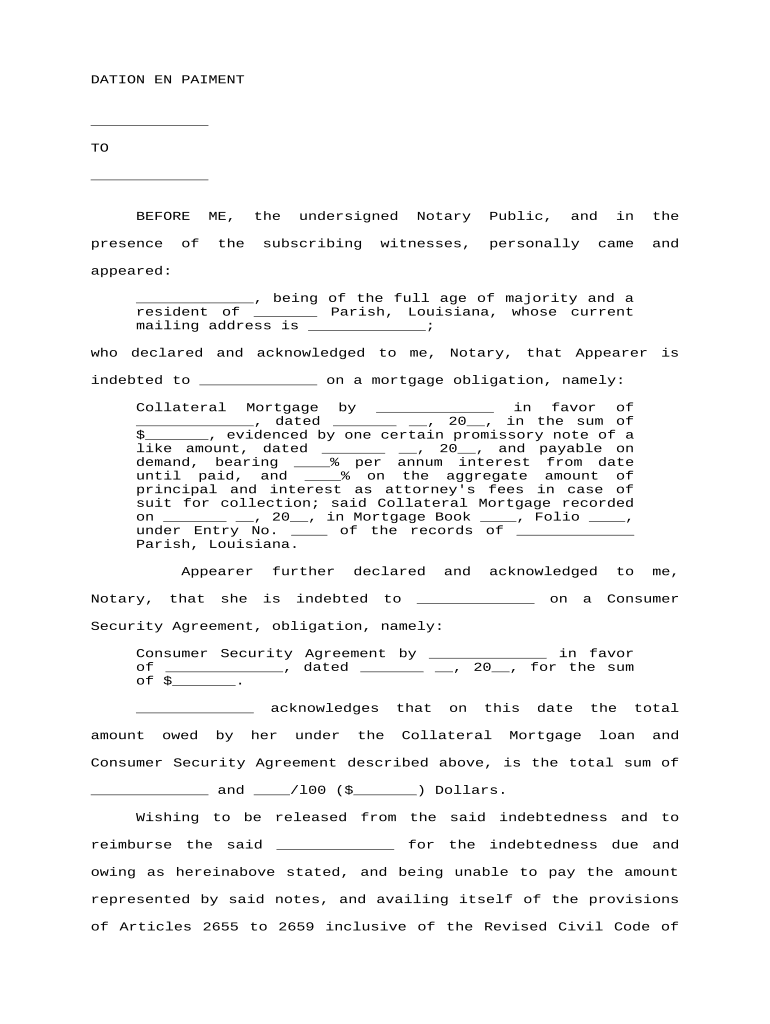
A Dation En Paiement in Louisiana is a civil-law settlement in which a debtor transfers specific property to a creditor in full or partial satisfaction of an obligation. It commonly appears in real estate, business asset settlements, and creditor-debtor restructurings where the parties agree the transferred asset equals the debt. Because Louisiana follows civil-law traditions, notarial form and proper recordation often determine third-party priority and enforceability; parties typically involve counsel and a notary public to prepare the instrument and confirm title transfer.

Why use a Dation En Paiement and the practical benefits

A properly drafted dation can resolve indebtedness without cash, avoid foreclosure or bankruptcy, and clarify creditor rights. It creates certainty by documenting the asset transferred, the consideration or debt forgiven, and any retained obligations, reducing future disputes when notarized and recorded correctly under Louisiana law.

Why use a Dation En Paiement and the practical benefits

Who typically completes or signs this document

In many matters a title search, notarial acknowledgment, and legal review are standard to protect priorities and tax reporting.

  • Secured creditors and lenders seeking to accept collateral instead of pursuing foreclosure or litigation.
  • Debtors or grantors transferring real property, business assets, or other titled property to resolve obligations.
  • Notaries and closing attorneys who prepare the instrument, verify identity, and handle recordation.

Signatory roles and practical responsibilities

Secured Creditor

A creditor accepting property should confirm clear title, obtain a notarial act or deed, and record the transfer to preserve priority; legal review clarifies whether debt is fully satisfied or any deficiency remains.

Debtor / Grantor

The debtor must disclose encumbrances and authorize transfer; signing in notarial form and using the exact legal name avoids mismatch problems and future challenges to the conveyance.

Essential facts to include on the dation instrument

Party Names: Full legal names
Property Description: Accurate legal description
Consideration: Amount or debt forgiven
Effective Date: MM/DD/YYYY format
Notary Acknowledgement: Notary signature and seal
Recordation Details: Parish clerk entry and book/page

Principal risks from incorrect or incomplete dation instruments

Invalid Transfer: Defective form can render transfer void
Priority Loss: Delayed recording can harm creditor priority
Tax Exposure: Unreported transfers may trigger tax liabilities
Title Defects: Undisclosed liens can survive transfer
Fraud Allegations: Insufficient identity proofing invites disputes
Statute Issues: Misdating can affect prescription periods

Common preparation pitfalls to avoid

  • Using informal language for the property description rather than the precise legal description leads to ambiguity and potential rejection by the parish recorder.
  • Failing to include a notarial acknowledgment when Louisiana practice expects notarial form can impair enforceability against third parties.
  • Not performing a title search before acceptance risks taking subject to unseen encumbrances and subsequent creditor challenges.
  • Overlooking tax consequences for the debtor or creditor — record the transaction correctly and consult tax counsel before finalizing.

Step-by-step: completing a Dation En Paiement in Louisiana

Follow these sequential steps to prepare a defensible dation instrument and reduce risk of post-closing disputes.

  • 01
    1. Confirm parties: Verify legal names and authority to sign
  • 02
    2. Describe asset: Insert precise legal description or asset identifiers
  • 03
    3. Specify consideration: State debt amount forgiven or offset
  • 04
    4. Notarize and record: Execute before notary, then record with parish clerk

Where to file or send the completed dation

After execution the document typically travels through a set of standard destinations to complete transfer and preserve rights.

  • Notary Office: Original notarized instrument retained by notary
  • Parish Clerk: Record deed or act in real property records
  • Title Company: Deliver copy for title insurance updates
  • Tax Authorities: File any required property or income reports

Key elements of a professionally drafted dation instrument

A complete dation instrument combines precise conveyance language with provisions addressing debt satisfaction, encumbrances, and post-transfer obligations to reduce future disputes.

Conveyance Clause

Clear statement transferring the identified property from debtor to creditor and the legal basis for the transfer, ensuring the act performs the agreed-for satisfaction of the specified debt.
Consideration Statement

Explicitly state the debt amount forgiven or offset, or a description of the debt being satisfied, to avoid ambiguity about whether the transfer fully extinguishes the obligation.

Encumbrance Disclosure

List known liens, mortgages, or servitudes; specify who will clear encumbrances or whether the creditor accepts the property subject to them.

Representations and Warranties

Debtor representations about title, authority, and absence of undisclosed encumbrances protect the creditor and provide contractual remedies for breach or fraud.

Notarial Formalities

A notary acknowledgment or authentication meeting Louisiana requirements is typically included to permit recordation and satisfy third-party expectations.

Recordation Instructions

Designate the parish clerk office and request prompt recording; the instrument should provide any indexing details required for efficient filing.

Recommended digital workflow settings for online completion

Configure a signing workflow that preserves identity, supports notarization where needed, and creates an auditable record for title and tax purposes.

Field Recommended Setting
Authentication Email + SMS code for signer attribution
Document Format PDF/A for preservation and recordation
Notary Workflow Support RON or in-person notarization depending on parish rules
Recordation Provide a final signed PDF for the parish clerk

Technical and security requirements for electronic handling

Confirm platform capabilities before relying on e-signature or e-notarization for dation instruments.

  • Integrations: Salesforce, NetSuite, Google Workspace
  • File Formats: PDF, DOCX, HTML
  • Security: TLS 1.2/1.3; AES-256 at rest

Typical timing and processing expectations

Timelines depend on notarization, title clearance, and parish clerk processing; allow extra time for title issues or tax reviews.

Execution and Notarization:

Complete signing and notary acknowledgement on the same date where possible

Title Clearance:

Allow several days for title search and lien reconciliation

Recordation:

Record promptly with the parish clerk to protect priority

Tax Reporting:

Report transfers in the applicable tax year when required

Processing Delays:

Expect additional time for RON session retention or complex lien resolution

Practical tips for accurate and efficient completion

Adopt these practices to reduce rework, speed recordation, and lower the risk of future disputes.

Use precise legal descriptions
Copy the property legal description directly from the existing deed or title commitment. Avoid colloquial addresses; imprecise descriptions can prevent clerks from indexing the instrument correctly and may create gaps in chain-of-title continuity.
Run a title search first
Obtain a current title commitment or lien search before accepting property to identify encumbrances. Knowing outstanding mortgages or judgments lets parties allocate responsibility for clearing liens or adjust the dation terms accordingly.
Document debt satisfaction clearly
State whether the dation fully discharges the debt or reduces it by a specified amount, including cross-references to loan numbers or debt instruments to avoid future claims about remaining obligations.
Coordinate notarization and recording
Schedule closing, notarization, and delivery to the parish clerk in a single, coordinated process where feasible; prompt recordation preserves priority and minimizes challenges from competing creditors.

Realistic scenarios showing how dation instruments are used

Two concise examples illustrate common ways a Dation En Paiement resolves obligations and transfers title in practice.

Creditor Accepting Property

A lender and borrower agree the borrower will transfer a residential parcel to extinguish a mortgage debt

  • The lender requires a title search and notarial deed
  • After notarization and parish recording, the lender receives title and the borrower is released from the specified debt, subject to any recorded encumbrances.

Debtor Transferring Business Assets

A company transfers equipment and inventory to a creditor in satisfaction of a business loan

  • Parties list assets, values, and remaining obligations in the instrument
  • With notary acknowledgement and recordation where required, the creditor takes possession and the loan is marked satisfied in accounting records.

Frequently asked questions about Dation En Paiement in Louisiana

Answers to common legal, notarization, and e-signature questions; consult counsel for complex or high-value transfers.


Need help? Contact support

eSignature vendor pricing and feature snapshot for executing Dation En Paiement documents

Compare starting price and basic enterprise features for common eSignature vendors; signNow is listed first for reference.

signNow DocuSign Adobe Sign PandaDoc HelloSign
Starting Price $8/user/mo $15/user/mo $14/user/mo $19/user/mo $15/user/mo
Free Trial Yes, 7-day trial Yes Yes Yes Yes
Bulk Send Yes Yes Yes Yes No
Audit Trail Yes Yes Yes Yes Yes
HIPAA Compliant Yes Yes Yes No No
be ready to get more
Join over 28 million airSlate SignNow users