Establishing secure connection…Loading editor…Preparing document…

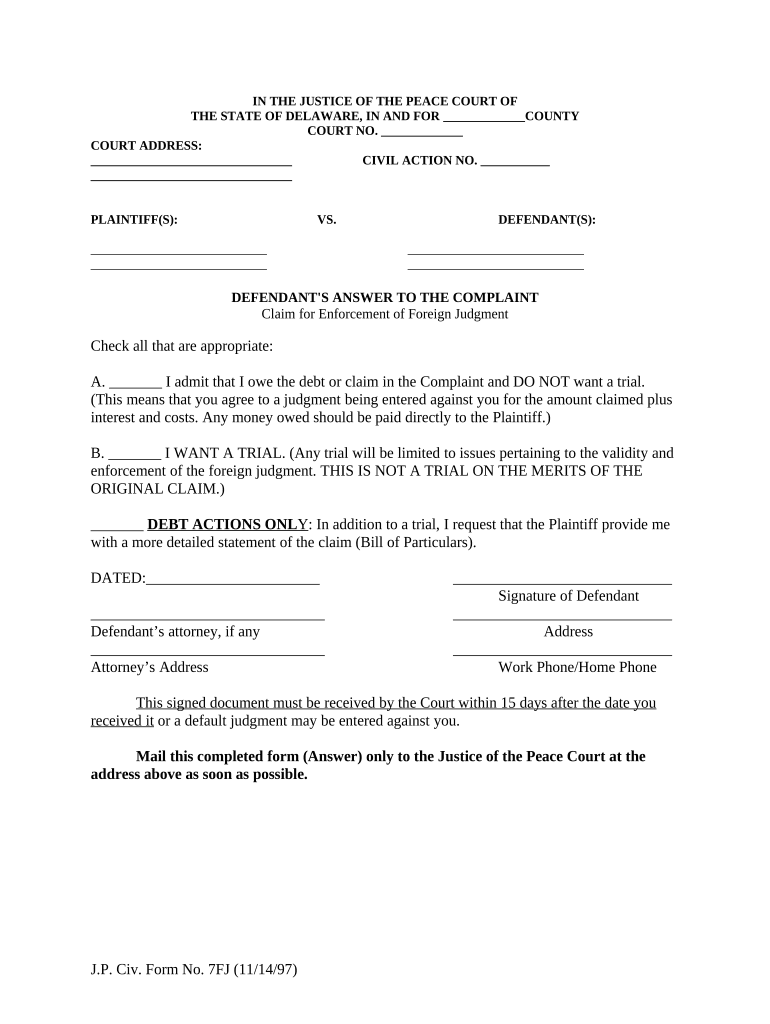
Defendant's Answer to Complaint

This template is fully customizable. Edit the text, fill out the fields, and send it for signature. Give it a try!
Defendant's Answer to Complaint

What a Defendant's Answer to Complaint Is and When it Matters

A Defendant's Answer to Complaint is a formal written response filed by a defendant after being served with a civil complaint. The Answer addresses the plaintiff's numbered allegations by admitting, denying, or stating lack of knowledge, asserts any affirmative defenses, and may include counterclaims or crossclaims. Filing a timely, complete Answer preserves defenses, avoids default judgment, and establishes the defendant's factual and legal positions for discovery and motion practice. The Answer becomes part of the court record and must conform to the court's local rules and applicable procedural statutes.

Why a Proper Answer Matters to Your Case

Filing a clear, timely Answer protects procedural rights, prevents an automatic default, and frames the disputed facts and legal defenses. A compliant Answer also starts the litigation timeline and enables access to discovery and dispositive motion opportunities.

Why a Proper Answer Matters to Your Case

Who Prepares and Uses a Defendant's Answer

Defendants, defense counsel, paralegals, and in limited cases self-represented litigants prepare Answers to complaints to respond to allegations and preserve legal defenses.

  • Civil defense attorneys and law firms managing client litigation and case strategy.
  • In-house legal teams and compliance officers handling corporate litigation responses.
  • Self-represented defendants completing pro se filings in state or federal court.

The specific drafter depends on case complexity and jurisdictional practice; counsel is common when affirmative defenses or counterclaims are involved.

Core Components of a Professional Defendant's Answer

A complete Answer follows court formatting rules and contains several discrete sections that organize responses and defenses clearly for the judge, the clerk, and opposing counsel.

Caption

Court name, docket number, party names, and a short title identifying the document as Defendant's Answer to Complaint; complies with local court caption format.
Admissions / Denials

Numbered responses corresponding to each allegation in the complaint, specifying whether each allegation is admitted, denied, or that the defendant lacks sufficient knowledge to admit or deny.

Affirmative Defenses

Concise numbered defenses (e.g., statute of limitations, failure to state a claim) that, if proven, defeat or limit plaintiff's recovery irrespective of admitted facts.

Counterclaims / Crossclaims

Optional section asserting any claims the defendant has against the plaintiff or co-defendants; includes demand for relief, factual basis, and jurisdictional allegations.

Prayer for Relief

A brief statement of the relief sought by the defendant, which may include dismissal, costs, fees, or other appropriate remedies.

Signature Block

Attorney or pro se defendant signature, typed name, bar number if applicable, address, telephone, email, and date; include certificate of service attesting to how parties were served.

Step-by-Step: Preparing and Filing Your Answer

Follow this practical sequence to draft, review, and file a compliant Answer with appropriate service and proof.

  • 01
    Review Complaint: Read each allegation and note deadlines for response.
  • 02
    Draft Responses: Prepare numbered admissions/denials and affirmative defenses.
  • 03
    Add Supporting Exhibits: Attach any documents referenced in counterclaims or defenses.
  • 04
    File and Serve: File with the court and serve opposing counsel per local rules.

Where to File and How the Submission Process Works

Know the correct filing destination and required service method for your jurisdiction to ensure timely acceptance and proper notice to the plaintiff.

  • Court Clerk: File the Answer with the clerk in the court listed on the complaint.
  • E-Filing Portals: Use the court's e-file system where available, following required PDF and format rules.
  • Service on Parties: Serve the plaintiff and counsel by the method required under local rules or FRCP.
  • Proof of Service: File a certificate of service showing date and method of service.

Configuring an Online Workflow to Draft and File an Answer

Set up a repeatable digital workflow to populate standard fields, collect signatures, attach evidence, and route filings to court and opposing counsel.

Upload Document Start with complaint and court caption to populate fields.
Place Response Fields Add numbered answer fields, signature, and date boxes.
Authentication Select signer authentication (email, SMS, or advanced methods).
Attach Exhibits Include exhibits as separate attachments with clear labels.
e-File Package Export PDF per court specs and submit via e-filing portal.

Technical Considerations for Digital Signing and eSubmission

Confirm file format, signature method, and authentication before electronic filing to meet court and opposing party expectations.

  • Supported Formats: PDF, DOCX
  • Integrations: CM/ECF and cloud storage connectors
  • Authentication: Email, SMS, or advanced signer verification

Ensure the chosen eSignature and e-filing tools produce court-ready PDFs with a complete audit trail and allow export of signed copies for your records.

Typical Deadlines and Timing Rules for Filing an Answer

Deadlines vary by jurisdiction; federal practice provides a standard reference for timing while states may set alternative schedules or extensions.

Federal Answer Deadline:

21 days from service (FRCP 12(a)(1)(A)(i)).

Extended Deadlines:

30–60 days when service is waived or as state rules allow.

Motion to Dismiss Timing:

Motion may be filed in lieu of an answer under FRCP timing rules.

Default Judgment:

Plaintiff may seek default after failure to answer within deadline.

Certificate of Service:

File with the answer to document how parties were served.

Key Litigation Milestones After Service

A typical sequence from service through responsive pleading and early motions sets the litigation timeline and triggers discovery readiness.

01

Service Completed

Plaintiff serves complaint and summons on defendant.

02

Draft and Review

Defendant prepares Answer, defenses, and potential counterclaims.

03

File and Serve

Defendant files Answer with court and serves all parties.

04

Early Motions

Parties may file motions to dismiss or for judgment as appropriate.

Common Preparation Mistakes to Avoid

  • Missing the deadline by relying on incorrect service date can lead to default judgment or waiver of defenses.
  • Using non-specific affirmative defenses with no factual support invites motion practice and possible striking of defenses.
  • Failing to serve all parties correctly or omitting certificate of service can cause clerical rejection or procedural sanctions.
  • Submitting exhibits without clear labels or redactions risks confidentiality breaches and evidentiary disputes.

Consequences of an Incorrect or Late Answer

Default Judgment: Risk of plaintiff obtaining judgment by default.
Sanctions: Potential court sanctions for procedural violations.
Waived Defenses: Certain defenses may be forfeited if not timely raised.
Adverse Procedure: Loss of opportunity for immediate discovery or counterclaims.
Financial Exposure: Judgment may include damages, costs, and attorney fees.
Jurisdiction Issues: Improper service responses may leave jurisdiction in doubt.

Comparing eSignature Vendors for Preparing and Signing an Answer

Cost and features vary; signNow appears first for quick comparison. Confirm plan details and court compatibility before committing to a provider.

signNow DocuSign Adobe Sign PandaDoc HelloSign
Starting Price $8/user/mo $15/user/mo $14/user/mo $19/user/mo $15/user/mo
Free Trial 7-day trial Varies by plan Varies by plan Varies by plan Varies by plan
Bulk Send Yes Yes Yes Yes No
Audit Trail Yes Yes Yes Yes Yes
HIPAA Compliant Yes Yes Yes No No
Envelope Cap No cap 100 envelopes/user/year Varies Varies Varies

Frequently Asked Questions About the Defendant's Answer

Common questions cover timing, service, e-signature validity, amendments, and what happens if an answer is late.


Need help? Contact support

be ready to get more
Join over 28 million airSlate SignNow users