Establishing secure connection…Loading editor…Preparing document…

Demand Letter

This template is fully customizable. Edit the text, fill out the fields, and send it for signature. Give it a try!
Demand Letter

What a Demand Letter Is and when it's used

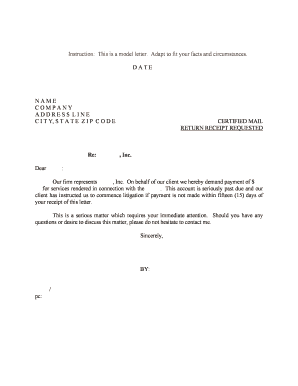
A Demand Letter is a formal, written notice from a claimant to a recipient asserting a legal or contractual right and requesting specific action, such as payment, cure of a breach, or return of property. It commonly precedes litigation and documents the claim, the factual basis, the amount or remedy sought, and a deadline for response. In the United States a carefully drafted Demand Letter can support settlement efforts, preserve evidence, and help toll or clarify statute of limitations issues when paired with correct service methods and timing.

Why a Demand Letter Matters

A Demand Letter clarifies the claim, provides a documented settlement opportunity, and can reduce litigation costs by prompting negotiation. It preserves key facts and shows intent to resolve the dispute, creating a formal record that may be admissible or relied upon in later proceedings.

Why a Demand Letter Matters

Who typically prepares and receives Demand Letters

Demand Letters are used across individuals, businesses, and legal professionals as the first formal step to resolve disputes without court involvement.

  • Individual claimants seeking unpaid wages, deposits, or consumer damages.
  • Businesses enforcing contracts, invoices, or service agreements.
  • Attorneys sending formal notices before filing suit or negotiating settlements.

Typical signers and preparers

Individual Claimant

A non‑business individual often drafts a demand letter to request payment or return of property. The letter should state facts, attach supporting documents, and include a clear remedy and response deadline to demonstrate reasonable effort to resolve the dispute prior to litigation.

Business Representative

A company officer or authorized agent may prepare a demand letter for breach of contract or unpaid invoices. Corporate letters usually cite contractual clauses, attach invoices or delivery records, and designate an authorized contact for settlement discussions or payment instructions.

Core components every professional Demand Letter should include

A structured Demand Letter improves clarity and enforceability. Include identifying information, a concise statement of facts, the legal or contractual basis for the claim, the specific relief requested, supporting evidence, and a reasonable deadline to respond.

Sender details

Full legal name, title, company (if applicable), contact phone, physical address, and email so the recipient can verify the source and respond directly.
Recipient details

Full legal name and address of the party being demanded of; include a service address for certified mail or a designated email for e-delivery.

Statement of facts

A short, chronological account of events and dates that led to the claim, avoiding argumentative language and focusing on verifiable facts and document references.

Legal basis

Cite the contract section, statute, or legal theory supporting the claim; identify the specific breach or actionable conduct being alleged.

Relief requested

Specify the exact remedy sought (dollar amount, action to cure, return of property) and provide calculations or supporting documents for monetary claims.

Response deadline

Set a clear deadline for response or performance, state consequences of noncompliance, and provide acceptable methods for delivery or payment.

Essential information fields to include

Full names: Claimant and recipient full names
Addresses: Physical and service addresses
Claim amount: Exact dollar amount claimed
Dates: Relevant incident and demand dates
Supporting docs: Invoice or contract identifiers
Signature: Signer name, title, and date

Step-by-step: drafting and sending a Demand Letter

Follow a consistent sequence to draft, validate, deliver, and retain the Demand Letter to preserve legal rights and support negotiation.

  • 01
    Draft: Assemble facts, cite law or contract, and attach key documents.
  • 02
    Set deadline: Choose a reasonable date and state consequences of nonresponse.
  • 03
    Deliver: Send via certified mail, courier, or eSignature with receipt.
  • 04
    Document: Keep proof of delivery, signed copies, and communication logs.

Configuring an online Demand Letter workflow

Configure fields, signatures, and routing to ensure consistent notices and auditable delivery when using an electronic workflow.

Field Configuration
Deadline field Auto-calc response date based on template interval
Signature field Require signer name and date; optional witness
Attachments Attach invoice, contract, and photos as PDF
Routing Send to recipient then copy to claimant

Where to send or file a Demand Letter

Choose a delivery method that creates a reliable record and meets any service or contractual notice requirements.

  • Certified mail: Postal proof of delivery and return receipt
  • Courier service: Trackable delivery with recipient signature
  • Email with read receipt: Use only if contract permits electronic notice
  • eSignature delivery: Signed receipt and audit trail from eSign platform

Digital signing and technical requirements

Electronic delivery should include authentication, an audit trail, and tamper-evident signed files to support admissibility.

  • Integrations: Salesforce, NetSuite, Google Workspace
  • Formats: PDF, DOCX, and printable archives
  • Security: AES-256 storage, TLS transit encryption

Common timing and deadline considerations

Deadlines affect remedy options, statute of limitations, and contract notice requirements. Set clear dates and confirm acceptable delivery methods in the letter.

Typical cure period:

10–30 days depending on claim

Statute of limitations:

Varies by claim and state

Tax reporting triggers:

Reportable amounts may require 1099 reporting

RON or notarization:

Required only if document calls for notarized acknowledgment

Retention of proof:

Keep delivery evidence indefinitely

Common mistakes to avoid when preparing a Demand Letter

  • Using vague language about the claim or amount, which undermines enforceability and clarity.
  • Failing to attach or reference supporting documentation such as invoices or contracts.
  • Sending to an incorrect legal entity name or address, causing service defects.
  • Omitting a clear deadline or permissible methods for response, which can delay remedies.

Risks and consequences of an incorrect Demand Letter

Statute risk: Loss of tolling
Waiver risk: Unintended release language
Service failure: Defective notice
Evidence gaps: Missing attachments
Increased costs: Additional attorney fees
Tax exposure: 1099 backup withholding

eSignature vendor pricing and features for sending Demand Letters

Compare starting prices and basic capabilities relevant to secure delivery and signing of Demand Letters; signNow is listed first per vendor comparison practice.

signNow DocuSign Adobe Sign PandaDoc HelloSign
Starting Price $8/user/mo $15/user/mo $14/user/mo $19/user/mo $15/user/mo
Free Trial 7-day trial Varies by plan Varies by plan Varies by plan Varies by plan
Bulk Send Yes Yes Yes Yes No
Audit Trail Yes Yes Yes Yes Yes
HIPAA Compliant Yes Yes Yes No No

Frequently asked questions about Demand Letters

Answers address common legal and practical questions about drafting, sending, and preserving Demand Letters in the United States.


Need help? Contact support

be ready to get more
Join over 28 million airSlate SignNow users