Establishing secure connection…Loading editor…Preparing document…

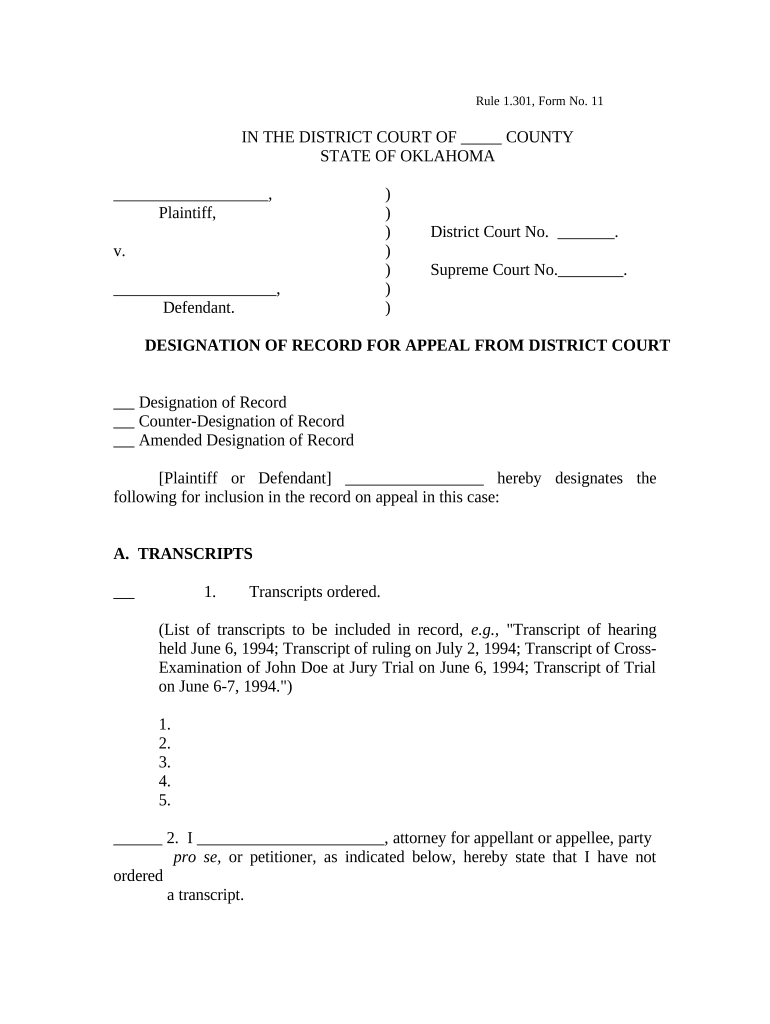
Oklahoma Designation of Record for Appeal

This template is fully customizable. Edit the text, fill out the fields, and send it for signature. Give it a try!
Oklahoma Designation of Record for Appeal

What the Oklahoma Designation of Record for Appeal Is

The Oklahoma Designation of Record for Appeal is a procedural filing that identifies which trial-court documents, exhibits, transcripts, and pleadings will form the appellate record. It tells the clerk and opposing parties which materials to transmit or include when the case proceeds to an appellate court, and it helps avoid disputes about what the court may review on appeal.

Why a Clear Designation Matters for an Appeal

A correct designation prevents evidence from being omitted, clarifies the scope of review, and speeds appellate processing by ensuring all parties and the clerk know which items are required for the record.

Why a Clear Designation Matters for an Appeal

Who Prepares and Uses a Designation of Record

This form is prepared by the appellant or the appellant's counsel to specify documents for transmission to the appellate court.

  • Appellants and counsel — Drafts the list and certifies completeness for appeal.
  • Respondents and counsel — Review the list and request corrections if items are missing.
  • Court clerks and reporters — Use the designation to prepare and file the physical or electronic record.

Stepwise: How to Prepare and File the Designation

Follow these steps to complete the form, serve opposing parties, and file with the appropriate clerk so the appellate record is prepared correctly.

  • 01
    Gather Documents: Collect pleadings, orders, exhibits, and transcripts to consider for inclusion.
  • 02
    Draft the List: Precisely identify each item using dates and exhibit labels.
  • 03
    Serve Opposing Parties: Provide a copy to counsel for respondents per local rules and proof of service requirements.
  • 04
    File with Clerk: Submit the designation to the trial or appellate clerk within the time allowed by court rules.

Typical Routing: From Filing to Appellate Record Assembly

Understand the usual flow so you can track progress and confirm that the clerk has received everything needed for the appeal.

  • Filing: Appellant files designation with trial or appellate clerk.
  • Service: Appellant serves opposing counsel and proof of service is filed.
  • Reporter Notice: Court reporter assembles requested transcripts; billing and ordering instructions follow local rules.
  • Record Assembly: Clerk compiles documents and transcripts into the official appellate record.

How to Configure an Electronic Designation Workflow

If you prepare and send designations electronically, set up a clear workflow for drafting, approvals, and delivery to the clerk and opposing counsel.

Field Configuration
Authoring Template with required fields to ensure consistency
Signer Authentication Email + name verification; add stronger auth for counsel if required
Service Tracking Automatic certificates of service and delivery logs
Archive Store signed copy and audit trail in case management

Digital Filing and eSubmission Considerations

Electronic submission saves time but requires adherence to court e-filing rules and secure handling of confidential materials.

  • File Formats: PDF/A preferred for long-term preservation
  • Security: Use TLS 1.2/1.3 in transit and AES-256 at rest
  • Integrations: Connect with document management and e-filing systems

Timing: Typical Deadlines and When to Act

Deadlines vary by state and by appellate court; verify local appellate rules. Commonly check the time to file notice of appeal, designation, and transcript requests.

Notice of Appeal:

Often required within 30 days of final judgment; confirm local rule.

Designation Filing:

Usually due shortly after notice of appeal; timing varies by jurisdiction.

Transcript Ordering:

Order transcripts early; reporters need time to prepare them.

Service on Parties:

Serve opposing counsel when filing and file proof of service.

Clerk Assembly:

Clerk will set schedule for record completion after receiving materials.

Common Pitfalls to Avoid

  • Vague descriptions — failing to identify exhibits by date or label invites disputes from the court and opposing counsel.
  • Late transcript orders — waiting to request reporters can delay the appellate record and extend deadlines.
  • Missing proof of service — failing to file proof that opposing counsel was served can jeopardize acceptance.
  • Incorrect case caption or number — clerks may reject filings that do not match the docket exactly.

Consequences of an Incorrect or Incomplete Designation

Record Exclusion: Appellate court may exclude documents not properly designated
Delay: Incomplete designations can cause continuances and extra costs
Sanctions: Courts may impose sanctions for bad-faith or frivolous filings
Waiver: Failure to include items can waive review of some issues
Increased Costs: Additional copying, certification, and reporter fees may be required
Procedural Default: Missing deadlines may result in dismissal of the appeal

Required Information and Security Considerations

Case Caption: Full caption
Case Number: Trial court number
Party Names: Appellant and respondent
Document List: Specific pleadings/exhibits
Transcripts: Dates and reporters
Certification: Signature, date, contact

Key Components of a Professional Designation Package

A complete package reduces disputes and speeds assembly. Include the designation form, certified copies of orders, transcripts, exhibit indices, proof of service, and a signed certification from counsel or the party.

Designation Form

A clear, itemized list of documents and exhibits requested for the appellate record, with dates and identifiers.
Transcripts

Ordered transcripts with specified trial dates and portions to be transcribed; include reporter contact and billing details.

Exhibit Index

Index mapping exhibit numbers to document descriptions and trial references to simplify clerk review.

Certified Copies

Certified copies of judgments or orders that are central to the appeal and must be in the record.

Proof of Service

Filed proof showing opposing counsel was served with the designation and supporting materials per rule.

Signature Block

Signed certification by counsel or appellant confirming completeness and accuracy of the designated items.

Real-World Examples: How Designations Are Used

Two practical scenarios show common approaches and outcomes when preparing the record for appeal.

Civil Appeal Example

A plaintiff-appellant listed trial exhibits and two hearing transcripts by date

  • The appellant ordered transcripts immediately
  • As a result the clerk compiled the record within the court’s schedule and avoided a continuance for missing pages.

Criminal Appeal Example

Defense counsel designated the full trial transcript and motion hearing exhibits

  • Counsel certified no additional exhibits existed
  • The appellate court accepted the record and proceeded on briefing without supplemental filings.

eSignature Provider Comparison for Completing and Delivering the Form

When using an eSignature provider to prepare, sign, and deliver the designation, compare basic plan pricing, trial options, bulk send, audit trail, and HIPAA availability to match court and privacy needs.

signNow DocuSign Adobe Sign PandaDoc HelloSign
Starting Price $8/user/mo $15/user/mo $14/user/mo $19/user/mo $15/user/mo
Free Trial 7-day free trial Varies Varies Varies Varies
Bulk Send Yes Yes Yes Yes No
Audit Trail Yes Yes Yes Yes Yes
HIPAA Compliant Yes Yes Yes No No

FAQs: Troubleshooting Common Issues with the Designation

Answers to frequent questions about signing, filing, correcting, and serving a designation of record for appeal.


Need help? Contact support

be ready to get more
Join over 28 million airSlate SignNow users