Establishing secure connection…Loading editor…Preparing document…

Investment Bond Form

This template is fully customizable. Edit the text, fill out the fields, and send it for signature. Give it a try!
Investment Bond Form

What the Investment Bond Form Is and when it’s used

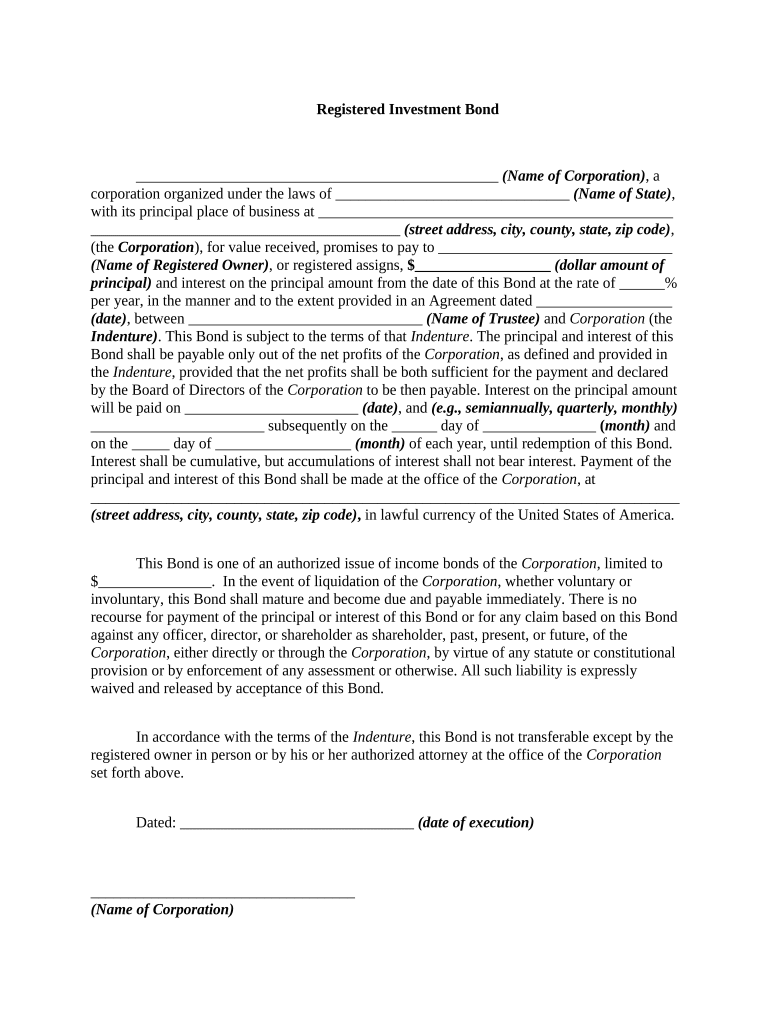
The Investment Bond Form documents a guarantee that secures performance, repayment, or other obligations tied to an investment transaction. It records parties (issuer, obligee, beneficiary), the bond amount, effective date, duration, key conditions for payout, and any collateral or security arrangements. In many commercial, construction, and financial contexts the form supports claims, indemnity, or compliance obligations and is used alongside purchase agreements, escrow instructions, or regulatory filings. Proper completion ensures clarity about liabilities and preserves enforceability under contract and securities rules.

Why a clear Investment Bond Form matters

A precise Investment Bond Form reduces disputes by setting clear obligations, timelines, and remedies; it supports enforceability under ESIGN and UETA when executed electronically and protects parties from avoidable claim denials or regulatory issues.

Why a clear Investment Bond Form matters

Typical users and stakeholders

Different professionals complete or rely on the Investment Bond Form depending on the transaction and industry.

  • Issuing entities and underwriters who guarantee repayment or performance on behalf of a principal party.
  • Beneficiaries and investors who rely on the bond as a remedy or payment source in default.
  • Legal counsel and compliance teams who draft bond language and verify enforceability.

Parties should coordinate early — issuer, beneficiary, counsel, and any trustee — to confirm required fields, authentication, and supporting attachments.

Essential sections to include in a professional form

A complete Investment Bond Form groups identification, monetary terms, obligations, proof and remedies, authentication, and any collateral or special conditions into clear labeled sections to avoid ambiguity in claims and enforcement.

Parties

Full legal names and entity types for issuer, obligee, beneficiary and any agent; include EIN or tax identifier when applicable to prevent disputes.
Bond Amount

Specify numeric and written amount, currency, and any tiered limits or caps; include calculation method for adjustable bonds.

Term & Dates

State effective date, expiration, and any renewal or call provisions; note whether obligations survive termination.

Obligations

Describe the triggering events, conditions precedent, claim procedure, and required documentation to make a valid claim.

Security

Identify collateral, escrow instructions, subordination terms, or third-party guarantors and how security is released.

Authentication

Signature blocks, notarization or RON instructions if required, witness lines and a field for an audit trail or electronic certificate.

Step-by-step: filling and finalizing the Investment Bond Form

Follow these steps to prepare, authenticate, and distribute a legally sound Investment Bond Form.

  • 01
    Gather documents: Collect IDs, incorporation documents, collateral schedules, and related agreements.
  • 02
    Complete form: Fill party names, bond amount, dates, and triggering conditions accurately.
  • 03
    Authenticate: Obtain required signatures, notarization, or RON session as specified.
  • 04
    Distribute copies: Send executed copies and retain audit trails for all parties.

Typical routing and processing flow

A straightforward routing path reduces delays: preparation, review, signature, notarization (if required), and retention.

  • Prepare: Author completes the draft with attachments and schedules.
  • Review: Legal and compliance review clauses and remedies.
  • Sign: Parties sign electronically or in person; collect initials where needed.
  • Record: Notarize or RON if required; store final copy with audit trail.

Configuring an electronic workflow for this form

Set up fields, authentication, and routing to match the bond’s required approvals and any notarization steps.

Field Configuration
Signature Type eSignature with audit trail or wet signature selection
Authentication Email link with optional SMS code or KBA for higher assurance
Notary Enable RON session or in-person notarization step where state law requires it
Routing Sequential or parallel signer order with conditional branching

Technical and integration considerations

Choose a platform that supports required authentication, audit trails, and integrations with your systems.

  • Integrations: Connect to CRM, document storage, or ERP for automatic record keeping
  • File formats: Accepts PDF, DOCX, and preserves form layout during signing
  • Authentication: Supports email, SMS, KBA, and advanced signer verification

Ensure chosen tools meet regulatory needs (HIPAA, 21 CFR Part 11 if applicable) and retain a verifiable audit trail for enforcement and compliance reviews.

Key timing elements and common deadlines

Track effective dates, claim windows, and retention obligations so rights and remedies remain available when needed.

Effective Date and Term:

Specify when the bond begins and when it expires or auto-renews.

Claim Window:

State the period within which a beneficiary must submit a claim under the bond.

Notarization Timing:

Complete notarization or RON before the effective date if required by the obligee.

Regulatory Filings:

File any required notices or attachments by dates specified in governing contracts.

Record Retention:

Retain executed copies per applicable retention rules and statute of limitations.

Security, encryption, and compliance essentials

In transit: TLS 1.2/1.3 encryption
At rest: AES-256 encryption
Audit Trail: Comprehensive signing metadata retained
Certifications: SOC 2 Type II and ISO 27001
HIPAA: BAA available where required
21 CFR Part 11: Support for regulated recordkeeping

Common mistakes that delay or void a bond

  • Using informal or abbreviated legal names causes identity disputes and may require costly corrections or re-execution.
  • Entering inconsistent amounts (numeric vs written) creates ambiguity that can lead to claim denial or litigation.
  • Failing to notarize or follow RON rules where required leaves the bond unenforceable in some jurisdictions.
  • Omitting supporting schedules, collateral descriptions, or required attachments leads to administrative rejection or incomplete security.

Consequences of incorrect or incomplete forms

Claim denial: Incorrect forms may cause beneficiaries to lose claim rights
Contract breach: Issuer may face breach claims and damages
Regulatory fines: Failure to meet filing requirements can incur penalties
Tax exposure: Misreporting tied to bond payments may trigger IRS review
Delay costs: Re-execution adds time and expense
Reputational risk: Disputes harm business relationships

Comparing eSignature options that support Investment Bond Forms

This table summarizes common pricing and capability points; confirm current plan details directly with each vendor before procurement.

signNow DocuSign Adobe Sign PandaDoc HelloSign
Starting Price $8/user/mo $15/user/mo $14/user/mo $19/user/mo $15/user/mo
Free Trial 7-day free trial Varies Varies Varies Varies
Bulk Send Yes Yes Yes Yes No
Audit Trail Yes Yes Yes Yes Yes
HIPAA Compliant Yes Yes Yes No No
Envelope Cap No cap 100 envelopes/user/year Varies Varies Varies

Real-world examples of bond form use

Practical examples show how different organizations prepare, sign, and manage Investment Bond Forms in live workflows.

Optica Ventures LLC

A venture firm needed a simple online guarantee form for co-investments to reduce turnaround time.

  • They required a reliable audit trail for investor acceptance.
  • 'The interface is simple and easy-to-use for our team; more importantly, it is just as easy for our customers.'

Martin Properties

A real estate operator used electronic bonds to secure escrow obligations on closings.

  • They required mobile signing and notarization support.
  • 'I can process and execute all of these documents online with 100% compliance and built-in security. Whether on mobile or working offline, I can get forms back to their necessary parties efficiently.'

Practical tips for accurate and efficient completion

Follow these best practices to minimize delays and strengthen enforceability of the Investment Bond Form.

Verify identities
Confirm signers’ legal names and matching IDs before execution to avoid re-execution or rejection.
Use clear amounts
Enter both numeric and written bond amounts and clarify currency and rounding rules.
Attach exhibits
Include collateral schedules, escrow instructions, and any referenced agreements as attachments.
Preserve audit trail
Retain timestamps, IP addresses, and notarization or RON session recordings when available.

Frequently asked questions about the Investment Bond Form

Answers to common questions about execution, notarization, electronic signing, and retention for Investment Bond Forms.


Need help? Contact support

be ready to get more
Join over 28 million airSlate SignNow users