Establishing secure connection…Loading editor…Preparing document…

E-Commerce Vendor Agreement

This template is fully customizable. Edit the text, fill out the fields, and send it for signature. Give it a try!
E-Commerce Vendor Agreement

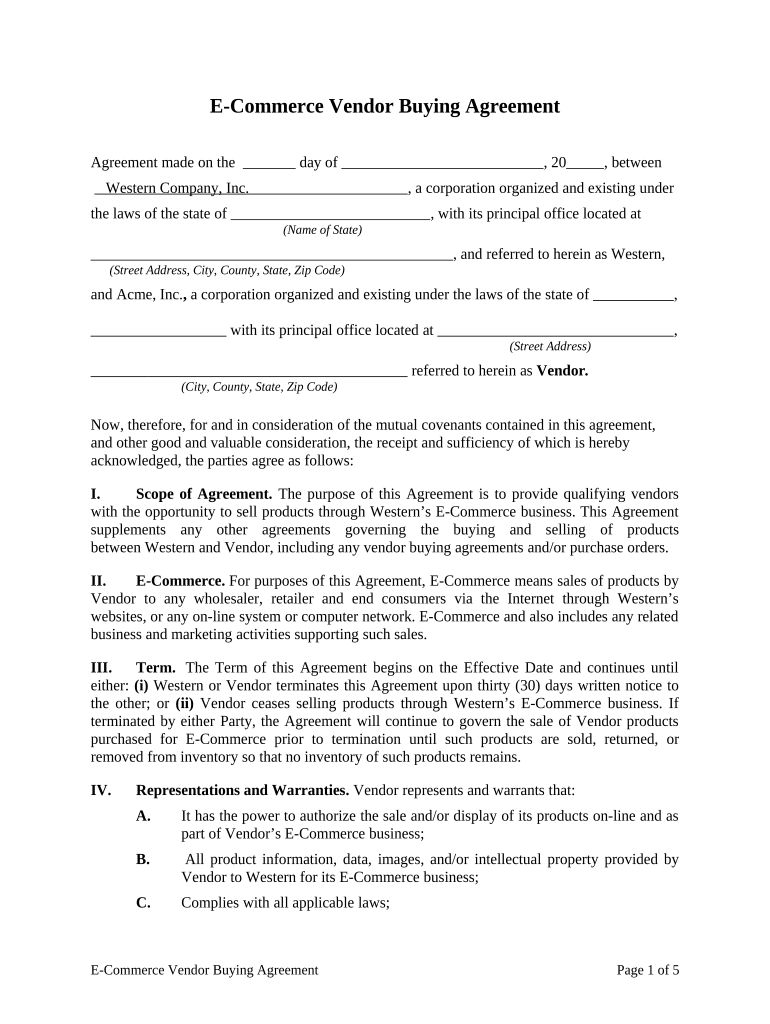
What an E-Commerce Vendor Agreement Is and Why It Matters

An E-Commerce Vendor Agreement is a written contract that defines the commercial relationship between an online marketplace or platform and a third‑party vendor. It sets out the services or products to be supplied, pricing and payment terms, responsibilities for shipping and returns, data protection and intellectual property rights, dispute resolution, and termination mechanics. For U.S. transactions the agreement should also address tax documentation, compliance with ESIGN and UETA where electronic execution is used, and whether any notarization or witness acknowledgment is required for particular clauses.

Why a Clear Vendor Agreement Reduces Risk

A well-drafted E-Commerce Vendor Agreement clarifies each party’s obligations, limits liability exposure, and establishes dispute resolution and payment processes to reduce operational friction and legal uncertainty.

Why a Clear Vendor Agreement Reduces Risk

Who Typically Prepares and Signs This Agreement

Platform operators, procurement and vendor management teams, and legal counsel commonly prepare or review vendor agreements before onboarding third-party sellers.

  • Marketplace operators and vendor managers responsible for onboarding and compliance
  • Small business owners and individual sellers supplying products or services online
  • Corporate legal and finance teams approving commercial and tax provisions

Core Sections to Include in a Professional Agreement

A complete E-Commerce Vendor Agreement groups expectations into logical sections to reduce ambiguity and support operational enforcement across listings, payments, returns, data handling, and disputes.

Parties

Identify the contracting legal entities and include DBA names, state of formation, and primary contact details to ensure contractual attribution and tax reporting align.
Scope

Define permitted products/services, listing responsibilities, pricing controls, approved territories, and any prohibited items or category restrictions to prevent downstream disputes.

Payment Terms

Specify payment schedule, invoice timing, chargebacks, fees retained by the platform, currency, and any required tax documentation such as W-9 or IRS forms.

Term & Termination

State the initial term, renewal rules, termination for convenience or cause, cure periods, and post-termination obligations such as inventory removal or settlement.

IP & Data

Allocate intellectual property rights, license grants for product content and images, and data handling obligations including consumer personal data and analytics feeds.

Liability & Indemnity

Limit liability, set indemnity scope for third-party claims, and clarify insurance requirements and caps on recoverable damages where permitted by law.

Essential Fields to Capture in the Agreement

Vendor Legal Name: Exact registered entity name
Tax Identification: EIN or SSN for IRS reporting
Payment Details: Bank account or payment processor info
Primary Contact: Name, phone, email
Product Catalog: SKUs or service descriptions
Insurance Certificates: Types and coverage limits

Step-by-Step: Completing the Vendor Agreement

Follow this sequence to prepare, execute, and archive a compliant agreement that supports onboarding and audit readiness.

  • 01
    Prepare: Collect vendor legal name, TIN, contact and bank details.
  • 02
    Customize: Confirm payment, returns, shipping, and service-level clauses.
  • 03
    Execute: Obtain authorized signatures and any required attestations.
  • 04
    Store: Save executed files and capture an audit trail.

Where To Send and How to Route Executed Agreements

Routing depends on whether the platform uses an internal vendor portal, a contract lifecycle system, or email-based exchange; plan the flow before execution.

  • Vendor Portal: Upload executed PDF to the vendor’s dashboard.
  • Email Archive: Send signed copies to finance and legal inboxes.
  • Contract Repository: Store master copy in centralized CLM or document storage.
  • Accounting Entry: Record payment terms and vendor as a payee.

How to Configure an Online Completion Workflow

Configure fields, signer roles, reminders, and retention settings when building the online template to support repeatable onboarding.

Field Configuration
Vendor Name Field Required text field, auto-validate with Magic field
Signature Block Signer role set to Vendor Authorized Signatory
Tax ID Field Masked field, required format digits only
Payment Terms Selector Conditional field showing net terms when selected

Digital Signing and Integration Considerations

Confirm platform requirements for file formats, authentication strength, and integration endpoints before sending documents for signature.

  • File Formats: PDF, DOCX, and HTML supported
  • Authentication: Email, SMS, or stronger methods available
  • Integrations: CRM and ERP connectors recommended

Comparing eSignature Vendors for Vendor Agreement Workflows

Key vendor differences include starting price, trial availability, bulk-send support, audit trails, and HIPAA compliance; signNow is listed first per comparative format.

signNow DocuSign Adobe Sign PandaDoc HelloSign
Starting Price $8/user/mo $15/user/mo $14/user/mo $19/user/mo $15/user/mo
Free Trial 7-day free trial, no card Varies by plan Varies by plan Varies by plan Varies by plan
Bulk Send Yes (Business Premium) Yes Yes Yes Varies
Audit Trail Yes Yes Yes Yes Yes
HIPAA Compliant Yes Yes Yes No No

Common Questions About Executing an E-Commerce Vendor Agreement

Answers to frequent questions about enforceability, e-signature types, notarization, and recordkeeping when completing vendor agreements.


Need help? Contact support

be ready to get more
Join over 28 million airSlate SignNow users