Establishing secure connection…Loading editor…Preparing document…

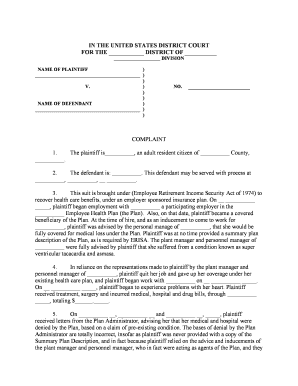
Complaint for Health Care Benefits Under ERISA

This template is fully customizable. Edit the text, fill out the fields, and send it for signature. Give it a try!
Complaint for Health Care Benefits Under ERISA

What a Complaint for Health Care Benefits Under ERISA Is

A Complaint for Health Care Benefits Under ERISA is a civil complaint filed in federal court to recover denied or withheld group health plan benefits or to enforce rights under an employee benefit plan governed by the Employee Retirement Income Security Act of 1974 (ERISA). Typical claims seek payment of benefits, plan interpretation, or a declaration of rights under 29 U.S.C. §1132(a). Plaintiffs commonly attach the plan document, summary plan description, denial letters, and administrative appeal records to show exhaustion or to explain any equitable exceptions to exhaustion.

Why filing this complaint matters

Filing an ERISA complaint preserves legal remedies to recover benefits, enforce plan terms, and obtain plan records and an accounting of benefits. It creates a formal record and triggers judicial review of plan administrator decisions under ERISA standards.

Why filing this complaint matters

Who commonly prepares and files this complaint

Typical filers include individual plan participants, beneficiaries, and attorneys representing them in benefits disputes.

  • Individual participant pursuing denied claims for medical care, seeking plan benefits and explanation of coverage decisions.
  • Plan beneficiary (e.g., dependent or surviving spouse) contesting benefit eligibility or survivor benefit determinations.
  • ERISA-specialty or health-law attorney preparing pleadings, assembling administrative record, and handling court procedures.

Representation by counsel is common because ERISA litigation involves administrative exhaustion, statutory standards, and plan-language interpretation.

Representative filing roles

Participant — Plaintiff

A plan participant or beneficiary who was denied health care benefits and seeks judicial review and recovery under ERISA. The participant supplies claim letters, plan documents, medical records, and correspondence showing exhaustion of internal appeals or reasons exhaustion is excused.

Attorney — Counsel

A civil litigation or ERISA-focused attorney who prepares the complaint, verifies jurisdiction and ERISA standing, compiles the administrative record, and handles service, motions, and potential settlement discussions on behalf of the client.

Essential compliance and security points for filings

Encryption: AES-256 at rest, TLS 1.2/1.3 in transit
Federal e-sign law: ESIGN and UETA compliant
Health privacy: HIPAA compliant with BAA required
Audit trail: Detailed timestamps and signer metadata
Certifications: SOC 2 Type II and ISO 27001
Accessibility: WCAG 2.0 Level AA

Primary risks and consequences of errors

Statute bars: Missing state or plan limits can bar claims
Preservation failures: Loss of administrative record undermines review
Jurisdiction errors: Wrong venue may result in dismissal
Incomplete service: Improper service can delay or void proceedings
Confidentiality breaches: HIPAA violations carry civil penalties
Costs orders: Unmeritorious claims risk fee-shifting

Common preparation pitfalls to avoid

  • Failing to attach the plan SPD and denial letters, which prevents the court from reviewing the administrator’s rationale.
  • Not exhausting internal appeals when required by plan terms, leading to procedural dismissal.
  • Submitting incomplete medical records or redacting material without documenting the reasons.
  • Using imprecise dates or incorrect party names that complicate service and jurisdictional arguments.

Step-by-step: preparing the ERISA benefits complaint

Follow these practical steps to assemble a clear, court-ready complaint and administrative record.

  • 01
    Gather records: Collect plan documents, SPD, claim forms, denials, and appeal letters.
  • 02
    Confirm exhaustion: Document completed internal appeals or establish exception to exhaustion.
  • 03
    Draft complaint: Allege jurisdiction, ERISA cause, relief sought, and attach exhibits.
  • 04
    File and serve: File in federal court and effect proper service on plan fiduciary and administrator.

High-level workflow from denial to judicial review

This sequence outlines the transition from an adverse benefits decision to federal court review.

  • Claim submission: Submit initial benefit claim to plan per procedures.
  • Administrative denial: Receive denial with reasons and appeal instructions.
  • Internal appeal: Complete required appeals within plan timelines.
  • Federal filing: File ERISA complaint if appeal is denied or exhaustion is excused.

Typical timing and deadlines to monitor

Monitor both plan-specific deadlines and statutory limitations when preparing a complaint.

Plan appeal window:

Check plan SPD; typical appeal windows are 60–180 days

Filing timeline:

File promptly after final denial and before any applicable statute of limitations

Service timeline:

Comply with Federal Rules for service after filing

Record preservation:

Retain all medical and plan records immediately upon denial

Statute considerations:

ERISA claims may be subject to contractual or state-bar periods; verify with counsel

Key milestones in the complaint lifecycle

Track these major stages from initial filing through resolution to manage deadlines and evidence.

01

File Complaint

Complaint filed in federal court and docketed.

02

Serve Defendants

Deliver summons and complaint to plan fiduciaries and administrators.

03

Administrative Record

Exchange and lodge the administrative record for judicial review.

04

Motion and Resolution

File dispositive motions or reach settlement; judge resolves claim.

How this complaint differs from administrative appeals

Compare the ERISA complaint with internal appeals to clarify purpose, venue, and remedies available.

Criteria ERISA Complaint Administrative Appeal
Purpose judicial review and remedies seek internal reversal of denial
Venue federal court plan administrator or insurer
Timeframe subject to filing limits governed by plan timelines
Remedies benefits, declaratory relief, fees reconsideration or benefit payment

eSignature vendor pricing and compliance snapshot

Comparison of common eSignature providers and core pricing or compliance attributes relevant when collecting signatures and records for ERISA complaints.

signNow DocuSign Adobe Sign PandaDoc HelloSign
Starting Price $8/user/mo $15/user/mo $14/user/mo $19/user/mo $15/user/mo
Free Trial 7-day free trial Varies Varies Varies Varies
Bulk Send Yes Yes Yes Yes Yes
Audit Trail Yes Yes Yes Yes Yes
Envelope Cap No cap 100 envelopes/user/year Varies Varies Varies

Technical requirements for eFiling and eSigning

Choose a platform that supports secure PDF, audit trails, and required integrations for court exhibits.

  • File formats: PDF, DOCX, and image support
  • Integrations: Salesforce, NetSuite, Google Workspace supported
  • Authentication: Email, SMS, or advanced signer verification

Illustrative examples of electronic preparation and signature

These real-world examples show how organizations use eSignature and digital records when assembling health-benefits complaints.

Optica Ventures (COO)

The interface is simple and easy-to-use for our team; more importantly, it is just as easy for our customers.

  • Their team automated form collection for denied claims, reducing turnaround time significantly.
  • As a result, administrative records were complete at filing and counsels’ review time dropped, supporting faster judicial review and clearer presentation of the claim.

Fertility Centers of Illinois (Founder)

airSlate SignNow team has been exceptional, responsive, the API has been great, and we're extremely happy that we chose airSlate SignNow as a company.

  • The center digitized patient authorizations and benefit denials.
  • Complete electronic exhibits, signed releases, and secure storage simplified evidence assembly and reduced the time clinicians needed to supply records during litigation.

Practical tips for accurate, defensible filings

Adopt consistent procedures to reduce defects and establish a clear administrative record for court review.

Assemble a complete administrative record
Include claim forms, plan SPD, full denial letters, all appeal submissions, and medical records. A complete record limits disputes about what the court may review and reduces later discovery conflicts. Label exhibits clearly and preserve original metadata.
Verify identity and signatures
When collecting authorizations or releases, require robust signer attribution by using authenticated eSignature methods, recording signer contact details, and retaining audit trails. Authentication reduces later challenges to signature validity.
Preserve HHS-protected data securely
Handle PHI in compliance with HIPAA: limit access, use encrypted storage, and, if using an eSignature vendor, ensure a signed BAA is in place. Document chain of custody for any transmitted medical records.
Document timelines and deadlines
Record dates of claim submissions, denials, and appeal filings using MM/DD/YYYY format. Early documentation supports statute-of-limitations analyses and preserves arguments for equitable tolling when agency delay or misinformation occurred.

Frequently asked questions about ERISA benefits complaints

Answers to common questions about filing, evidence, and eSignature considerations for ERISA benefits litigation.


Need help? Contact support

be ready to get more
Join over 28 million airSlate SignNow users