Establishing secure connection…Loading editor…Preparing document…

Ex Parte Motion

This template is fully customizable. Edit the text, fill out the fields, and send it for signature. Give it a try!
Ex Parte Motion

What an Ex Parte Motion Is and when it's used

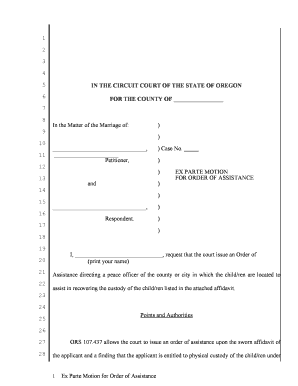
An Ex Parte Motion is a court filing that requests immediate or expedited relief without prior notice to the opposing party. Courts allow ex parte requests only in narrow circumstances—typically when delay would cause irreparable harm, evidence would be lost, or safety is threatened. Local court rules and state statutes set precise procedures, required affidavits or declarations, and the evidentiary showing needed for relief.

Why lawyers and litigants use Ex Parte Motions

Ex parte motions preserve rights and seek temporary remedies when notice would frustrate relief. They are appropriate for emergency stays, temporary restraining orders, or limited procedural relief, but require a clear showing of urgency, lack of adequate remedy at law, and often supporting sworn testimony.

Why lawyers and litigants use Ex Parte Motions

Who commonly files an Ex Parte Motion

Ex parte motions are filed by parties needing immediate court intervention; preparation varies by legal role and jurisdiction.

  • Civil litigators and defense lawyers handling urgent injunctive relief, protective orders, or asset preservation requests.
  • Family law attorneys seeking emergency custody, protection orders, or temporary support pending a hearing.
  • Self-represented litigants in urgent circumstances, often guided by court self-help materials or pro bono counsel.

Court staff and judges expect concise factual statements and sworn declarations; follow local rules closely to avoid denial or sanctions.

Core parts of a professional Ex Parte Motion

A strong ex parte filing is concise, fact-focused, and supported by admissible sworn statements. Include a proposed order and clearly explain why immediate relief is necessary under the governing rules.

Caption

Court name, case title, docket number and party designations appearing exactly as in the underlying case filing.
Relief Requested

A precise statement of the temporary or emergency relief sought, with specific deadlines or scope defined in plain terms.

Statement of Facts

Chronological, date-stamped facts showing immediacy and risk of harm; avoid argumentative language and cite exhibits where needed.

Sworn Declaration

A signed affidavit or declaration under penalty of perjury presenting witness facts and supporting exhibits; include foundation for each exhibit.

Legal Argument

Brief citation to controlling statutes and case law that support the emergency standard and the specific relief requested.

Proposed Order

A ready-to-sign order tailored to the request with exact operative language and any required notice or return hearing date.

Step-by-step: preparing and filing an Ex Parte Motion

Follow these sequential actions to prepare a compliant ex parte filing; adapt to local rules and court clerks' procedures.

  • 01
    Draft Motion: Prepare relief, facts, and legal support succinctly.
  • 02
    Attach Declaration: Include sworn statements and labeled exhibits.
  • 03
    File with Clerk: Submit per court's emergency or ex parte filing rules.
  • 04
    Judge Review: Court may set immediate hearing or rule on papers.

Configuring an online ex parte workflow

When working digitally, set fields and authentication to mirror court requirements and preserve an auditable record of submission and signatures.

Field Configuration
Document Format Submit as PDF/A for court compatibility
Authentication Use email plus SMS or ID verification where required
Attachment Handling Embed exhibits and exhibit list in one PDF
Audit Trail Retain complete signing metadata and timestamps

Technical considerations for e-submission and e-signing

Courts and clerks differ on e-filing and electronic signature acceptance; confirm local e-filing and signature authentication rules before submitting.

  • Supported Formats: PDF, PDF/A preferred
  • Integrations: E-filing portals and case management systems
  • Signer Authentication: Email, SMS, or higher-assurance ID methods

Keep a reproducible record: signed PDF, audit trail, and copies sent to the clerk; verify whether the court requires original notarized affidavits for emergency certifications.

How the ex parte filing process typically flows

This simplified flow shows the typical stages from filing to order entry; precise timing and procedural steps depend on local rules and judicial preferences.

  • Prepare Filing: Assemble motion, declaration, exhibits
  • Submit to Clerk: Use court e-filing or in-person emergency channel
  • Judicial Review: Judge examines papers or schedules hearing
  • Order Issued: Emergency order entered or hearing set

Typical timing and deadlines to expect

Timelines are governed by local court rules; below are common timing outcomes to plan for during emergency filings.

Immediate Hearing:

Same-day review in many emergency dockets

Temporary Orders:

Short-term relief until a noticed hearing

Service Requirements:

Some courts require prompt post-filing notice to opponents

Return Hearing:

Judge may set a prompt hearing for full briefing

Record Retention:

Keep filed documents and exhibits indefinitely

Key milestones after filing an Ex Parte Motion

Track these sequential milestones from filing through the resulting hearing or order to ensure compliance and preserve appellate rights.

01

Emergency Arises

Identify immediate risk and gather supporting documents

02

File Motion

Submit motion and sworn declaration to the clerk

03

Court Review

Judge reviews papers or schedules expedited hearing

04

Order or Hearing

Judge issues temporary order or directs further proceedings

Common mistakes when preparing an Ex Parte Motion

  • Failing to show immediate, irreparable harm and why notice would frustrate relief — courts deny motions lacking urgency.
  • Submitting unsigned or improperly sworn declarations; unsigned affidavits often cause rejection or delay at intake.
  • Neglecting local rule requirements for certificate of service, proposed order format, or required forms, which can return the filing.
  • Overbroad proposed orders that grant relief beyond the narrowly tailored emergency remedy courts will authorize.

Consequences of flawed or improper ex parte filings

Denial of Relief: Court may refuse emergency relief
Sanctions: Monetary sanctions for misuse of ex parte procedures
Contempt: Failure to comply with orders can trigger contempt
Appeal Reversal: Orders entered without adequate basis can be reversed
Delay Costs: Additional litigation delay and expense
Ethics Risk: Potential professional responsibility inquiries

Essential information to include and preserve

Court Name: Exact court designation and division
Case Number: Accurate docket number for matching
Party Names: Full legal names for each party
Sworn Statement: Declaration signed under penalty of perjury
Exhibit Index: Labeled exhibit list with descriptions
Proposed Order: Clean, sign-ready order for judicial use

eSignature vendor comparison for filing and signing court papers

Compare basic plan pricing and core capabilities for e-signature solutions commonly used to prepare, sign, and store court filings and sworn declarations.

signNow DocuSign Adobe Sign PandaDoc HelloSign
Starting Price $8/user/mo $15/user/mo $14/user/mo $19/user/mo $15/user/mo
Free Trial Yes — 7-day trial No No Yes, limited Yes, limited
Bulk Send Yes Yes Yes Yes No
Audit Trail Yes Yes Yes Yes Yes
HIPAA Compliant Yes Yes Yes No No

Frequently asked questions about Ex Parte Motions

Answers to common procedural and practical questions about ex parte filings, evidence, timing, electronic signing, and how to correct or withdraw a motion.


Need help? Contact support

be ready to get more
Join over 28 million airSlate SignNow users