Establishing secure connection…Loading editor…Preparing document…

Texas Executor's Deed of Distribution

This template is fully customizable. Edit the text, fill out the fields, and send it for signature. Give it a try!
Texas Executor's Deed of Distribution

What the Texas Executor's Deed of Distribution Is

The Texas Executor's Deed of Distribution is a post‑probate instrument executed by the estate's appointed executor (personal representative) to transfer the decedent's interest in real property to beneficiaries named in a will or by court order. The deed typically recites the probate cause and the executor's authority (letters testamentary or letters of administration), contains the legal description, and conveys the estate's title interest. The document is signed by the executor, acknowledged before a notary, and recorded in the county deed records to complete the transfer and update the chain of title for title companies and subsequent purchasers.

Why an Executor's Deed of Distribution Matters

This deed clarifies ownership after probate, allows beneficiaries to hold and market property, and provides a recorded instrument that title companies accept for clearing title. Proper execution and recording reduce disputes and protect the executor and grantees.

Why an Executor's Deed of Distribution Matters

Who Prepares and Relies on This Deed

Typical users involved in preparing or receiving an executor's deed of distribution include legal and title professionals, the executor, and beneficiaries.

  • Executor or personal representative — prepares, signs, and delivers the deed under probate court authority; responsible for accuracy and delivery.
  • Probate attorney or drafter — ensures deed language, recitals, and attached documents meet court and county recording requirements.
  • Title company or closing agent — reviews for marketable title, may require supporting probate documents and may handle recording.

Core Elements Found in a Professional Deed

A complete Texas Executor's Deed of Distribution includes specific data and legal statements designed to support recording and future marketability.

Grantor

Names the executor as grantor using the exact legal name and office title (for example, 'John Doe, Independent Executor of the Estate of Jane Doe, Deceased').
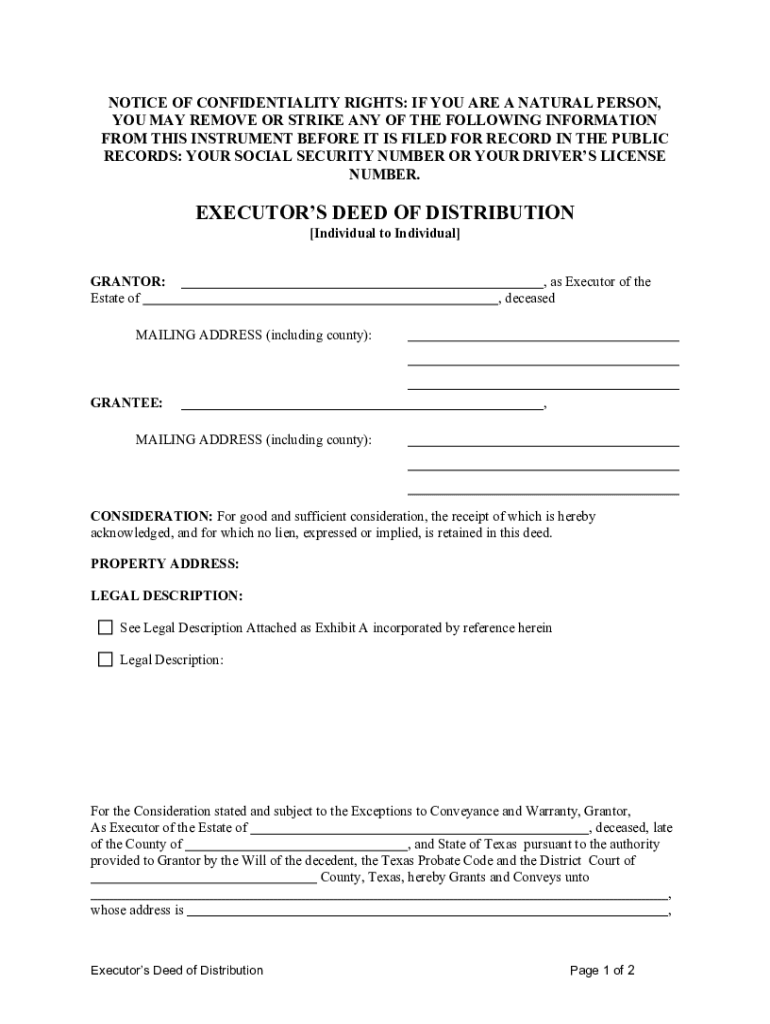
Grantee

Identifies beneficiary(ies) precisely, using full legal names and specifying tenancy type (joint tenants, tenants in common) when applicable.

Legal Description

Includes the full metes and bounds or lot/ block/plat citation used by the county deed records to avoid ambiguity and ensure accurate indexing.

Recital Clause

States the probate cause number, court, and that letters testamentary or administration were issued, establishing executor authority to convey property.

Consideration

Describes the consideration (often nominal, e.g., 'for $10 and other good and valuable consideration') to support transfer validity and recording.

Notary Acknowledgment

Contains an acknowledgement block signed by the notary public; many counties require this for recording and chain‑of‑title clarity.

Required Identifiers and Short Data Checklist

Executor Name: Full legal name
Probate Case Number: Court cause number
County Recorder: County name for recording
Property Address: Street, city, ZIP
Legal Description: Metes/bounds or plat
Signature Date: MM/DD/YYYY format

Step-by-Step: Preparing and Recording the Deed

Follow these core steps to prepare an executor's deed that will be accepted for recording and for clearing title.

  • 01
    Draft Deed: Populate grantor, grantee, legal description, recital and consideration.
  • 02
    Attach Probate Paperwork: Include letters testamentary/administration and death certificate copies.
  • 03
    Notarize: Executor signs before a notary; include required acknowledgement language.
  • 04
    Record: Submit to the county clerk/recorder and pay recording fees.

How to Configure an Online Deed Workflow

Set up a predictable signing workflow when completing the deed digitally or preparing files for recording.

Field Configuration
Signers Executor first; notary separate signer if using RON
Authentication Email plus SMS or ID verification for higher assurance
Attachments Attach letters testamentary and death certificate PDFs
Save Format Export signed file as PDF/A for archiving

From Draft to County Records: Process Overview

A clear path from drafting to recording reduces friction and title defects; these phases summarize common handoffs.

  • Draft: Prepare deed language and verify legal description and beneficiary details.
  • Authenticate: Confirm executor's authority and attach probate documents for title review.
  • Sign & Notarize: Executor signs; notary completes acknowledgement or RON session as required.
  • Record: File with county clerk, pay fees, and obtain recorded instrument number.

Digital Signing, File Formats, and Integrations

Use software that supports PDF, DOCX uploads, audit trails, and secure signer authentication when handling deeds online.

  • File formats: PDF and Word (DOCX) for upload and export
  • Integrations: Connectors to title systems and cloud storage
  • Authentication: Email, SMS, KBA, or ID verification

Timing Considerations and Practical Deadlines

While Texas has no single statutory deadline for recording an executor's deed, timely recording protects grantees and purchasers from intervening claims.

Probate completion:

Record the deed after the court issues letters testamentary or administration.

Deed execution:

Sign, notarize, and deliver as soon as estate authority and beneficiary details are confirmed.

Recording window:

Record promptly; county acceptance ensures priority over later claims or liens.

Indexing time:

County processing and indexing times vary by county and can affect availability.

Tax reporting:

Address any property tax or transfer tax implications promptly with the county tax office.

Common Mistakes to Avoid

  • Using an informal or incomplete legal description that prevents accurate recording and causes title exceptions during closing.
  • Failing to attach or reference letters testamentary or administration, leading the recorder or title company to reject the submission.
  • Mismatching executor or grantee names compared to supporting documents, producing recording delays or title objections.
  • Not verifying county recording requirements for acknowledgements or RON sessions, resulting in returned or rejected deeds.

Key Legal Risks If the Deed Is Incorrect

Clouded Title: Title problems that hinder sale
Recording Rejection: County may refuse to record
Tax Issues: Unresolved transfer or tax liabilities
Personal Liability: Executor liable for improper transfers
Invalid Transfer: Conveyance may be void or voidable
Fraud Allegations: Challenges to executor authority

eSignature Vendor Comparison for Executing Deeds

Compare common eSignature attributes for document workflows used to prepare and transmit deeds. SignNow is listed first as the baseline comparison.

signNow DocuSign Adobe Sign PandaDoc HelloSign
Starting Price $8/user/mo $15/user/mo $14/user/mo $19/user/mo $15/user/mo
Free Trial 7-day free trial, no card Varies by vendor Varies by vendor Varies by vendor Varies by vendor
Bulk Send Yes Yes Yes Yes No
Audit Trail Yes Yes Yes Yes Yes
HIPAA Compliant Yes Yes Yes No No

Real-World Scenarios Where This Deed Is Used

These examples show typical situations and the practical outcome when the executor's deed is prepared and recorded correctly.

Family Homestead Transfer

Probate concluded and executor appointed

  • Executor executes deed conveying homestead to named beneficiaries
  • Recorded deed clarifies ownership, allows beneficiaries to refinance or sell without probate reopening and avoids title objections.

Estate With Multiple Properties

Decedent owned several parcels in one county

  • Separate executor's deeds prepared per parcel with specific legal descriptions
  • Timely recording of each deed enables property management and distributes proceeds in accordance with the will.

Frequently Asked Questions and Practical Answers

Answers to frequent questions encountered when preparing, signing, or recording an executor's deed of distribution.


Need help? Contact support

be ready to get more
Join over 28 million airSlate SignNow users