Establishing secure connection…Loading editor…Preparing document…

Exhibit and Witness List

This template is fully customizable. Edit the text, fill out the fields, and send it for signature. Give it a try!
Exhibit and Witness List

What an Exhibit and Witness List Is and when it’s used

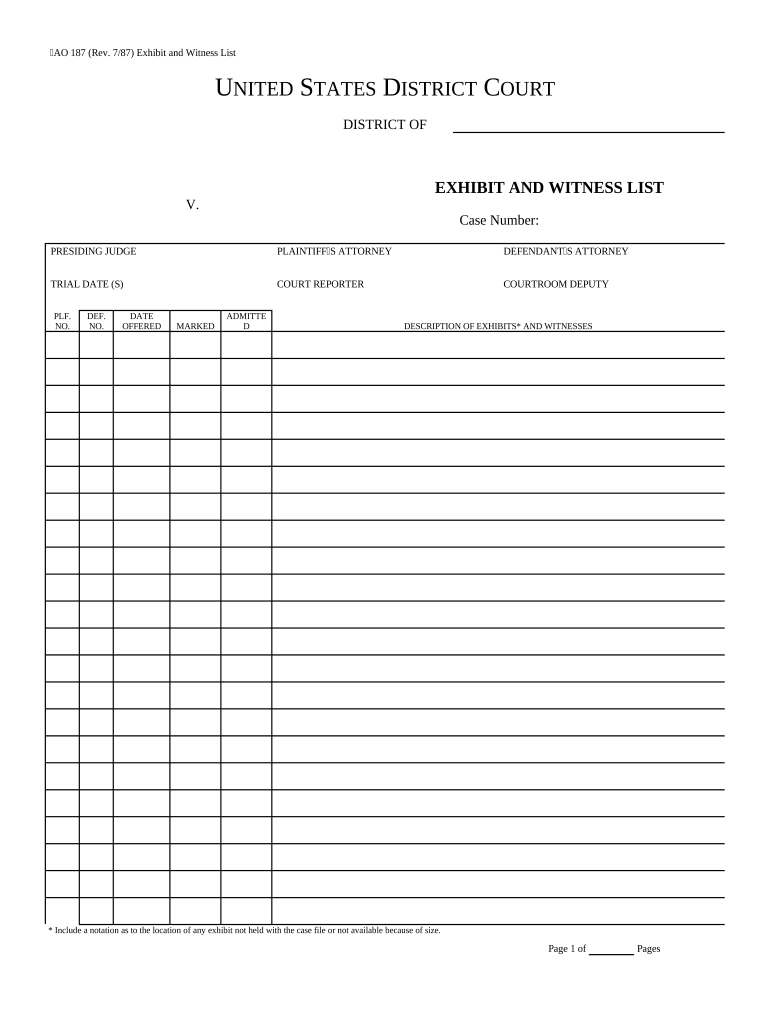
An Exhibit and Witness List is a litigation document that identifies physical and documentary exhibits and the individuals who will testify at trial or a hearing. It typically includes exhibit numbers, concise exhibit descriptions, Bates or page ranges, custodians, witness names, subjects of testimony, and expected time estimates. Courts often require exchange of these lists before trial under the Federal Rules of Civil Procedure (see Rule 26(a)(3)) or local rules so parties and the court can plan evidentiary hearings and resolve objections in advance.

Why an accurate Exhibit and Witness List matters

A complete list reduces surprises at trial, supports chain-of-custody documentation, and helps preserve admissibility. Courts may exclude unrevealed exhibits or witnesses under discovery and sanction rules, increasing litigation risk and cost.

Why an accurate Exhibit and Witness List matters

Who prepares and relies on an Exhibit and Witness List

Accurate lists also assist mediators, experts, and client representatives in preparing for testimony and cross-examination.

  • Lead counsel and trial attorneys responsible for disclosure and objections to exhibits.
  • Paralegals and litigation support who prepare exhibit binders, Bates ranges, and link documents to witness testimony.
  • Court clerks and scheduling officers who use lists for pretrial orders and exhibit notebooks.

Core components of a professional Exhibit and Witness List

A clear structure and consistent identifiers make exhibits and witness testimony easy to locate and verify during trial.

Exhibit ID

Unique number or letter assigned to each item; used consistently in pleadings, pretrial orders, and trial notebooks to avoid confusion.
Description

Short, specific description of the exhibit’s contents and relevance so judges and opposing counsel can assess admissibility quickly.

Bates Range

Starting and ending Bates numbers or page range that shows the exact pages produced and simplifies referencing in court.

Custodian / Source

Name of person or organization that maintained the exhibit, to establish chain of custody and foundation for admissibility.

Witness Name

Full legal name and role of each witness, plus the subject(s) they will address and whether testimony is live or via deposition.

Foundation Notes

Brief foundation statements (authenticating facts, custody history, or predicate testimony) to support preliminary admissibility arguments.

Essential record and security details to include

Chain of Custody: Document transfer history
Access Controls: Who can view and edit
Audit Trail: Time-stamped actions recorded
Redaction Status: Whether PII has been redacted
Storage Format: PDF, TIFF, or native file
Retention Period: How long originals kept

Step-by-step sequence to prepare and exchange your list

Follow this sequence to assemble exhibits and witnesses, confirm foundation, and serve opposing parties in compliance with pretrial rules.

  • 01
    Collect Materials: Gather produced documents and mark proposed exhibits.
  • 02
    Number and Index: Assign exhibit IDs and record Bates ranges.
  • 03
    Draft Witness List: List witnesses and topics for direct testimony.
  • 04
    Serve and File: Exchange lists with opponents and file per local rules.

How to configure an online workflow for lists and exhibits

Set fields and authentication to match court requirements and your internal review steps when creating a digital workflow.

Field Configuration
Authentication Email + SMS code or stronger
Signing Order Sequential or parallel signer flow
Attach Exhibits Allow PDF uploads, full-text search
Retention Policy Specify retention and export rules

Technical considerations for eDelivery and eSignature

Confirm compatibility with your court’s e-filing system and preserve logs and signed copies for the official record and appeal readiness.

  • File Formats: PDF, DOCX, and searchable TIFF
  • Authentication: Email, SMS, or KBA options
  • Integrations: CM/ECF, cloud storage, or docket systems

Where to send and file the Exhibit and Witness List

Distribution usually includes opposing counsel, the court clerk, and trial staff; confirm local filing procedures and acceptable formats.

  • Opposing Counsel: Serve per local rules and the case scheduling order
  • Court Clerk: File the list in the court docket or as directed
  • Trial Notebook: Provide paper or electronic binders for the judge and court reporters
  • E-filing System: Submit via CM/ECF or applicable state court portal

Typical timing and deadlines to plan around

Deadlines vary by jurisdiction; use the scheduling order and FRCP guidance to set internal deadlines for disclosure and objections.

Pretrial Disclosure:

Exchange exhibits and witness lists at least 30 days before trial (FRCP 26(a)(3)).

Objection Period:

Serve objections and stated grounds typically 14 days after disclosure; check local rules.

Amendments:

File any substitutions or updates per court cutoffs and with leave of court.

Exhibit Exchange:

Provide exhibit copies to opposing counsel and the court per scheduling order.

Pretrial Conference:

Confirm final exhibit lists and objections at the pretrial conference.

Milestone timeline for getting lists trial-ready

Use a dated milestone plan so tasks, dependencies, and court deadlines are visible to the litigation team.

01

Document Collection

Complete collection and initial review of potential exhibits.

02

Exhibit Numbering

Assign IDs and prepare Bates ranges and indexes.

03

Exchange Lists

Serve lists and supporting materials on opposing counsel.

04

Finalize for Trial

Resolve objections and assemble the final trial binder.

Common preparation errors to avoid

  • Incomplete descriptions that omit dates or authors cause unnecessary objections and slow evidentiary rulings.
  • Mismatched Bates ranges between production and the list lead to confusion and can result in excluded pages.
  • Failing to state foundation or authentication plans forces on-the-spot foundation hearings at trial.
  • Late service of amended lists risks exclusion under discovery sanction rules and disrupts trial logistics.

Consequences of an incorrect or late list

Exclusion of Evidence: May be excluded under FRCP 37(c)(1)
Monetary Sanctions: Court may award fees or fines
Adverse Inference: Jury instructions or negative findings
Trial Delay: Continuances and increased costs
Waiver of Objections: Failure to timely object can forfeit issues
Preservation Risk: Loss of authentication or chain-of-custody proof

Real-world examples of list preparation and digital handling

Practitioners use digital tools and structured lists to shorten exchange time and preserve admissibility in complex cases.

Optica Ventures LLC

Brian Fitzgibbons simplified exhibit indexes for investor disputes

  • The team centralized Bates ranges and witness topics
  • As a result, reviewers located foundation pages faster and the court accepted evidence with fewer follow-up authentication requests.

Martin Properties

Tim Martin processed lease exhibits and witness statements online

  • He used consistent exhibit IDs tied to production sets
  • That consistency reduced pretrial meet-and-confer disputes and streamlined courtroom presentation.

Comparison of representative eSignature vendor pricing and capabilities

Comparison shows starting price and common capability lines; select a vendor that meets court, security, and workflow integration needs.

signNow DocuSign Adobe Sign PandaDoc HelloSign
Starting Price $8/user/mo $15/user/mo $14/user/mo $19/user/mo $15/user/mo
Free Trial Yes, 7-day free trial Varies by vendor Varies by vendor Varies by vendor Varies by vendor
Bulk Send Yes Yes Yes Yes No
Audit Trail Yes Yes Yes Yes Yes
HIPAA Compliant Yes Yes Yes No No
Envelope Cap No envelope cap 100 envelopes/user/year Varies by plan Varies by plan Varies by plan

Frequently asked questions about Exhibit and Witness Lists

Practical answers to common questions about e-signature validity, witness requirements, and handling objections in court.


Need help? Contact support

be ready to get more
Join over 28 million airSlate SignNow users