Establishing secure connection…Loading editor…Preparing document…

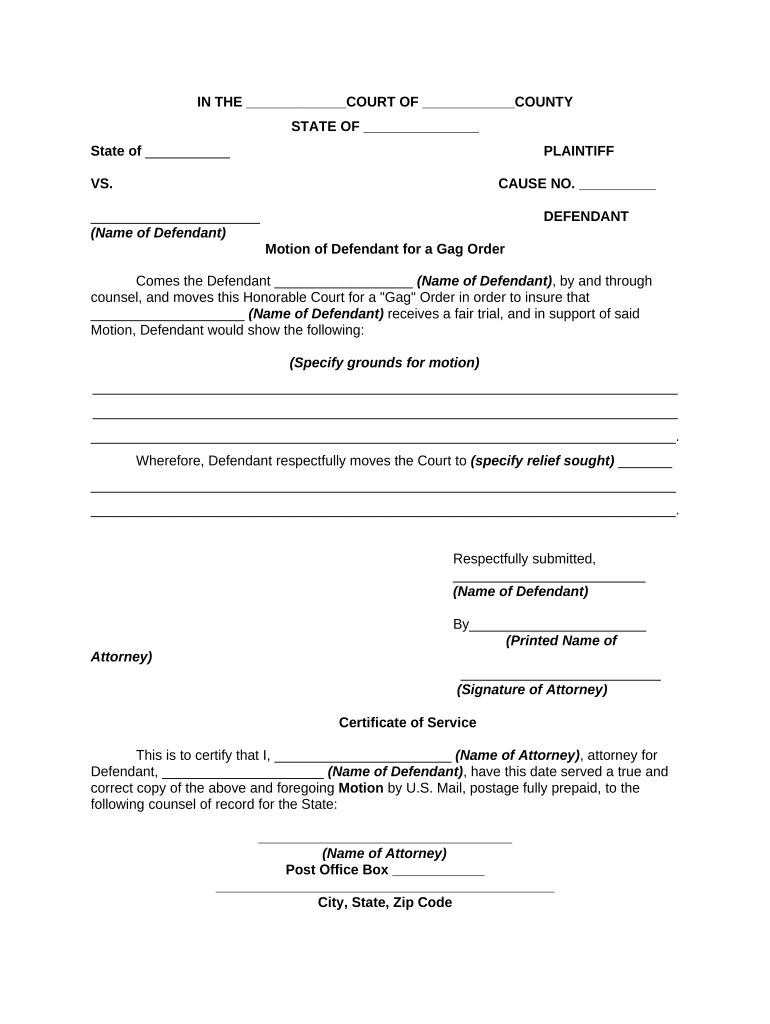
Gag Order

This template is fully customizable. Edit the text, fill out the fields, and send it for signature. Give it a try!
Gag Order

What a Gag Order Is and when it’s used

A Gag Order is a court-issued directive that restricts parties, counsel, witnesses, or other participants from publicly disclosing specified information about a case or investigation. It can limit what may be discussed with the media, on social media, or in other public forums and is typically entered to protect fair trial rights, confidential information, or ongoing investigations. Gag orders vary by jurisdiction and may be standalone court orders, part of protective orders, or included in settlement agreements. Courts balance First Amendment interests against needs for confidentiality, safety, or due process.

Why a Gag Order may be necessary

Gag orders prevent prejudicial publicity, protect witness safety, and preserve confidential information during litigation or investigations. Where lawful, they help ensure a fair trial and maintain the integrity of sensitive proceedings while balancing free-speech rights under governing law such as the First Amendment and applicable state rules.

Why a Gag Order may be necessary

Who typically prepares or is bound by a Gag Order

Gag orders are used in litigation, regulatory investigations, and certain transactional settlements where confidential information or fair-trial integrity is at stake.

  • Plaintiffs and defendants in criminal or civil cases who seek to limit public disclosures about the matter.
  • Counsel and parties in high-profile matters where media coverage could prejudice jurors or compromise safety.
  • Regulators, prosecutors, or companies in internal investigations needing confidentiality for witnesses or proprietary data.

The document’s scope and enforceability depend on court authority and precise drafting; signatories should understand limits, duration, and carve-outs.

Step-by-step: completing and submitting a Gag Order

Follow these steps to draft, review, and submit a Gag Order that is narrowly tailored and procedurally proper.

  • 01
    Draft Order: Prepare precise language limiting only necessary information.
  • 02
    Review with Counsel: Have defense/plaintiff counsel and ethics counsel review scope.
  • 03
    File Motion: Submit supporting motion showing need and proposed order.
  • 04
    Judge’s Entry: Obtain the court-signed order and serve on all parties.

How eFiling and eSignature work with Gag Orders

Electronic workflows let parties prepare, sign, and file proposed gag orders while preserving an audit trail required for court processes.

  • Prepare: Upload draft as PDF or DOCX and place signature fields.
  • Sign: Parties sign electronically; capture timestamps and IP.
  • Download: Save signed copy with audit trail for filing.
  • File: Upload to the court’s eFiling portal per local rules.

Technical needs for eSigning and eFiling a Gag Order

Confirm that your eSignature platform supports PDF/DOCX, audit trails, and required signer authentication before beginning.

  • File formats: PDF/A or DOCX accepted by most courts.
  • Authentication: Email, SMS, or advanced ID verification.
  • Audit Trail: Timestamps, IP, and signer history.

Ensure exported signed files include the certificate of completion and are formatted for the court’s eFiling system; confirm any local eFiling size or metadata rules.

Recommended eSignature settings for a Gag Order workflow

Adjust these settings in your eSignature platform to capture strong evidence of signing and consent.

Field Configuration
Signature Type Visible signature + audit record
Authentication Email + SMS code or ID check
Document Retention Retain signed PDF + audit trail
Access Controls Role-based permissions for editors

Security and compliance items to confirm for electronic Gag Orders

Encryption: TLS 1.2/1.3 in transit; AES-256 at rest
Audit Trail: Timestamps, IP, signer actions retained
Regulatory Compliance: ESIGN and UETA adherence
HIPAA Support: BAA available where required
21 CFR Part 11: Compliant for FDA-regulated records
Certifications: SOC 2 Type II, ISO 27001 available

Potential consequences of an improperly drafted Gag Order

Contempt Sanctions: Court may impose fines or jail
Overbreadth Challenges: Order may be overturned on appeal
First Amendment Risk: Unconstitutional restraint may be vacated
Civil Liability: Damages if order harms third parties
Enforcement Costs: Expense of monitoring and prosecuting violations
Reputational Harm: Public backlash if perceived as unjust

Common drafting mistakes to avoid

  • Using vague or catchall language that fails to define prohibited topics precisely, which invites constitutional challenges and narrowings by the court.
  • Leaving the duration open-ended without event-based termination or periodic review, increasing the likelihood of being found overbroad.
  • Failing to include standard exceptions (counsel communications, compelled disclosures, privileged communications) that courts generally expect.
  • Not tailoring restrictions to the least-restrictive means necessary, rather than imposing blanket publication bans that extend beyond the case.

Core sections every professional Gag Order should include

A well-drafted Gag Order is clear, narrow, and enforceable; include these elements to improve judicial acceptance and practical enforceability.

Identifying Data

Court caption, docket number, parties named precisely so the order applies only to intended actors and records.
Scope Language

Detailed description of restricted topics (what may not be disclosed) with concrete examples and boundaries.

Duration Clause

Clear start and end dates or event triggers that terminate the restriction automatically.

Authorized Disclosures

Carve-outs for privileged communications, counsel, compelled disclosures, and required regulatory reporting.

Enforcement Mechanism

Procedures for alleging breaches, evidentiary standards, and remedies such as sanctions or injunctions.

Signatures and Entry

Judge’s signature line, party signatures if stipulated, and instruction for filing and service.

Illustrative examples of Gag Order use

Below are two anonymized examples that show how scope, duration, and exceptions differ by situation.

High-Profile Criminal Case

A court limits public discussion of witness identities and forensic details to prevent jury prejudice.

  • Order lasts until trial conclusion.
  • The order included explicit media carve-outs for factual reporting and procedures for counsel to request limited disclosures under seal.

Corporate Trade Secret Litigation

Parties agreed to a protective gag order restricting disclosure of customer lists and technical designs.

  • Duration tied to case conclusion and a five-year post-judgment quiet period.
  • The order permitted disclosures to outside counsel and expert witnesses under written confidentiality undertakings.

Comparing common eSignature providers for signing and storing a Gag Order

Select a platform that supports audit trails, required authentication, and retention policies aligned with court and regulatory requirements.

signNow DocuSign Adobe Sign PandaDoc HelloSign
Starting Price $8/user/mo $15/user/mo $14/user/mo $19/user/mo $15/user/mo
Free Trial Yes, 7-day trial Varies by plan Varies by plan Varies by plan Varies by plan
Bulk Send Yes Varies by plan Varies by plan Varies by plan Varies by plan
Audit Trail Yes Yes Yes Yes Yes
HIPAA Compliant Yes Yes Yes No No

Frequently asked questions about Gag Orders and electronic signing

Common procedural and enforceability questions are summarized below to help practitioners and signatories avoid pitfalls.


Need help? Contact support

be ready to get more
Join over 28 million airSlate SignNow users