Trust Property
Describe assets transferred into the trust, including real estate, securities, cash accounts, and personal property; provide schedules or exhibits identifying each asset and its legal description or account identifiers.
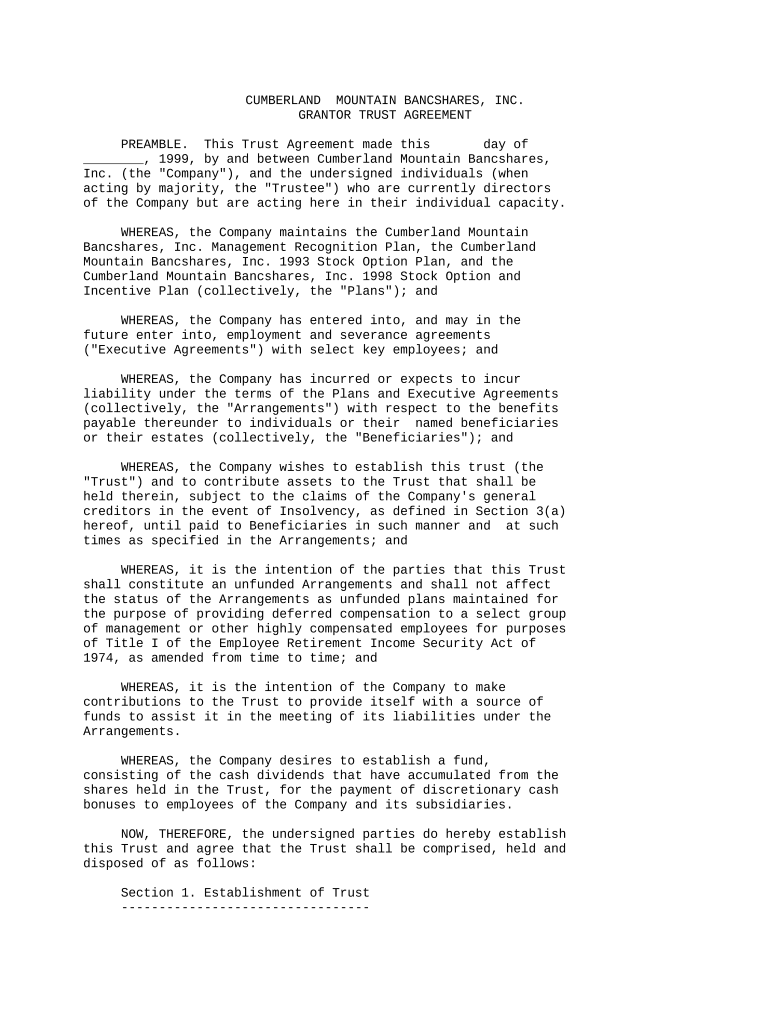
Use a Grantor Trust Agreement to clarify ownership, centralize asset management, reduce probate exposure, and specify distribution timing. A well-drafted agreement allocates trustee authority, preserves beneficiary expectations, and supports estate-tax planning while documenting the grantor’s intent under applicable state and federal law.

Typical users include estate planners, trustees, beneficiaries, attorneys, and financial advisors preparing or administering grantor trusts.
Describe assets transferred into the trust, including real estate, securities, cash accounts, and personal property; provide schedules or exhibits identifying each asset and its legal description or account identifiers.
Specify authority to invest, sell, lease, borrow, delegate, and hire advisors; include discretionary distribution powers and standards for exercising fiduciary duties to beneficiaries and recordkeeping requirements.
Identify current and contingent beneficiaries, their vested interests, distribution timing, permissible withdrawals, and procedures for contesting or disclaiming interest, including notice requirements and required consents.
Declare grantor trust tax status, allocation of income, principal, and tax reporting responsibilities; address grantor trust rules under IRS guidance and potential gift or estate tax consequences.
State whether the trust is revocable or irrevocable, procedures for amendment, required notices, trustee consent rules, effective dates for changes, including successor trustee appointment process and recording obligations.
Set conditions for trust termination, distribution mechanics on termination, successor trustee duties at wind-up, and post-termination tax reporting, final accounting to beneficiaries, and instructions for asset transfer or sale.
| Field configuration and purpose for online signing | How to set and recommended values |
|---|---|
| Signer authentication method and strength | Use email+SMS or KBA for high-assurance signers. |
| Document template and version control | Lock final template, track edits, and maintain version history. |
| Automated routing and approval steps | Define signer order, conditional routing, and notifications. |
| Storage, export, and retention settings | Save PDFs with audit trail; set retention policies per jurisdiction. |
Use an eSignature platform that supports role-based signing, audit trails, and secure storage compliant with ESIGN and UETA.
The individual or entity creating the trust. Responsibilities include funding the trust, specifying terms, and confirming identity. The grantor’s tax status and retained powers determine whether the trust is treated as a grantor trust for income tax purposes; consult tax counsel for consequences.
The appointed fiduciary who holds legal title and manages trust property under the agreement. Duties include prudently investing assets, keeping records, making distributions per terms, providing accountings to beneficiaries, and complying with state trust statutes; failure can expose the trustee to liability.
A family transferred rental properties into a revocable grantor trust to simplify management and avoid probate for heirs.
A high-net-worth individual used an irrevocable grantor trust to transfer business interests while retaining certain tax attributes for estate planning.
Enter as MM/DD/YYYY; determines start of obligations.
Fund trust promptly to avoid assets remaining in grantor’s estate.
Record deed within county-specific timeframes to protect purchaser interests.
If non-grantor trust, file Form 1041 by April 15 or extended date.
Provide accountings and material notices within state-mandated timeframes.
| signNow | DocuSign | Adobe Sign | PandaDoc | HelloSign | |
|---|---|---|---|---|---|
| Starting Price | $8/user/mo | $15/user/mo | $14/user/mo | $19/user/mo | $15/user/mo |
| Free Trial | 7-day free trial | Varies by vendor; check plans | Varies by vendor; check plans | Varies by vendor; check plans | Varies by vendor; check plans |
| Bulk Send | Yes | Yes | Yes | Yes | No |
| Audit Trail | Yes | Yes | Yes | Yes | Yes |
| HIPAA Compliant | Yes | Yes | Yes | No | No |
| Envelope Cap | No envelope cap | 100 envelopes/user/year | Varies by plan | Varies by plan | Varies by plan |
Finalize terms and attach asset schedules before signing.
Sign with required witnesses or notary per state rules.
Transfer title, retitle accounts, and record deeds where applicable.
Trustee assumes duties, maintains records, and provides accountings.
Export final executed documents as PDF/A for long-term archiving, standard PDF for sharing, and DOCX for editable copies retained by counsel; include certificates of completion and embedded audit trails for evidentiary purposes.
Store encrypted offsite backups, maintain immutable version history, apply access controls, and document backup schedules to ensure recoverability and auditability through the retention period required by law.
Include a signed certificate of trust, trustee acceptance, and notarial acknowledgements where applicable; attach copies of deeds or transfer instruments as exhibits and index each exhibit in a table of contents.
Maintain time-stamped logs with signer attribution, IP addresses, geolocation when available, and full document change history; export certificates for court or tax audits on request.