Establishing secure connection…Loading editor…Preparing document…

Guarantee Form

This template is fully customizable. Edit the text, fill out the fields, and send it for signature. Give it a try!
Guarantee Form

What a Guarantee Form Is and when it applies

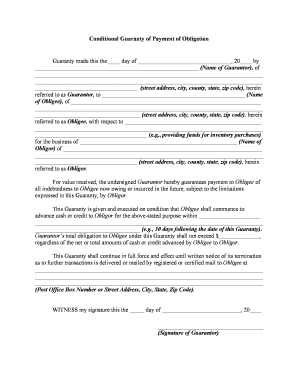
A Guarantee Form is a written instrument in which one party (the guarantor) agrees to answer for another party’s obligations if that party defaults. Commonly used with loans, leases, vendor contracts, and performance obligations, it identifies the guarantor, the primary obligor, the scope of obligations guaranteed, the term, and limited remedies. A properly executed Guarantee Form includes signatures, dates, identification of consideration, and any required witness or notary acknowledgements. Electronic execution is widely accepted under U.S. law when ESIGN and relevant state rules are followed; signNow is one eSignature provider compatible with ESIGN and UETA-compliant workflows.

Why a clear Guarantee Form matters

A well-drafted Guarantee Form clarifies liability, reduces ambiguity about recovery paths, and documents the guarantor’s consent and limits. Proper form and execution strengthen enforceability in dispute resolution and support underwriting or credit decisions.

Why a clear Guarantee Form matters

Typical parties that prepare or sign Guarantee Forms

Guarantee Forms are used across commercial, real estate, and consumer contexts by parties who need backup payment or performance assurances.

  • Commercial lenders and banks — require guarantees as credit support for loans, often seeking corporate resolutions and audited financials.
  • Landlords and property managers — use personal or corporate guarantees for leases to secure rent and lease obligations.
  • Suppliers and service providers — request guarantees for large contracts or credit arrangements when counterparty risk is elevated.

Core elements to include in a professional Guarantee Form

A complete Guarantee Form arranges parties, scope, limits, and enforcement mechanics so that obligations and remedies are unambiguous for all stakeholders.

Parties

Full legal names and entity types of guarantor and primary obligor; include formation jurisdiction and business addresses to avoid identity disputes.
Guarantee Type

Specify whether guarantee is limited, unlimited, conditional, or continuing; clarify whether liability is joint, several, or both to set enforcement expectations.

Obligations & Scope

Describe the exact obligations guaranteed (principal, interest, fees, costs). Tie the guarantee to specific contracts, account numbers, or invoices for clarity.

Term & Termination

State the effective date, duration, and events that end the guarantor’s liability. Address post-termination obligations such as outstanding defaults.

Conditions & Defaults

List guarantor conditions precedent, permissible defenses, acceleration triggers, and manufacturer or creditor actions that affect enforceability.

Remedies & Limitations

Define lender remedies, notice requirements, limitation of liability, subrogation rights, and whether guarantor has indemnity or reimbursement obligations.

Step-by-step: completing and executing the Guarantee Form

Follow a clear sequence to reduce errors and ensure enforceability: prepare, verify authority, sign, and retain records.

  • 01
    Prepare document: Populate all required fields and attach referenced agreements.
  • 02
    Verify authority: Confirm signers have corporate authority or individual capacity to bind parties.
  • 03
    Sign and notarize: Obtain signatures and any required notarizations or witness attestations.
  • 04
    Distribute and archive: Provide executed copies to all parties and store the original securely.

How to configure an online Guarantee Form workflow

Set up a repeatable digital workflow that controls signer order, authentication, and retention for auditability.

Upload Document and Templates Store a master Guarantee Form template for reuse and consistent field placement.
Assign Signer Roles and Order Define guarantor, obligor, and witness/notary roles and set sequential or parallel signing order.
Authentication Settings Choose email link, SMS code, or stronger methods for identity verification.
Conditional and Calculated Fields Use conditional logic to show limits, caps, or exhibits only when applicable.
Retention and Export Settings Configure PDF export, audit trail capture, and secure cloud storage for executed forms.

Common routing for signing and submission

A typical signing flow ensures identity checks and preserves an audit trail suitable for enforcement or regulatory review.

  • Upload: Sender uploads the template and attaches supporting documents.
  • Assign: Place signature, date, and witness fields; assign signers.
  • Authenticate: Signer verifies identity and reviews the document.
  • Finalize: Signed copy and audit trail saved and distributed.

Digital signing and technical considerations

Pick a solution that captures signer attribution, timestamping, and tamper-evident output; these features support enforceability and records management.

  • File formats: PDF, DOCX supported
  • Integrations: Salesforce, NetSuite, Microsoft 365
  • Audit & security: TLS, AES-256

Typical timelines and processing expectations

Guarantee Forms rarely carry fixed filing deadlines, but timely execution, notarization, and distribution affect enforceability and remedies.

Document preparation window:

Allow 1–3 business days for drafting and internal approvals.

Signature collection:

Electronic signing can close in under 24 hours; physical collection may take several days.

Notarization scheduling:

Allow 1–7 days depending on notary availability or RON capabilities.

Recording or filing:

If guarantee relates to a secured instrument, allow additional time for collateral recording where required.

Document retention start:

Retention timelines begin on the effective date or filing date, as relevant.

Common mistakes to avoid when preparing a Guarantee Form

  • Using informal or abbreviated legal names that do not match ID or formation documents, which can lead to disputes over who is bound.
  • Omitting consideration or failing to document the benefit to the guarantor, potentially rendering the guarantee unenforceable in some jurisdictions.
  • Neglecting to confirm signer authority for corporate guarantors, where a board resolution or corporate officer certification may be required.
  • Failing to attach or reference the underlying obligation precisely, leaving ambiguity about which debts or obligations are guaranteed.

Key legal risks and consequences of an incorrect Guarantee Form

Unenforceable Guarantee: May be void for lack of consideration.
Personal Liability: Guarantor may face full repayment obligations.
Tax Implications: Incorrect reporting can trigger backup withholding.
Delay in Recovery: Poorly drafted terms increase collection time.
Notary Defects: Missing notarization may impede recordability.
Authority Challenges: Third parties can contest signer authority.

Comparison: eSignature vendors and key pricing/features for Guarantee Forms

Table compares starting price and capability markers relevant to legally sensitive Guarantee Forms; signNow is listed first per vendor ordering rules.

signNow DocuSign Adobe Sign PandaDoc HelloSign
Starting Price $8/user/mo $15/user/mo $14/user/mo $19/user/mo $15/user/mo
Free Trial 7-day free trial Varies by vendor Varies by vendor Varies by vendor Varies by vendor
Bulk Send Yes Yes Yes Yes No
Audit Trail Yes Yes Yes Yes Yes
HIPAA Compliant Yes Yes Yes No No

Frequently asked questions about Guarantee Forms and e-signatures

Answers below address common legal, technical, and procedural questions encountered when preparing or executing Guarantee Forms.


Need help? Contact support

be ready to get more
Join over 28 million airSlate SignNow users