Establishing secure connection…Loading editor…Preparing document…

Injunction Order

This template is fully customizable. Edit the text, fill out the fields, and send it for signature. Give it a try!
Injunction Order

What an Injunction Order Is and when courts issue it

An Injunction Order is a court-issued directive that requires a party to do or refrain from doing specific acts to prevent irreparable harm or preserve the status quo while litigation proceeds. Injunctions can be temporary (including temporary restraining orders and preliminary injunctions) or permanent, and they are obtained through a formal court filing that explains the facts, legal basis, and requested relief. Courts enter injunctions after evaluating likelihood of success, irreparable injury, balance of harms, and public interest; compliance and enforcement are controlled by the issuing court.

Why an Injunction Order matters in litigation

An injunction prevents immediate or continuing harm that monetary damages cannot remedy, preserves legal rights pending adjudication, and offers a court-enforceable remedy. Properly drafted orders define the restrained acts, time limits, and enforcement mechanisms to reduce ambiguity and avoid contempt proceedings.

Why an Injunction Order matters in litigation

Who prepares and relies on an Injunction Order

Several parties are involved in preparing, filing, and enforcing injunctions; responsibilities vary by role.

  • Plaintiff’s counsel — drafts the motion, proposed order, and supporting affidavit or brief.
  • Court clerks and judges — accept filings, schedule hearings, and sign the formal order.
  • Process servers or law enforcement — effect service and deliver the signed order to the respondent.

Typical signatories and document owners

Petitioner — Attorney

A licensed attorney for the petitioner usually prepares and signs the proposed order for submission to the court; the attorney certifies the factual basis and ensures the order wording aligns with the motion and local rules.

Court — Judge/Clerk

A judge or authorized clerk signs and files the injunction order on the court docket; the signed order, once entered, is the official enforceable instrument and must be served according to civil procedure rules.

Key security and compliance points to consider

Encryption: AES-256 at rest
Transport: TLS 1.2 / 1.3
Audit Trail: Signed event history
Legal Frameworks: ESIGN and UETA
Healthcare: HIPAA requires BAA
Regulatory: 21 CFR Part 11 available

Consequences of errors or improper orders

Contempt of Court: Civil fines or jail
Vacatur Risk: Order may be set aside
Service Defects: Enforcement delays possible
Incorrect Parties: Relief may not bind respondent
Insufficient Findings: Appellate reversal risk
Improper E-signature: Authentication challenges

Common preparation pitfalls to avoid

  • Using vague relief language that omits specific prohibited acts and geographic or temporal limits, creating enforcement and contempt issues.
  • Failing to attach sworn affidavits or supporting evidence demonstrating likelihood of irreparable harm and likelihood of success on the merits.
  • Not following local court form and captioning rules, which can result in rejection or delay by the clerk’s office.
  • Serving the wrong party or using improper service methods that leave the order unenforceable or subject to collateral attack.

Step-by-step: preparing and filing an Injunction Order

Follow a clear sequence to draft the motion, assemble evidence, submit a proposed order, and complete service to help the court enter enforceable relief.

  • 01
    Draft motion: Prepare pleadings and proposed order
  • 02
    Attach evidence: Include affidavits and exhibits
  • 03
    File with court: Submit per local e-filing rules
  • 04
    Serve respondent: Effect service under procedural rules

Elements a professional Injunction Order should include

A clear, court-ready injunction order contains standardized structural elements that reduce ambiguity and support enforceability when entered.

Caption

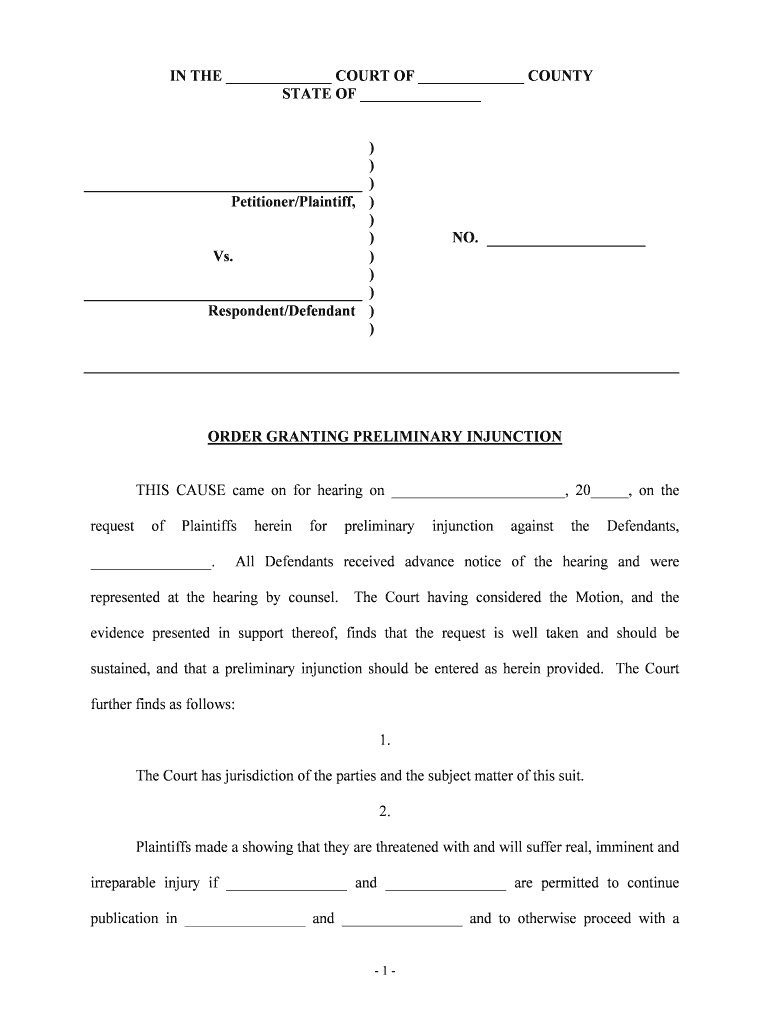
Complete caption and case number identify the court and parties; accuracy avoids misfiling and ensures the document attaches to the correct docket entry.
Intro Paragraph

A concise introductory paragraph states who sought relief, the motion type, and whether the order follows an evidentiary hearing or is entered ex parte.

Findings of Fact

A court’s factual findings should explain the evidence supporting relief and the immediacy or irreparability of harm to justify the injunction.

Conclusions of Law

Legal conclusions cite the governing standards for injunctive relief and explain why the law supports the specific remedy requested.

Order Language

Precise operative language defines prohibited or required acts, spatial and temporal limits, any bond, and conditions for modification or dissolution.

Service and Enforcement

Instructions for service, effective date, and the court’s contempt or sanctions provisions clarify how the order will be enforced after entry.

Where to file, how to serve, and what happens after entry

Follow the filing and service sequence required by the court to ensure the order is entered, served, and enforceable.

  • File with Court: Submit motion and proposed order via e-file or clerk’s office
  • Judge Signs: Judge reviews and signs if standards are met
  • Serve Order: Serve respondent according to procedural rules
  • Enforcement: Court may hold hearings or impose sanctions

Digital signing and eSubmission considerations for court documents

Courts vary on acceptance of electronically executed documents; check local rules before e-signing or e-filing an injunction order.

  • File format: Use court-accepted PDF format
  • Authentication: Use verifiable signer authentication
  • Audit trail: Retain timestamp and event log

When permitted, use systems that provide tamper-evident signed PDFs, audit trails, and retention compliant with ESIGN, UETA, and any local court technical standards.

Recommended eSubmission setup for injunction filings

Configure your document workflow to meet court e-filing and signature requirements and to create an auditable record.

Field Configuration
Document Type PDF/A with embedded metadata
Signature Type Electronic signature or digital PKI as required
Authentication Email + SMS code or stronger KBA
Retention Secure storage with audit trail

How Injunction Orders compare with temporary restraining orders

Compare typical procedural characteristics to determine which remedy fits your immediate needs and litigation strategy.

Comparison Injunction Order Temporary Restraining Order
Duration longer term short term
Hearing required usually yes often immediate short hearing
Ex parte rare possible
Bond required may require bond often requires bond

Key timing rules and statutory deadlines to watch

Certain federal rules provide concrete timing limits; local rules and emergency procedures also control hearings and service.

TRO maximum:

FRCP 65(b) allows ex parte TROs typically for 14 days

Service deadline:

Service generally within 90 days (FRCP 4(m))

Hearing scheduling:

Preliminary injunction hearings vary by court

Bond timing:

Bond set at or before entry if required

Local rules:

Check county or district local rules for variations

Typical milestone sequence for an injunction proceeding

Milestones move from filing to enforcement; meeting each step promptly reduces the risk of procedural dismissal or delay.

01

Filing

File motion, proposed order, and supporting affidavits

02

Interim Relief

Court may issue TRO or set expedited hearing

03

Hearing

Adjudicate preliminary injunction with evidence and argument

04

Final Order

Court enters preliminary or permanent injunction

Representative eSignature vendor comparison for court documents

Compare starting prices and core features relevant to executing and storing legal documents; signNow is listed first per vendor ordering rules.

signNow DocuSign Adobe Sign PandaDoc HelloSign
Starting Price $8/user/mo $15/user/mo $14/user/mo $19/user/mo $15/user/mo
Free Trial 7-day free trial Varies Varies Varies Varies
Bulk Send Yes (Premium+) Yes Yes Yes No
Audit Trail Yes Yes Yes Yes Yes
HIPAA Compliant Yes Yes Yes No No

Illustrative scenarios where injunctions are used

These examples show common fact patterns and the type of relief typically requested in injunction motions.

Neighbor Dispute

A homeowner alleges ongoing trespass and property damage by a neighbor

  • Plaintiff seeks a prohibitory injunction to stop entry
  • The proposed order defines prohibited acts, a geographic boundary, enforcement steps, and a timeline for compliance and future contempt hearings.

IP Infringement

A company identifies unauthorized distribution of proprietary software online

  • Plaintiff requests a preliminary injunction to halt distribution and preserve evidence
  • The order seeks injunctive relief, expedited discovery, and coordination with service providers for asset freezes and takedowns.

Practical tips for accurate, enforceable injunction orders

Follow these best practices to minimize procedural objections and improve enforceability of the court’s order.

Be specific in operative language
Draft narrowly tailored prohibitions and timeframes to avoid overbreadth and make enforcement straightforward rather than ambiguous.
Attach sworn evidence
Support assertions of irreparable harm with affidavits, exhibits, and declarations to meet the court’s evidentiary threshold.
Comply with local rules
Use correct captioning, required forms, and local formatting rules to prevent clerical rejection or delays.
Document service carefully
Retain proof of service that complies with FRCP or applicable state rules to establish proper notice before enforcement.

Frequently asked questions about Injunction Orders

Answers to common procedural and technical questions when preparing, filing, signing, and serving injunction-related documents.


Need help? Contact support

be ready to get more
Join over 28 million airSlate SignNow users