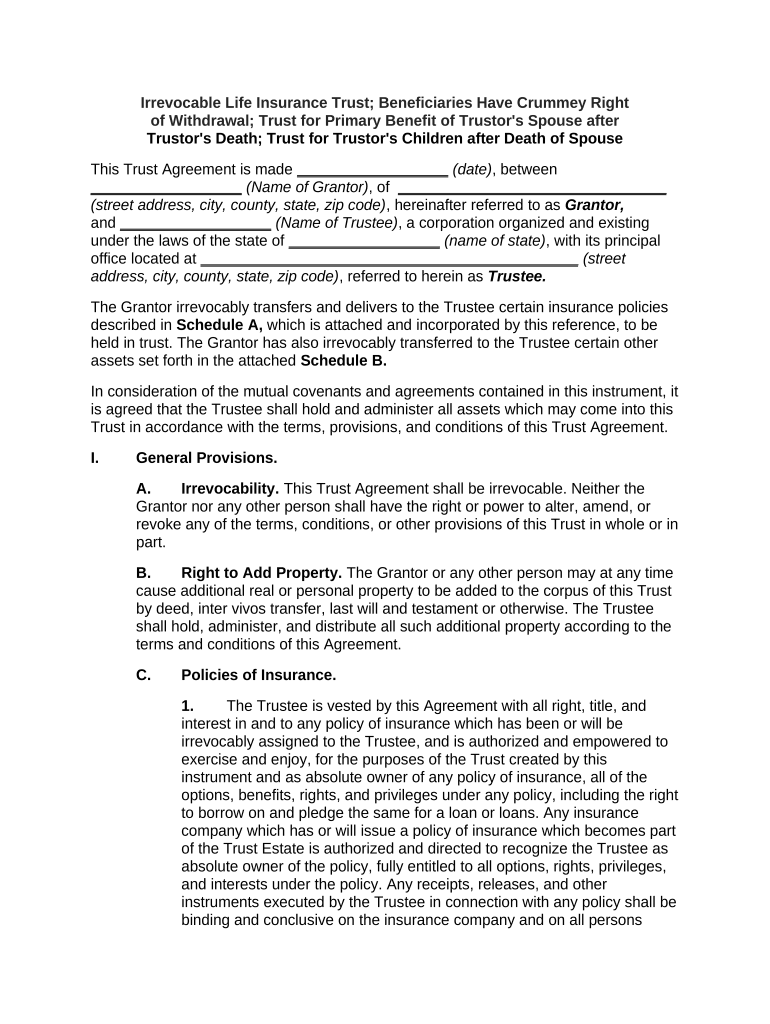
Irrevocable Life Insurance Trust; Beneficiaries Have Crummey Right
of Withdrawal; Trust for Primary Benefit of Trustor's Spouse after
Trustor's Death; Trust for Trustor's Children after Death of Spouse
This Trust Agreement is made __________________ (date) , between
__________________ (Name of Grantor) , of ________________________________
(street address, city, county, state, zip code) , hereinafter referred to as Grantor,
and __________________ (Name of Trustee) , a corporation organized and existing
under the laws of the state of __________________ (name of state) , with its principal
office located at _____________________________________________ (street
address, city, county, state, zip code) , referred to herein as Trustee.
The Grantor irrevocably transfers and delivers to the Trustee certain insurance policies
described in Schedule A, which is attached and incorporated by this reference, to be
held in trust. The Grantor has also irrevocably transferred to the Trustee certain other
assets set forth in the attached Schedule B.
In consideration of the mutual covenants and agreements contained in this instrument, it
is agreed that the Trustee shall hold and administer all assets which may come into this
Trust in accordance with the terms, provisions, and conditions of this Trust Agreement.
I. General Provisions.
A. Irrevocability. This Trust Agreement shall be irrevocable. Neither the
Grantor nor any other person shall have the right or power to alter, amend, or
revoke any of the terms, conditions, or other provisions of this Trust in whole or in
part.
B. Right to Add Property. T he Grantor or any other person may at any time
cause additional real or personal property to be added to the corpus of this Trust
by deed, inter vivos transfer, last will and testament or otherwise. The Trustee
shall hold, administer, and distribute all such additional property according to the
terms and conditions of this Agreement.
C. Policies of Insurance.
1. The Trustee is vested by this Agreement with all right, title, and
interest in and to any policy of insurance which has been or will be
irrevocably assigned to the Trustee, and is authorized and empowered to
exercise and enjoy, for the purposes of the Trust created by this
instrument and as absolute owner of any policy of insurance, all of the
options, benefits, rights, and privileges under any policy, including the right
to borrow on and pledge the same for a loan or loans. Any insurance
company which has or will issue a policy of insurance which becomes part
of the Trust Estate is authorized and directed to recognize the Trustee as
absolute owner of the policy, fully entitled to all options, rights, privileges,
and interests under the policy. Any receipts, releases, and other
instruments executed by the Trustee in connection with any policy shall be
binding and conclusive on the insurance company and on all persons
interested in this Trust. The Grantor relinquishes all rights and powers in
any policy of insurance forming a part of the Trust Estate and will, at the
request of the Trustee, execute any and all instruments reasonably
required to effectuate this relinquishment.
2. The Trustee shall, to the extent the assets of the Trust permit, pay
the premiums which may become due and payable under the provisions of
any policy of insurance forming a part of the Trust Estate. If the assets of
the Trust do not permit such payment of premiums, the Trustee shall be
under no obligation to pay the premiums which may become due and
payable under the provisions of any policy of insurance forming a part of
this Trust Estate, or to make certain that the premiums are paid by the
Grantor or others, or to notify any persons of the nonpayment of the
premiums. The Trustee shall be under no responsibility or liability of any
kind if the premiums are not paid, except that it shall apply any dividends
received on any policy to the payment of premiums on the policy. On
notice, at any time during the continuance of this Trust, that the premiums
due on any policy are in default, or that premiums to become due will not
be paid, by the Grantor, the Trustee, or any other person, the Trustee, in
its sole discretion, may apply any cash values attributable to any policy to
the purchase of paid-up insurance or of extended insurance, or may
borrow on any policy for the payment of premiums due on the policy, or
may accept cash values of any policy on its forfeiture. If the Grantor
becomes totally and permanently disabled, within the meaning of any
policy forming part of the Trust Estate, and as a result the payment of
premiums or any of them shall during the pendency of the disability be
waived, the Trustee, on receipt of such knowledge, shall promptly notify
the insurance company which has issued any policy, and shall take any
and all steps necessary to make such waiver of premium provision
effective.
3. In the year of the creation of this Trust, and in every succeeding
calendar year in which the Grantor shall transfer property to this Trust, the
Trustee shall pay immediately to or for the benefit of each designated
beneficiary of the Grantor, who personally or through his or her guardian
shall request (in an instrument in writing deposited with the Trustee no
later than __________________ (number) days after notice is sent to the
designated beneficiary or his or her representative that property has been
transferred to this Trust) property of a value equal to (a) the value, as of
the date of the transfer, of the property so transferred in the respective
year divided by (b) the number of then designated beneficiaries of the
Grantor; provided, however, that the total amount that may be so
requested by the beneficiary in each calendar year shall not exceed the
greater of $5,000 or the maximum gift-tax exclusion. The Trustee shall
send a notice in writing by mail or deliver a notice personally to each
designated beneficiary representative within __________________
(number) days after it receives the transfer.
4. The Trustee shall be under no obligation or duty except: (1) those
duties set forth in this Agreement; (2) the duty of safekeeping of any policy
of insurance forming part of the Trust Estate; and (3) the duty to receive
such sums as may be paid to it, in accordance with the requirements of
this Trust, by the company issuing any such policy, or to hold and disburse
such proceeds subject to the terms of this Agreement. On the death of the
insured under any such policy, the Trustee shall make reasonable efforts
to carry out the provisions of this Agreement, including the maintenance or
defense of any suit; provided, however, it shall be under no duty to
maintain or enter into any litigation unless its expenses, including counsel
fees and costs, have been advanced or guaranteed in an amount and in a
manner reasonably satisfactory to it. The Trustee may repay any
advances made by it or reimburse itself for any such fees and costs out of
any principal or income of this Trust.
D. Right to Loan Assets. The Trustee may, in its absolute and uncontrolled
discretion, loan assets with adequate interest and security, as the Trustee
determines, to the Estate of the Grantor, to the Estate of the Grantor's spouse, or
to the Estate of any beneficiary of any Trust fund created by this Agreement. The
propriety of the loan, the amount of the loan, and the interest chargeable, and the
security for the loan shall be solely within the discretion of the Trustee. The
Trustee shall incur no liability as a result of the loan or by the default in
repayment of the loan in whole or in part.
II. Disposition of Trust Estate for Spouse of Grantor. During the Life of Grantor's
Spouse:
A. The entire net income received by the Trustee (after payment of all
administrative obligations or premiums on life-insurance policies, if any), shall be
paid to or for the benefit of the spouse of the Grantor, if living, in monthly or other
convenient installments during __________________ (his/her) lifetime.
B. Furthermore, the Trustee is authorized to pay to, or for the benefit of, the
Grantor's spouse and issue of the Grantor, such portions of the principal of this
Trust, whether the whole or a lesser amount, as the Trustee shall, from time to
time, determine to be necessary in its absolute and uncontrolled discretion for his
or her health, maintenance, support, and education, in accordance with his or her
station in life, due regard being given by the Trustee to the amount of income
available to him or her from this Trust, and from sources other than this Trust. It
is the Grantor's intention that the health, maintenance, and support of the
Grantor's spouse shall be of primary concern, and the Trustee shall exercise its
discretion in using principal for the Grantor's spouse in a reasonable manner
consistent with maintaining the accustomed manner of living of the Grantor's
spouse, considering all other beneficiaries of this Trust to be secondary and
without liability to any other beneficiary for the use of principal for the Grantor's
spouse.
III. Disposition of Trust Estate after Death of Spouse of Grantor.
A. Income and Principal to Grantor's Children. On the subsequent death
of the spouse of the Grantor, if the Grantor predeceases, or on the death of the
Grantor, if the spouse predeceases, the balance of this Trust shall be held and
distributed as follows:
1. The Trustee shall divide the Trust assets for accounting purposes into as
many equal shares as shall be equal to the number of children of the Grantor
who are then living and the number of children of the Grantor who are deceased,
leaving issue then surviving. The Trustee need not physically divide the Trust
assets into shares, but may regard all shares as a single fund for investment
purposes, if it desires. However, all distributions of income and principal shall be
made to the beneficiaries of each share from the share created for his or her
benefit.
2. After this Trust is divided into separate shares, the Trustee shall pay to or
for the benefit of each child of the Grantor all of the net income derived from his
or her respective share, in quarterly, annual, or other convenient installments,
and so much of the principal of his or her respective share, from time to time, as
it deems advisable in its absolute and uncontrolled discretion, for his or her
health, maintenance, support, and education, until his or her respective share is
distributed by way of final distribution. At any time after this Trust is divided into
separate shares, the Trustee is authorized, if it considers it advisable to do so, to
advance to the beneficiaries of each share sufficient amounts to enable them to
marry, to purchase a home, to enter or purchase a business, to establish a
professional office, to travel, to take postgraduate work, to purchase automobiles,
and for other similar purposes.
3. When such child attains the age of __________________ (number) years,
the Trustee shall distribute to the child _______ % of the balance of the principal
of his or her share of the Trust Estate. When the child attains the age of
__________________ (number) years, the Trustee shall distribute to the
child _______ % of the balance of the principal of his or her share of the Trust
Estate. When the child attains the age of __________________ (number) years,
the Trustee shall then distribute the remaining balance of his or her share of the
Trust Estate.
4. If a share is created for the issue of any deceased child of the Grantor, or
if any child of the Grantor dies before receiving all of the assets of his or her
respective share leaving issue then surviving, the Trustee shall pay such parts of
income and such parts of principal as the Trustee shall, from time to time,
determine to be necessary for the health, maintenance, support, and education
of the issue from his or her respective share, and then distribute the share of the
deceased child of the Grantor, per stirpes, when the youngest living child of the
deceased child of the Grantor reaches _______ (18/21) years of age.
5. If any child of the Grantor dies before receiving all of the assets of his or
her respective share, without leaving issue surviving him or her, or if all of his or
her issue shall die before final distribution of the share of the deceased child of
the Grantor, the share of the deceased child of the Grantor shall be added
equally to the shares of the other children of the Grantor (counting as one such
share the share held for the issue of another deceased child of the Grantor), in
equal proportions, to be held in Trust if the shares have not been distributed, or
to be distributed outright to the Grantor's other children if their shares have
already been distributed to them; or if the Grantor's other children have already
received final distribution of his or her share or are no longer living, to the issue
of such other deceased child of the Grantor, per stirpes.
6. The Grantor presently has __________________ (number) children
whose names and birthdates for purposes of this Trust are as follows:
___________________________________________________________
(names of children), (birthdates of children) .
However, this Trust shall also be for the benefit of other children of the Grantor
who may be born or legally adopted by the Grantor after the date this Trust
Agreement is signed.
B. Death of Grantor, Grantor's Spouse, and All Issue of Grantor. In the
event of the death of the Grantor, the Grantor's spouse, all issue of the Grantor,
and all other beneficiaries of this Trust, prior to the time set for final distribution of
the assets of this Trust, the remaining Trust assets, including accumulated
income, shall be distributed to the Estate of the Grantor.
IV. Spendthrift Provision. The income and principal of this Trust shall not be
alienated or disposed of, or in any manner encumbered by the beneficiaries while in the
possession and control of the Trustee. If a beneficiary shall alienate, charge, or dispose
of his or her income or principal, or any part of or any interest in the same, or if by
reason of his or her bankruptcy, or other event endangering a beneficiary's interest in
this Trust which may occur at any time during the continuance of this Trust, the income
or principal otherwise intended for the beneficiary shall wholly or in part cease to be
enjoyed by him or her as above provided. In such event, the Trust above-mentioned
concerning the income and principal shall then cease and terminate as to the
beneficiary. The income and principal otherwise provided for him or her subsequently
shall be held and distributed by the Trustee for him or her, during the remainder of his or
her life, according to the absolute discretion of the Trustee. However, the Trustee may,
nevertheless, pay to him or her, or for his or her health, maintenance, support, and
education, or to his or her child, children, or spouse, from such income and principal,
such sums as it, in its absolute discretion, shall think fit and proper, having regard for
the wishes of the Grantor as in this instrument expressed, and retaining any
unexpended sums as part of the principal of the Trust to be finally disposed of after the
death of the beneficiary, as provided in this Agreement.
V. Dispensing with Accrual of Income. Income accrued on property originally
placed in or subsequently added to this Trust at the time of its transfer to the Trustee,
and dividends on shares of stock originally placed in or subsequently added to this Trust
which are declared prior to the date the shares are placed in or added to this Trust, but
payable to stockholders of record determined as of a date which is on or subsequent to
the date the shares are placed in or added to this Trust, shall be income of this Trust.
On the termination of any interest in this Trust under this Agreement, all income which
has accrued on such interest, but which has not been received by the Trustee, and all
dividends declared on such interest, but not yet received by the Trustee, shall belong to
the succeeding estate, subject to any charges or advances against the income or
dividends.
VI. Termination.
A. By Law. Anything to the contrary notwithstanding, the Trust created in this
Agreement shall terminate not later than __________________ (number) years
after the death of the last survivor of the group composed of the Grantor, the
Grantor's spouse, and the Grantor's issue who are living at the date this Trust
Agreement is signed. If any Trust created in this Agreement has not sooner
terminated, the Trustee at that time shall pay over, convey, and deliver the
remaining Trust assets then in its possession in equal shares to the persons then
entitled to receive the income from the Trust.
B. Premature Termination by Trustee. Notwithstanding any other
provisions of this Trust Agreement, after the death of the Grantor and the
Grantor's spouse, the Trustee shall be authorized to terminate, at any time, any
Trust created under this Agreement prior to the time provided above for the
termination, if the Trustee shall determine, in the absolute and uncontrolled
discretion of the Trustee without notice or the approval of any court or affected
beneficiary, that the expense of the continuation of the Trust is unreasonably
great in relation to the assets of the Trust and that the termination of the Trust will
not result in unreasonable financial or other inconvenience to the beneficiaries of
the Trust. A Trust may be so terminated prior to the determination of a class of
beneficiaries of the Trust. In the event of any such termination the principal and
accumulated income, if any, of the Trust shall be distributed to the then-living
beneficiaries for whom the Trust was held, per stirpes, except as may be
otherwise provided on the termination of the Trust at the time provided above.
C. Termination by Lapsing. This Trust may also be terminated at the sole
option of the Trustee at any time after __________________ (number) years
after the death of the second one to die of the Grantor and the Grantor's spouse,
if no assets other than a nominal deposit have been received by the Trustee as
Trust assets.
VII. Trustee’s Powers of Administration. In addition to and not in limitation of the
powers given by law, the Trustee shall have full power:
A. To hold and retain any of the property coming into its possession under
this Agreement in the same form of investment as those forms in which it was
received by the Trustee, even though the retention may result in an excess
concentration in one class of property, without incurring liability in any way for
any loss of principal or income caused by the decline in value of any such
investment or investments;
B. To sell or exchange at public or private sale, lease, pledge, mortgage,
donate, abandon, or otherwise dispose of, deal with, or encumber (for any period
of time whatsoever, whether or not ending during the term of the Trust), any real
or personal property comprising part of the Trust Estate;
C. To borrow money on the credit of the Trust Estate from itself or from other
sources;
D. To invest and reinvest any money, whether the income or principal at any
time in the Trust in such bonds, stocks, notes, real-estate mortgages, or other
securities, life-insurance policies, or in such other property, real or personal, or in
a common trust fund, as the Trustee shall deem wise, without being limited by
any statute or rule of law of __________________ (name of state) regarding
investments by Trustees now or later in effect;
E. To maintain an uninvested cash reserve;
F. To cause any security or other property which may at any time constitute a
portion of the Trust to be issued, held, or registered in the name of a nominee or
in such form that title will pass by delivery;
G. To keep any real or personal property of this Trust at any location within
the United States or abroad, or to keep any such property with a reasonable
depository or custodian at any location;
H. To vow by proxy or in person, and exercise all other rights in relation to all
stocks and securities contained in the Trust;
I. To enter into option or voting trust agreements and to consent to the
reorganization, consolidation, liquidation, readjustment of the financial structure,
or sale of the assets of any corporation or other organization, the securities of
which constitute a portion of the Trust, and to take any action with reference to
the securities which, in the opinion of the Trustee, is necessary to obtain the
benefit of any such reorganization, consolidation, readjustment, or sale; to
exercise any conversion privilege or subscription right given to it as the owner of
any security constituting a portion of the Trust; to accept and hold as a portion of
the Trust the securities resulting from any such reorganization, consolidation,
readjustment, sale, conversion or subscription;
J. To hold, administer, maintain, subdivide, and manage any real estate
coming into the Trust estate, paying all taxes, assessments, maintenance, and
other proper charges on the real estate, with full power to mortgage the real
estate if necessary for the purposes of conserving the Trust estate; and to make
such improvements, additions, and alterations as in its judgment will be beneficial
to the real estate, and to charge any costs and expenses of the same to principal
or income as the Trustee shall deem equitable;
K. To make payments directly to minor beneficiaries, or to the person with
whom the minors are living, without requiring the appointment of a legal guardian
to receive such payments, and the receipt signed by the minor beneficiary or the
person with whom the minor is living, shall discharge the Trustee of any liability
to see to the application of such payments;
L. To retain any interest held by it in any business, or to enter into or acquire
any interest in any business, whether as a stockholder or security holder of a
corporation, a general or limited partner, a sole proprietor, or otherwise, for any
length of time, without limitations; to participate in the conduct of such business,
and take or delegate to others discretionary power to take any action with respect
to its management and affairs which an individual could take as the owner of the
business, including the voting of stock, and the determination of any or all
questions of policy; to participate in any incorporation, reorganization, merger,
consolidation, recapitalization, or liquidation of such business; to invest additional
capital in, subscribe to additional stock or securities of, and loan money or credit
with or without security to, such business out of the Trust property, to elect or
employ directors, officers, employees, or agents of such business, and
compensate any persons, including any Trustee or a director, officer, or agent of
any Trustee; to deal with and act for the business in any capacity, including any
banking or trust capacity and the loaning of money out of the Trustee's own
funds, and to be compensated for the same; and to sell or liquidate such interest
or any part of it at any time; all without liability, responsibility, or accountability for
any action taken by it with regard to such interests or investments, or for any
decrease in the value of the same, provided the Trustee shall have been acting
at all times in good faith and within the powers and responsibilities conferred on it
by law or by this instrument;
M. To employ and compensate out of the Trust Estate, such attorneys,
agents, accountants, brokers, investment counsel, appraisers, custodians, and
other specialists, advisers, and assistants whose services are deemed by the
Trustee to be desirable for the proper administration of the Trust. The Trustee
shall not be liable for any neglect, omission, misconduct, or default of any such
persons, or for any action or nonaction which the Trustee may take in reliance on
the counsel of such persons, provided that the Trustee shall have selected and
retained such person with reasonable care;
N. To contract on such terms which expressly limit liability under the contract
to the assets of this Trust and which expressly exempt from liability the assets of
the Trustee;
O. To rely on affidavits, certificates, letters, statements, telegrams, or other
forms of written or oral notice which the Trustee shall believe to be genuine and
sufficient, in accordance with the duties and discretions granted to the Trustee,
without liability, provided the Trustee acts in good faith and without actual
knowledge of any condition or changed condition which may affect distributions
or operations under this Trust, or the status of any beneficiary of this Trust;
P. To determine what is income and what is principal, and to charge or credit
expenses, gains, losses, premiums, discounts, waste, and appreciation or
depreciation in value to principal or income, or partly to each. In all cases,
however, the Trustee shall act in accordance with trust accounting principles as
established by available case or statutory law in __________________ (name of
state) . The foregoing power shall apply to, but not be limited to, cash and
noncash dividends, stock dividends, liquidating dividends, distributions from
regulated investment companies, premiums, and discounts on the purchase of
investments, and includes the power to set up or not to set up reserves and
sinking funds for taxes, assessments, insurance premiums, repairs,
improvements, depreciation, obsolescence, and maintenance, and for any other
purpose;
Q. To carry such insurance, including public liability, and property damage
insurance, against such hazards to the Trustee or the Trust estate, in such
amounts and with such insurance companies (whether stock companies or
mutual companies) as the Trustee deems advisable;
R. To execute and deliver such deeds, bills of sale, mortgages, releases,
consents, and other legal instruments as may be necessary or appropriate to
deliver in connection with the administration of the Trust; and
S. To do anything for the preservation and management of the Trust Estate
that it deems necessary, desirable, or expedient, and to exercise with respect to
the Trust Estate, all powers of an absolute legal and beneficial owner of the
same. The Trustee may act under this Agreement without prior notice to any
person and without the approval of any court. All powers of the Trustee shall be
continuing ones; none shall be exhausted by the exercise or repeated exercise of
the power. A power once exercised may be exercised in a different way and with
a different or inconsistent result on any subsequent exercise of the power.
VIII. Miscellaneous Provisions Relating to Trustee.
A. Trustee May Buy Insurance on Lives of Beneficiaries. After the death
of the Grantor, if there are sufficient assets in this Trust to do so, the Trustee is
authorized to purchase and maintain insurance on the lives of the beneficiaries of
the Trust created by this Agreement or on the lives of anyone in whom a
beneficiary of this Trust has an insurable interest, as well as health, accident,
hospitalization, major medical, or other casualty insurance, as a Trust
investment, and to pay the premium on the insurance policies as they become
due and payable out of either the income or the principal of this Trust. On any life
insurance so purchased, the Trustee shall be the owner and beneficiary of it.
B. Division into Shares. In any case in which the Trustee is required, or
desires, to divide the principal of the Trust Estate into parts or shares, it is
authorized and empowered in its sole discretion to make division in kind, or partly
in kind and partly in money. The judgment of the Trustee concerning the values
for the purpose of the division of the property or securities shall be binding and
conclusive on all interested parties.
C. Trustee Shall Keep Correct Books of Account. The Trustee shall keep
true and correct books of account showing all transactions in the Trust estate,
which books of account shall at all reasonable times be open to the inspection of
any beneficiary. The Trustee shall render annual statements of receipts and
disbursements and an inventory showing the assets and property constituting the
Trust Estate to the income beneficiaries of this Trust.
D. Trustee Entitled to Reasonable Compensation. The Trustee shall be
entitled to receive reasonable compensation for services rendered in the
administration of this Trust, which compensation may be paid from the income or
the principal of the Trust estate, or both.
E. Merger. If the fiduciary powers and services of the Trustee shall at any
time be merged with, consolidated with, be operated under joint agreement with,
or be transferred to any other corporation, association, subsidiary, or trust
company, or be reorganized into a new corporation, association, subsidiary, or
trust company, then the corporation, association, subsidiary, or trust company of
which it becomes a part, or the corporation, association, subsidiary, or trust
company succeeding to the fiduciary powers and services of the Trustee shall,
without any further act on the part of either of the parties to this Agreement, be
substituted in place and stead of the Trustee as fiduciary under this Agreement
and shall have all of the rights, powers, and authorities given to the Trustee, as
the fiduciary, and shall be subject to all of the duties, liabilities, and responsibilities
imposed on the Trustee as fiduciary.
F. Removal and Resignation of Trustee.
1. The Grantor's spouse, during the spouse's lifetime, at the spouse's
discretion, may remove or cause the removal of the Trustee or any
successor Trustee, as Trustee under the Trust. On such removal or in the
event of the resignation of the Trustee or any successor Trustee, the
Grantor's spouse shall designate, at the spouse's own discretion, another
corporate Trustee to serve as successor Trustee under this Agreement.
2. After the death of the Grantor's spouse, the children of the Grantor,
by a majority vote, may remove or cause the removal of the Trustee or
any successor Trustee, as Trustee under the Trust. On such removal or in
the event of the resignation of the Trustee or any successor Trustee, the
children of the Grantor, on a vote by a majority of them, shall designate
another corporate trustee to serve as successor Trustee under this
Agreement.
3. The removal of the Trustee or any successor Trustee shall be
accomplished by the delivery of an instrument in writing, executed by the
person or persons then entitled to remove or cause the removal of the
Trustee or any successor Trustee, to the Trustee or successor Trustee,
giving notice of such removal, together with the delivery of an instrument
in writing acknowledging acceptance of the appointment by the successor
corporate Trustee signed by an authorized officer of the successor
Trustee. On the receipt of such notice, the removed Trustee shall transfer
all of the Trust assets to the designated successor Trustee, subject to the
payment of all expenses and reasonable compensation to the removed
Trustee.
4. Any Trustee may at any time resign its duties as Trustee by
delivering an instrument in writing signed by an authorized officer to the
person or persons then entitled to remove a Trustee under this Agreement
or to their authorized representatives. On the receipt of such notice, the
person or persons then entitled to remove a Trustee or their authorized
representatives shall select and designate in writing another corporate
successor Trustee to serve, or an interim or permanent individual
successor Trustee (who is not a beneficiary of this Trust) if no corporate
successor Trustee accepts appointment. On the notice of the appointment
and the written acceptance by the successor Trustee, the resigning
Trustee shall deliver all of the Trust assets to the successor Trustee,
subject to the payment of all expenses and reasonable compensation to
the resigning Trustee.
5. On the acceptance by the successor Trustee and on the accounting
and delivery of all Trust assets to the successor Trustee, the removed or
resigning Trustee shall be completely discharged of any further
responsibility for the administration of this Trust. No successor Trustee
shall have any duty to inquire into the administration of the Trust by any
prior Trustee, and the successor Trustee shall not have any liability with
respect to such administration or any failure of the prior Trustee fully to
account. Any claim or action against a prior Trustee may in such event be
asserted or filed by a beneficiary or a successor Trustee only
within ________________________ ((number of months)/(number of
years))(months/years) after the date of the appointment of a successor
Trustee. On the delivery of all Trust assets, the successor Trustee shall be
vested with all of the rights, powers, duties and discretion of the prior
Trustee.
G. Word Usage and Captions. Whenever words are used in this Agreement
in any gender, they shall be construed as though they were used in the gender
appropriate to the circumstances; and wherever words are used in the singular or
plural form, they shall be construed as though they were used in the form
appropriate to the circumstances. Headings and captions in this Agreement are
inserted for convenience or reference. They constitute no part of this Agreement
and are not to be considered in the construction of this Agreement. Every
pronoun includes corresponding pronouns in the same person of different
genders or numbers or both, to the extent the context permits.
The words child, children, and issue used in this Trust shall include legally
adopted children, and designated heirs. The word issue shall mean lineal
descendants indefinitely.
H. Governing Law. This Agreement shall be construed under the applicable
laws of __________________ (name of state) in effect from time to time.
The Grantor has affixed the Grantor's signature and the Trustee has caused its
corporate signature to be affixed to this Agreement on the date first above-written.
______________________
(Signature of Grantor)
________________________
(Printed Name of Grantor)
________________________
(Name of Trustee)
By:____________________
(Signature of Trustee)
________________________
(Printed Name of Officer of Trustee)
________________________
(Title of Officer of Trustee)
(Acknowledgments)
(Attach Schedules)