Establishing secure connection…Loading editor…Preparing document…

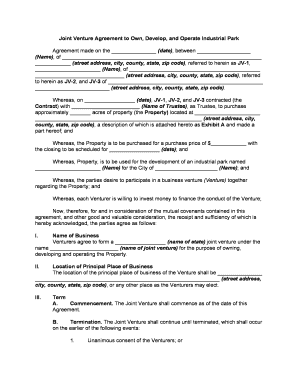
Joint Venture Agreement to Own, Develop, and Operate Industrial Park

This template is fully customizable. Edit the text, fill out the fields, and send it for signature. Give it a try!
Joint Venture Agreement to Own, Develop, and Operate Industrial Park

What this Joint Venture Agreement covers

A Joint Venture Agreement to Own, Develop, and Operate Industrial Park is a legally binding contract between two or more parties that establishes a joint enterprise to acquire land, design and build infrastructure, secure permits, and manage an industrial park for leasing or sale. The agreement sets out capital contributions, profit and loss sharing, governance and management structures, development schedules, permitting responsibilities, lien and easement allocation, insurance and indemnity provisions, and exit or dissolution mechanics. It is used to align expectations, reduce operational disputes, and document compliance with local land use and commercial laws.

Why use a formal joint venture agreement for an industrial park

A written joint venture agreement clarifies ownership percentages, development obligations, cost sharing, and decision-making authority, reducing dispute risk and enabling lenders and investors to rely on a documented governance framework under applicable state corporate and real estate law.

Why use a formal joint venture agreement for an industrial park

Who commonly participates in these joint ventures

Typical participants include equity investors, landowners, development firms, and operating managers brought together to share risk and expertise.

  • Developers and builders managing construction schedules and contractor relationships.
  • Private equity or institutional investors providing capital and requiring reporting controls.
  • Local landowners or municipalities contributing land or approvals to the project.

Parties should confirm roles, capital calls, and dispute resolution processes in writing before undertaking permitting or construction to avoid costly delays.

Core clauses to include in the agreement

A comprehensive agreement addresses governance, financing, development scope, risk allocation, operating controls, and exit mechanics to protect each party during development and post-construction operations.

Governing structure

Specify the legal vehicle (joint venture LLC or partnership), voting thresholds, managers, and reserved matters to control major decisions during development and operations.
Capital and contributions

Detail initial capital, subsequent capital call mechanics, contribution types (cash, land, services), dilution protections, and remedies for missed contributions.

Development obligations

Allocate responsibilities for permits, engineering, construction management, contractor procurement, and timeline milestones with acceptance criteria.

Profit and loss allocation

Define distribution waterfalls, preferred returns, operating cash flow treatment, tax allocations, and accounting conventions applicable to the JV.

Risk allocation

Include insurance requirements, indemnities, environmental representations, lien waivers, and procedures for unknown site conditions or regulatory changes.

Exit and dissolution

Prescribe transfer restrictions, buy‑sell mechanisms, valuation methods, foreclosure procedures, and dissolution steps post-completion or upon default.

Step-by-step: completing the agreement

Follow a consistent sequence to draft, approve, and execute the agreement to preserve evidence and satisfy lenders, title insurers, and permitting authorities.

  • 01
    Draft terms: Assemble term sheet into a first draft.
  • 02
    Legal review: Have counsel review for tax, environmental, and real estate risk.
  • 03
    Obtain approvals: Secure board or investor consents and lender pre-approvals.
  • 04
    Execute and record: Sign, notarize if needed, and file necessary records.

Digital workflow settings for eSigning and approvals

Configure an online signing workflow that matches the agreement's execution order and required authentication strength.

Field Configuration
Signer order Sequential | Ensure parties sign in agreed order
Authentication Email + SMS | Use SMS codes for higher assurance
Conditional fields Enabled | Reveal annexes based on selections
Audit trail On | Retain IP, timestamps, and actions

Typical electronic execution flow

An eSignature workflow reduces turnaround and centralizes records while capturing evidence required for enforceability under U.S. law.

  • Upload document: Sender uploads final agreement.
  • Place fields: Add sign, initial, and date fields.
  • Send to signers: Dispatch by email or link.
  • Complete signing: System captures audit trail.

Technical requirements and compatibility

Choose a platform that supports required authentication, secure storage, and integration with your document management systems.

  • File formats: PDF, DOCX
  • Integrations: Salesforce, NetSuite
  • Security: AES-256 at rest

Ensure the provider supports audit logs, industry compliance (e.g., HIPAA if relevant), and exports that meet lender or title insurer requirements.

Practical tips to streamline preparation and execution

Adopt these practices to minimize disputes, accelerate approvals, and preserve evidentiary requirements for lenders and title companies.

Use a clear term sheet
Begin negotiations with a concise term sheet covering capital structure, milestones, and key approvals; convert it into the draft agreement to reduce revisions.
Document contributions precisely
Quantify noncash contributions (acreage, improvements) and attach valuation exhibits to prevent later claims of over- or under-contribution.
Coordinate with lenders early
Share draft JV and development budgets with potential lenders to identify title, lien, and collateral issues well before closing.
Preserve execution evidence
Use an eSignature solution that captures IP, timestamps, signer authentication, and produces a tamper-evident certificate for recordkeeping.

Common drafting and execution pitfalls

  • Vague contribution terms that omit valuation method lead to capital disputes and dilution fights between partners.
  • Missing permits or unclear permit responsibility causes construction delays and increased cost exposure.
  • Failure to define dispute resolution and deadlock procedures can stall decisions and jeopardize project continuity.
  • Not coordinating lien waivers and payment bonds may result in mechanic liens that cloud title and delay sales.

Short list of legal and financial risks

Tax exposure: Incorrect allocations
Lien risk: Contractor liens
Permit defaults: Work stoppage
Breach damages: Monetary liability
Fraud allegations: Criminal risk
Title issues: Delayed closings

eSignature vendor feature and price comparison for executing JV documents

Compare foundational pricing and compliance features when choosing an eSignature provider; signNow is shown first for reference against market alternatives.

signNow DocuSign Adobe Sign PandaDoc HelloSign
Starting Price $8/user/mo $15/user/mo $14/user/mo $19/user/mo $15/user/mo
Free Trial 7-day free trial Varies Varies Varies Varies
Bulk Send Yes (Business Premium) Yes Yes Yes No
Audit Trail Yes Yes Yes Yes Yes
HIPAA Compliant Yes Yes Yes No No
Envelope Cap No envelope cap 100 envelopes/user/year Varies Varies Varies

Frequently asked questions and common execution issues

Practical answers to recurring questions about signing, notarization, enforceability, and electronic recordkeeping for JV agreements.


Need help? Contact support

be ready to get more
Join over 28 million airSlate SignNow users