Establishing secure connection…Loading editor…Preparing document…

Layoff Checklist

This template is fully customizable. Edit the text, fill out the fields, and send it for signature. Give it a try!
Layoff Checklist

What the Layoff Checklist Is and When to Use It

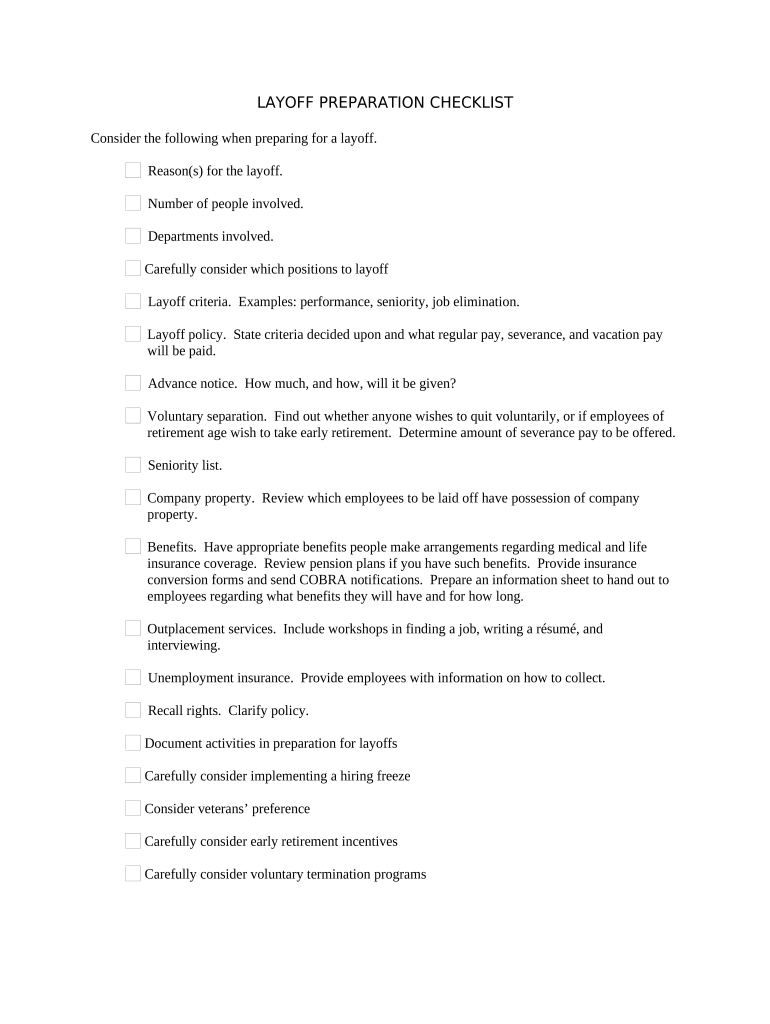
A Layoff Checklist is a structured internal HR document that captures the steps, approvals, notifications, and recordkeeping required when reducing staff. It organizes legal notices, benefits actions, payroll adjustments, final pay arrangements, return-of-property steps, and required government forms so decisions are consistent and auditable. Use it to document compliance with federal rules, applicable state WARN requirements, I-9 retention, unemployment filings, and any industry-specific obligations. A clear checklist reduces oversights during a time-sensitive process and supports defensible documentation in the event of disputes or regulatory review.

Why a Layoff Checklist Matters for HR Controls

A checklist centralizes legal, payroll, and communications tasks to reduce errors and preserve evidence of compliance. It helps coordinate cross-functional teams, ensures consistent treatment of affected employees, and provides an auditable trail for legal and regulatory review.

Why a Layoff Checklist Matters for HR Controls

Who Typically Prepares and Uses a Layoff Checklist

HR leaders, company legal counsel, and operations managers typically prepare and rely on the checklist during workforce reductions.

  • Human Resources teams responsible for benefits, payroll triggers, and termination communications.
  • In-house Legal counsel for WARN, discrimination, and release agreement review.
  • Finance and Payroll teams for final pay, PTO payout, and tax reporting.

Use a single checklist shared across stakeholders to reduce duplication, track completion, and retain proof of the steps taken.

Core Components to Include in a Professional Layoff Checklist

A comprehensive checklist groups legal requirements, employee-level actions, approvals, and communications so each layoff is consistently managed and documented.

Employee Data

Full legal name, employee ID, job title, department, manager, last day, and preferred contact information for record accuracy and future correspondence.
Legal Notices

Federal WARN act screening and any state WARN obligations, with dates and method of delivery documented for potential administrative review or litigation.

Payroll Actions

Final paycheck timing, accrued PTO payout, tax withholdings, COBRA notice timing, and paystub evidence required for audit and state wage laws.

Benefits & COBRA

Benefit termination dates, COBRA election packet dispatch, health plan continuation options, and any employer subsidy or administrative contact details.

Property Return

Inventory of company property, access revocation dates, IT offboarding steps, and confirmation fields for returned hardware or revoked credentials.

Signatures & Approvals

Document pre-termination approvals, severance or separation agreements, release signatures, and signatory authority with timestamped audit trail entries.

Step-by-step Sequence for Completing a Layoff Checklist

Follow a standard sequence to ensure legal, payroll, and communications items are completed in order and documented.

  • 01
    Screen for WARN: Assess need for federal or state WARN notice.
  • 02
    Approve Separation: Obtain HR and legal sign-off.
  • 03
    Prepare Notices: Draft termination and benefits notices.
  • 04
    Finalize Offboarding: Complete payroll, return property, and revoke access.

How to Configure an Online Checklist Workflow

Set up roles, required fields, and routing so approvals and signatures happen automatically and records are retained.

Field Configuration
Required Approvals HR Manager → Legal → Finance
Signature Order Sequential with audit timestamps
Retention Setting Auto-archive after retention period
Access Controls Role-based access and SSO where available

Typical Routing for Electronic Layoff Checklists

An electronic workflow reduces handoffs and centralizes evidence: upload, assign, sign, and store with a searchable audit trail.

  • Upload Document: HR uploads the completed checklist.
  • Assign Reviewers: Legal and Finance receive the routing task.
  • Sign & Timestamp: Authorized signers apply eSignatures.
  • Archive Record: System stores audit trail and final PDF.

Technical Considerations for eSubmission and Signing

Verify platform compliance, supported formats, and authentication methods before e-submitting legally-sensitive layoff documents.

  • File Formats: PDF and DOCX accepted
  • Authentication: Email, SMS, or stronger options
  • Integrations: Connects to HRIS and payroll

Choose a platform that supports audit trails, role-based access, and retention controls; confirm HIPAA or other BAAs if handling protected health information.

Common eSignature Vendor Pricing and Feature Snapshot

Compare basic pricing and a few core capabilities. signNow is listed first per platform comparison conventions; consult vendor sites for full plan detail.

signNow DocuSign Adobe Sign PandaDoc HelloSign
Starting Price $8/user/mo $15/user/mo $14/user/mo $19/user/mo $15/user/mo
Free Trial 7-day free trial Varies by plan Varies by plan Varies by plan Varies by plan
Bulk Send Yes (Business Premium) Varies by plan Varies by plan Varies by plan Varies by plan
Audit Trail Yes Yes Yes Yes Yes
HIPAA Compliant Yes (BAA required) Varies by plan Varies by plan Varies by plan Varies by plan
Envelope Cap No envelope cap 100 envelopes/user/year Varies by plan Varies by plan Varies by plan

Key Risks and Penalties of Incomplete or Incorrect Checklists

I-9 Violations: I-9 paperwork penalties range $281–$2,789 per violation (8 CFR §274a.2).
WARN Noncompliance: Potential back pay and penalties for failing to meet WARN notice obligations.
Benefit Errors: Incorrect COBRA handling can trigger claims and administrative fines.
Payroll Violations: Late final pay or PTO payout may violate state wage laws and incur penalties.
Discrimination Claims: Inconsistent selection or documentation increases exposure to adverse action claims.
Data Breach Risk: Improper storage of employee data can trigger HIPAA/CCPA exposure where applicable.

Common Mistakes When Preparing a Layoff Checklist

  • Failing to evaluate federal and state WARN obligations before sending notices, which can create exposure to claims.
  • Using inconsistent employee names or IDs across systems, causing payroll or benefits processing delays and reconciliation issues.
  • Neglecting to document the method and date of notice delivery, eliminating proof of compliance in disputes.
  • Skipping a formal approval step from legal or finance, increasing the risk of reversible errors and inconsistent severance offers.

Practical Tips for Accurate and Efficient Completion

Adopt consistent templates and automate routine steps to reduce errors and administrative burden while preserving an audit trail.

Standardize Templates
Use a single template with mandatory fields to ensure every layoff captures legal notices, payroll triggers, and signatory information consistently.
Use Electronic Routing
Automated routing reduces delays and centralizes signatures; include time- and IP-stamped audit trails for evidentiary value.
Document Decisions
Record selection criteria and approvals to support defensibility against discrimination or disparate impact claims.
Limit Legal Reviews
Reserve attorney review for threshold issues and complex cases to control cost and maintain speed for routine reductions.

Who Is Authorized to Sign Layoff Documentation

HR Director

The HR Director typically executes administrative confirmations and ensures payroll and benefits actions are triggered. They document the checklist completion and retain proof of delivery and receipts.

General Counsel

Company counsel approves legal language, release terms, and WARN analyses. Counsel signs or certifies that legal reviews were completed prior to notice or separation.

Real-World Examples of Checklist Use

Examples show how organizations adapt checklists to protect compliance while managing operational impact.

Large Hospital System

The HR team standardized a checklist for seasonal workforce reductions to capture HIPAA-safe notices

  • Point: centralized audit trail reduced processing time
  • The result was consistent notices, documented benefit transitions, and a retained record for six years to meet HIPAA rules.

Regional Technology Firm

A technology company used an electronic checklist integrated with payroll and SSO to revoke access and schedule final pay

  • Point: automated routing ensured Legal and Finance sign-off
  • This reduced access risks and provided time-stamped evidence of approvals for future audits.

Frequently Asked Questions About Layoff Checklists

Answers to common questions about legal validity, signatures, retention, and typical pitfalls when using a Layoff Checklist.


Need help? Contact support

be ready to get more
Join over 28 million airSlate SignNow users