Authority language
State explicitly who is authorized to cancel the deed of trust, reference the party's title (e.g., beneficiary, trustee), and cite the source of authority such as a payoff, assignment, or court order.
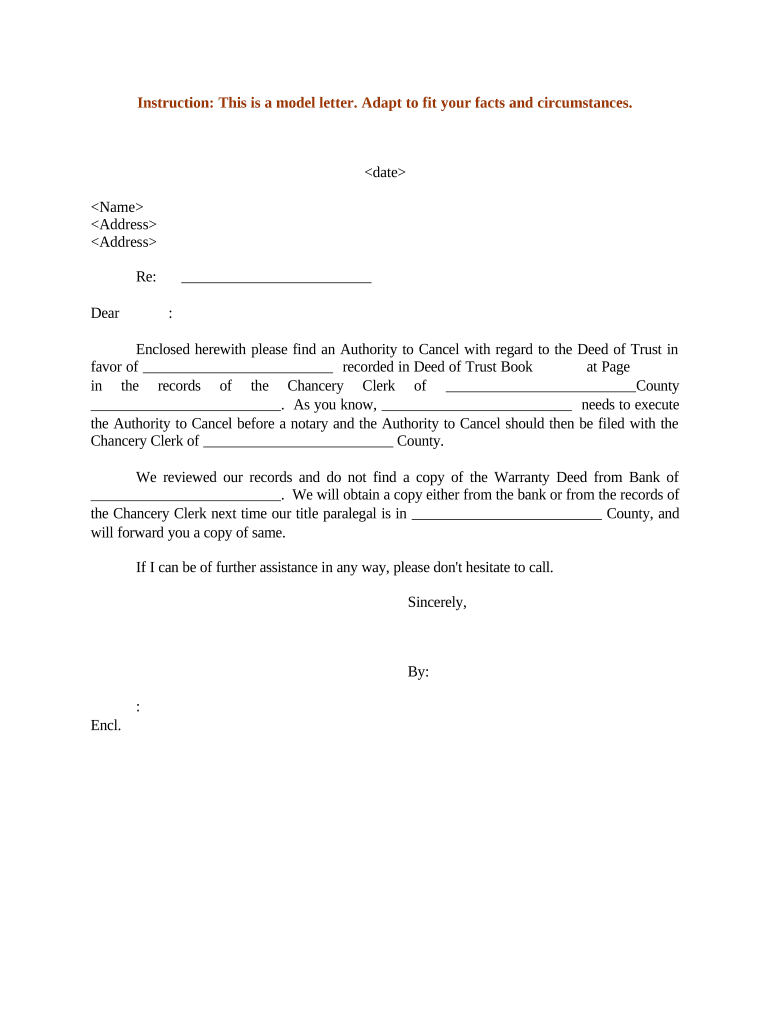
A clear Letter Regarding Authority to Cancel Deed of Trust reduces recording errors, documents chain of authority, and helps title companies and county recorders process reconveyance quickly. It provides legal clarity about who may authorize cancellation and when the release takes effect.

Lenders, trustees, title companies, servicers, and property owners commonly prepare or request this letter when a loan is satisfied.
State explicitly who is authorized to cancel the deed of trust, reference the party's title (e.g., beneficiary, trustee), and cite the source of authority such as a payoff, assignment, or court order.
Include the original deed of trust recording date, county recorder's book/page or instrument number, loan account number, and property legal description or parcel number to ensure accurate matching at the recorder's office.
Specify the date the cancellation takes effect and whether the action is retroactive to the payoff date or effective upon recording; clarify any conditions precedent that must be satisfied.
Name the trustee or recording office and provide a mailing or electronic submission address, required routing steps, and any preferred recording instructions or follow-up contact details.
Require signatures from authorized signers with printed names, titles, and dates; state notarization or witness requirements and include a signature block formatted for county acceptance.
Attach payoff statements, release letters, satisfaction affidavits, assignment documents, or court orders that corroborate authority and streamline the recorder's review process.
| Field | Configuration |
|---|---|
| Signature type | Choose e-sign, RON, or wet-notary. |
| Authentication | Use email OTP, SMS code, or KBA for identity. |
| Attachments | Require payoff and assignment PDFs as exhibits. |
| Routing order | Set signer, trustee, then recording office. |
Digital signing and submission require compatible formats, signer authentication, and recordkeeping to meet ESIGN and UETA standards.
1–7 business days to assemble documents.
Same-day to several days, depending on notary availability.
County recording often 1–4 weeks, varies by county.
RON sessions complete same day; recording delay depends on recorder.
Allow 30–60 days for official reconveyance to appear.
PDF/A archival copies preserve document appearance and metadata; use searchable PDFs for indexing and redaction-friendly storage to ensure future accessibility by title examiners and compliance teams.
Adopt consistent naming: PropertyAddress_Instrument#_Year.pdf; include recorder number and signature date to improve retrieval during title searches and audits.
Store signed originals in secure cloud repositories with versioning and restricted access; maintain an offline backup or archival export for long-term legal evidence.
Retain a certified paper copy or microfiche per county preferences, and record tracking information in your title operating system for chain-of-custody audits.
A title company received a lender-issued letter with full deed reference and payoff exhibit that matched recording records.
A mortgage servicer submitted a signed letter, notarized power of attorney, and payoff confirmation to the trustee for a matured loan.
| signNow | DocuSign | Adobe Sign | PandaDoc | HelloSign | |
|---|---|---|---|---|---|
| Starting Price | $8/user/mo | $15/user/mo | $14/user/mo | $19/user/mo | $15/user/mo |
| Free Trial | 7-day trial | No | No | Yes, limited | Yes, limited |
| Bulk Send | Yes | Yes | Yes | Yes | No |
| Audit Trail | Yes | Yes | Yes | Yes | Yes |
| HIPAA Compliant | Yes | Yes | Yes | No | No |