Establishing secure connection…Loading editor…Preparing document…

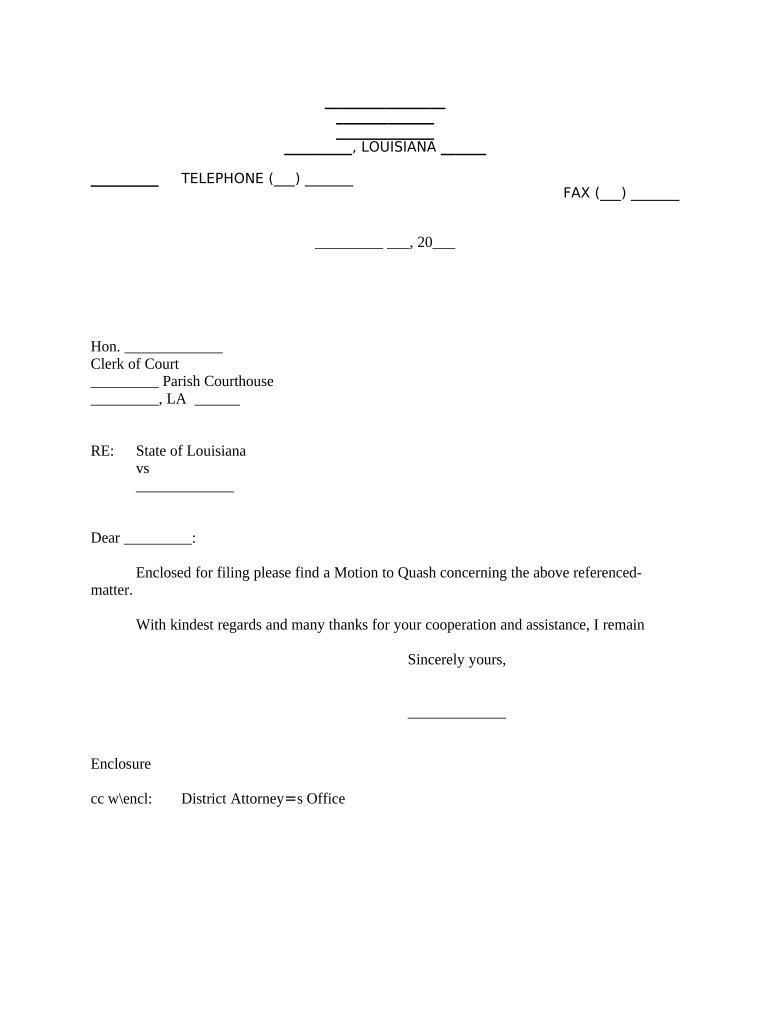
Louisiana Motion to Quash

This template is fully customizable. Edit the text, fill out the fields, and send it for signature. Give it a try!
Louisiana Motion to Quash

What a Louisiana Motion to Quash Is and When It Applies

A Louisiana Motion to Quash is a court filing asking a judge to dismiss or invalidate a pleading, subpoena, or service due to procedural defects, lack of jurisdiction, improper service, or insufficiency of process. In state and federal practice within Louisiana, parties use this motion to challenge the legal sufficiency or timing of an opposing party's filing rather than the merits of the underlying claims. The motion typically asks the court to prevent a case from proceeding until the defect is cured or to dismiss the challenged matter entirely.

Why Use a Motion to Quash in Louisiana

A Motion to Quash protects procedural rights early in litigation by removing jurisdictional or service defects that, if uncorrected, can prejudice a party. Properly used, it preserves defenses, narrows disputes, and can avoid unnecessary discovery or default judgments while the court resolves threshold issues.

Why Use a Motion to Quash in Louisiana

Who Typically Files or Responds to a Motion to Quash

Parties and counsel who face defective service, improper subpoenas, or jurisdictional challenges file motions to quash to preserve procedural defenses and limit exposure before answering on the merits.

  • Defense counsel seeking to avoid default or improper discovery while preserving jurisdictional objections.
  • Corporate legal teams protecting corporate entities from defective service or unauthorized personal jurisdiction.
  • Pro se litigants challenging defective subpoenas, improper service, or lack of notice.

Primary Users and Signatories

Civil Defense Attorney

A litigation attorney representing an individual or entity files a Motion to Quash to assert lack of personal jurisdiction, improper service, or insufficiency of process. The filing protects statutory timelines and preserves appellate rights while the court decides jurisdictional or procedural defects.

Corporate Counsel

In-house counsel for a business uses a Motion to Quash when subpoenas seek privileged materials or when service was not properly effected under Louisiana law. The motion helps limit discovery scope and reduces exposure while seeking judicial resolution.

Step-by-Step: Preparing and Filing a Motion to Quash

Follow a clear, procedural sequence to draft, serve, and file the motion while preserving record and deadlines.

  • 01
    Identify Defect: Confirm the precise procedural flaw to assert.
  • 02
    Draft Motion: Draft legal argument, facts, and relief requested.
  • 03
    Attach Evidence: Include affidavit or proof supporting service facts.
  • 04
    File and Serve: File with court clerk and serve opposing counsel per rules.

Digital Workflow Setup for Online Filing and Service

Configure your document workflow to ensure timely filing, service, and retention when using electronic tools and eSignature.

Field Configuration
Document Template Use a standardized Motion to Quash template with fixed caption fields.
Signer Roles Designate filer and counsel as signers; require signer authentication.
Service Automation Enable email service notifications and PDF rendering for court filing.
Storage Policy Save final PDF and certificate to secure cloud storage.

Typical Online Submission Flow

A streamlined eFiling and eService process reduces delays and creates an auditable record from drafting through court receipt.

  • Prepare Document: Complete template and attach affidavits.
  • Authenticate Signer: Use email, SMS, or stronger verification.
  • Apply Signatures: Sign and timestamp the motion.
  • File & Serve: Transmit to court and opposing counsel.

Essential Elements of a Professional Motion to Quash

Include six core elements to make the motion effective, focused, and procedurally sound for Louisiana practice.

Caption

Complete court caption with docket number and party names exactly as prior filings to ensure correct placement on the court docket.
Statement of Jurisdiction

Explain why the court lacks personal or subject-matter jurisdiction, or why service is defective, with concise legal citations when possible.

Factual Support

Attach sworn affidavits or declarations describing when and how service occurred, including who served and method used.

Legal Argument

Cite Louisiana procedural rules and relevant authorities supporting quash relief; address counterarguments briefly.

Relief Sought

Specify whether you seek quashal, dismissal without prejudice, or an order to restrain further proceedings until cure.

Certificate of Service

Document how and when the motion was served on opposing counsel and any applicable eService rules followed.

Document Integrity and Security Considerations

Encryption: TLS 1.2/1.3; AES-256
Audit Trail: Detailed timestamp and IP
Access Controls: Role-based permissions
BAA Availability: HIPAA BAA required
Retention Options: Configurable archival
Certifications: SOC 2 Type II, ISO 27001

Risks of Filing an Incorrect or Untimely Motion

Waiver: Defense waived
Sanctions: Court sanctions possible
Delay: Extended litigation timeline
Costs: Adverse cost awards
Default Risk: Risk of default judgment
Evidence Loss: Lost preservation window

Common Mistakes to Avoid When Preparing the Motion

  • Failing to attach sworn affidavits or proof of the facts supporting improper service undermines the motion's credibility and may lead to denial.
  • Using an incorrect court caption or docket number can result in misfiling or the clerk rejecting the submission, delaying proceedings.
  • Arguing merits instead of procedural defects converts a threshold motion into a premature merits challenge and may waive procedural objections.
  • Missing local rule requirements for timing, page limits, or required supporting forms can cause the court to refuse consideration.

How a Motion to Quash Differs from Similar pleadings

Compare the Motion to Quash with commonly confused motions to ensure you choose the correct procedural vehicle.

Criteria Motion to Quash Motion to Dismiss
Primary Purpose procedural defect fail to state claim
Timing early procedural stage can be after answer
Focus service/jurisdiction legal sufficiency
Typical Relief quash or dismiss dismiss with prejudice

Timing Considerations and Typical Deadlines

Observe court rules and local practice for service, response, and hearing scheduling; deadlines are jurisdiction-specific and often short.

File Promptly:

File as soon as defect is known to preserve rights

Service Deadline:

Serve motion per local rules, often within days of filing

Response Period:

Opposing party typically has a short window to respond

Hearing Notice:

Court may set hearing 7–30 days after filing

Appeal Timing:

Appeal windows follow final orders per state appellate rules

Key Milestones in a Motion to Quash Proceeding

Track and document each milestone from drafting through the court's ruling to maintain procedural protection and evidentiary record.

01

Draft and File

Prepare motion, attach affidavits, and file with court clerk.

02

Serve Opposing Party

Serve counsel and any affected parties according to local rules.

03

Hearing Scheduled

Court issues a hearing date or decides on submission without oral argument.

04

Court Ruling

Judge grants, denies, or partially grants relief and enters written order.

Practical Examples of Motions to Quash in Use

Real-world examples illustrate how targeted procedural challenges can resolve disputes without litigating the merits.

Optica Ventures LLC

Counsel filed a Motion to Quash service after the plaintiff used an out-of-state process server with incomplete proof

  • Motion relied on defective service dates and lack of personal jurisdiction
  • The judge ordered renewed service under local rules, preserved defenses, and avoided immediate discovery while the parties corrected service.

BIS

A company moved to quash an overbroad subpoena seeking privileged communications

  • The motion emphasized privilege logs and narrow scope alternatives
  • The court narrowed the subpoena, required redactions, and avoided production of clearly privileged materials.

eSignature Provider Comparison for Filing and Serving Motions

Compare basic pricing and feature availability for common eSignature needs when preparing and serving legal motions; signNow is listed first by design.

signNow DocuSign Adobe Sign PandaDoc HelloSign
Starting Price $8/user/mo $15/user/mo $14/user/mo $19/user/mo $15/user/mo
Free Trial Yes, 7-day trial No No No No
Bulk Send Yes Yes Yes Yes No
Audit Trail Yes Yes Yes Yes Yes
Envelope Cap No cap 100 envelopes/user/year Varies Varies Varies

Technical and Platform Requirements for eSubmission

Ensure your eSignature and eFiling platform meets legal, security, and integration needs before submitting a motion electronically.

  • File Formats: PDF, DOCX supported
  • Integrations: Salesforce, NetSuite, Google Workspace
  • Authentication: Email, SMS, or advanced methods

Frequently Asked Questions About Motions to Quash in Louisiana

Answers to common procedural and technical questions help reduce filing errors and strengthen your motion's record.


Need help? Contact support

be ready to get more
Join over 28 million airSlate SignNow users