Establishing secure connection…Loading editor…Preparing document…

Customer Follow-up Letter

This template is fully customizable. Edit the text, fill out the fields, and send it for signature. Give it a try!
Customer Follow-up Letter

What a Customer Follow-up Letter Is and When It's Used

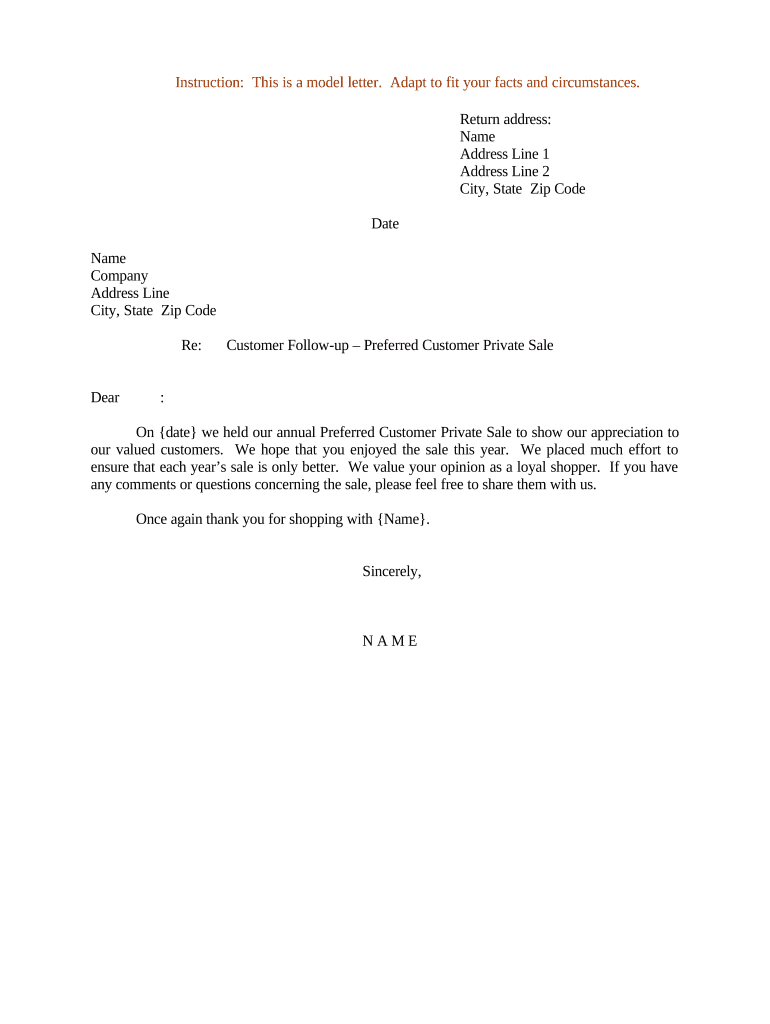
A Customer Follow-up Letter is a written communication sent to a customer after a prior interaction, transaction, or unresolved issue to confirm next steps, request information, remind about obligations, or document a resolution attempt. It typically references prior correspondence, includes account or invoice details, states an action requested and a deadline, and provides contact information. Organizations use follow-up letters for collections, order clarifications, service confirmations, warranty claims, and regulatory notices. When executed electronically, a follow-up letter can carry an e-signature and an audit trail to support attribution and retention.

Why a Clear Follow-up Letter Matters

A concise, well-structured follow-up letter reduces miscommunication, documents company efforts, and creates a clear paper trail that supports collections, dispute resolution, and regulatory compliance. Proper form and timestamps help demonstrate intent and reasonable notice when obligations are contested.

Why a Clear Follow-up Letter Matters

Who Typically Prepares and Receives These Letters

Customer follow-up letters are used across teams and industries to formalize next steps after service, sales, or support interactions.

  • Customer service teams handling unresolved support tickets and warranty claims, documenting attempts to resolve issues and next steps.
  • Accounts receivable or billing teams seeking overdue payment, stating invoice references and requested payment dates to reduce collection disputes.
  • Legal or contract administrators following up on confirmations, contract deliverables, or cure periods as part of dispute avoidance and evidence preservation.

Step-by-step: Drafting and Sending a Follow-up Letter

Follow a consistent sequence from drafting through delivery to preserve records and demonstrate good-faith efforts.

  • 01
    Prepare content: Reference prior interaction, state requested action, and set a clear deadline.
  • 02
    Add identifiers: Include account numbers, dates, and supporting document references.
  • 03
    Choose delivery: Select email, certified mail, or eSignature route based on risk and proof needs.
  • 04
    Record completion: Save signed copy, timestamp, and delivery confirmation for the file.

Configuring an Online Follow-up Letter Workflow

Set up digital fields and routing to streamline creation, approvals, and signature capture.

Field Configuration
Document upload Upload final template as PDF or DOCX for consistent formatting.
Field placement Add signature, date, and text fields with required flags where needed.
Signer authentication Select email link, SMS code, or advanced verification based on risk.
Notifications Enable reminders and completion emails to track signer response.

Typical Digital Send-and-Sign Flow

A standard electronic workflow moves a draft from sender to signer, captures consent, and archives the signed record with an audit trail.

  • Upload document: Sender uploads follow-up letter and configures fields.
  • Assign signers: Add recipient emails and designate signing order if needed.
  • Authenticate signer: Apply email, SMS, or additional checks as required.
  • Capture signature: Signer reviews and signs; system logs timestamp and IP address.

Delivery Channels and Technical Compatibility

Choose delivery methods based on evidentiary needs: email, certified mail, courier, or secure e-signature platforms.

  • Integrations: Salesforce, NetSuite, Microsoft 365 supported
  • File formats: PDF, DOCX, and HTML accepted
  • Authentication: Email link, SMS code, or KBA

Essential Data Elements to Protect

Personal Data: Recipient PII must be redacted when not required
Account Identifiers: Protect invoice and account numbers
Health Information: PHI requires HIPAA safeguards
Payment Details: Secure storage for bank or card data
Signature Evidence: Audit trail with timestamps
Access Logs: Retain access and change records

Common Timelines and Response Windows

Set explicit timeframes and track responses to support collections, compliance, and dispute resolution.

Initial send window:

Send within 7 business days after unresolved event

Response deadline:

Request reply within 10–14 calendar days

Follow-up cadence:

Repeat every 7 days for up to three attempts

Escalation timing:

Escalate to collections or legal after 30 days

Record closure:

Document final outcome within three days

Common Mistakes to Avoid

  • Failing to include a clear deadline or acceptable payment method — vague timelines create disputes and delay resolution.
  • Using inconsistent identifiers (invoice or account numbers) across communications, which causes processing errors and misapplied payments.
  • Not recording delivery or signature metadata; without delivery receipts or audit logs, establishing proof of notice becomes difficult in disputes.
  • Sending sensitive customer information via unsecured channels instead of encrypted delivery or secure portals, increasing compliance risk.

Practical Risks of Incomplete or Incorrect Letters

Contract Dispute: Loss of clear evidence
Customer Churn: Damaged relationship
Regulatory Exposure: Potential compliance review
Payment Delay: Longer receivable cycle
Data Breach: PHI exposure risk
Record Loss: Missing audit trail

Examples: How Organizations Use Follow-up Letters

Real-world examples show how follow-up letters clarify obligations and preserve evidence across industries.

Billing Follow-up at a Mid-size Retailer

A retailer sent a follow-up after a missed payment referencing invoice and due date to avoid collections.

  • The follow-up requested payment within 14 days and offered online payment instructions.
  • The documented sequence of communication and signed acceptance of a payment plan resolved the account without escalation and reduced days sales outstanding.

Patient Authorization Reminder at a Clinic

A clinic issued a follow-up to obtain a signed consent form for a procedure and to confirm insurance details.

  • It requested the patient return an e-signed form within ten days.
  • Retaining the signed electronic record with a time-stamped audit trail ensured compliance with internal policy and supported billing and medical record completeness.

Key Elements to Include in Every Follow-up Letter

Ensure clarity and proof by including these structural elements in each letter.

Opening Reference

Begin with a concise reference to the prior interaction, date, and relevant document or ticket number so the recipient immediately recognizes the context and purpose.
Action and Terms

Clearly state the action requested, acceptable methods for compliance, and any fees or penalties that may apply, using specific language to reduce ambiguity and future dispute.

Deadlines and Consequences

Provide a specific deadline in MM/DD/YYYY and describe what will occur if the deadline is missed, such as escalation steps, late fees, or referral to collections.

Supporting Details

Attach or reference invoices, receipts, or prior correspondence with precise identifiers to enable quick reconciliation and accurate processing by the recipient.

Contact Information

List the sender's name, role, department, and direct contact methods so the recipient can resolve questions without delay and the record shows available assistance.

Signature and Audit Details

Include a dated signature block; for electronic execution, capture the signer identity, timestamp, and platform audit trail to support attribution under ESIGN and UETA.

Supplemental Components That Improve Compliance

Adding these elements increases clarity and defensibility when a follow-up letter may be reviewed by third parties.

Attachment Index

Provide a numbered list of attached documents with brief descriptions (invoice, contract excerpt, prior email) and exact file names to ensure completeness when the file is reviewed.

Signature Metadata

Retain metadata such as signer IP, device type, and timestamp with the signed copy to assist in establishing intent, consent, and attribution during dispute resolution.

Privacy Notice

Include a brief notice when the letter contains sensitive data (PHI or financial information) describing secure handling practices and, when applicable, HIPAA protections.

Alternative Contacts

Name a backup contact or escalation path for recipients who have accessibility needs or require additional verification steps to complete the requested action.

Key Milestones from Draft to Resolution

Track milestones to document each stage of the follow-up process and maintain a defensible chain of events.

01

Draft Completed

Letter prepared with references and required attachments.

02

Sent to Recipient

Delivery method recorded and timestamp retained.

03

First Response Due

Recipient deadline for action or reply.

04

Final Outcome Documented

Record resolution, payment, or escalation steps taken.

Frequently Asked Questions about Follow-up Letters

Answers to common questions about validity, signing, retention, and corrective actions for Customer Follow-up Letters.


Need help? Contact support

be ready to get more
Join over 28 million airSlate SignNow users