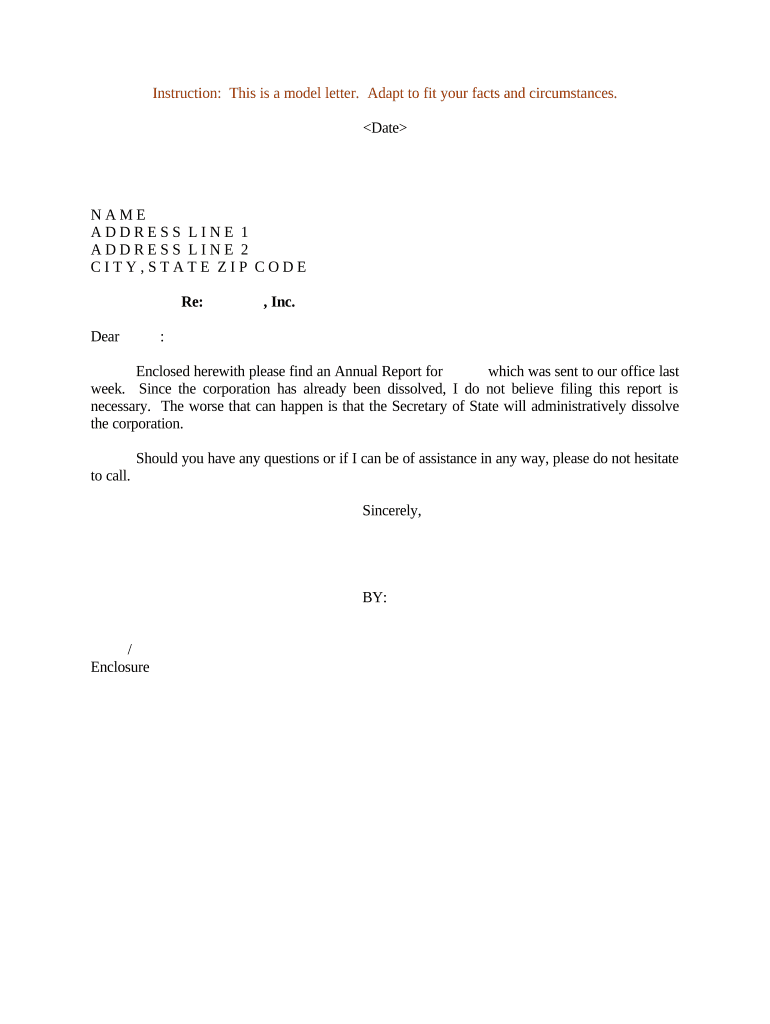
Letter Regarding Annual Report for Dissolved Corporation
What this Letter Is and When it Applies
Why this Letter Matters for Compliance and Recordkeeping
The letter helps close administrative loops with the Secretary of State, notifies interested parties, and creates a dated record showing intent and completion of post-dissolution reporting obligations.
Which Roles Typically Prepare and Receive This Letter
Keep a copy in the corporate minute book and electronic file for the retention period applicable to tax and corporate dissolution records.
- Company officers and in-house counsel who manage corporate record closing and ensure statutory filings are completed.
- Registered agents or third-party compliance firms acting on behalf of the dissolved entity to satisfy state requirements.
- Accountants or tax preparers who need confirmation to close tax accounts or complete final returns.
Primary Signers and Contact Roles
Corporate Secretary
Typically signs or certifies the letter on behalf of the board. Responsible for verifying the dissolution resolution, the final annual report year, and that corporate minutes reflect the dissolution decision.
Registered Agent
May send the letter to the state or act as recipient for official notices. Ensures the mailing address is current and confirms acceptance or additional state requirements for post-dissolution filings.
Step-by-Step: Preparing the Letter
-
01Verify Identity: Confirm the exact corporate name and EIN match state records.
-
02State Details: Include state of incorporation and the official dissolution filing number if available.
-
03Report Year: Specify the year of the final annual report and whether it was filed or waived.
-
04Sign and Date: Have an authorized officer sign and include date and contact information.
Typical Digital Workflow Setup for the Letter
| Field | Configuration |
|---|---|
| Upload Document | Use PDF or DOCX; preserve original formatting |
| Signature Field | Assign to authorized signer with date field |
| Authentication | Email link or SMS code for signer identity |
| Recipient Copies | Auto-send completed PDF and audit trail to parties |
Platform and Format Considerations
Ensure the chosen platform records IP, timestamp, and signer actions to meet ESIGN/UETA evidentiary factors.
- File Formats: PDF and DOCX are standard; signed PDF preserves page integrity
- Integrations: Integrate with Salesforce, Microsoft 365, Google Workspace, or NetSuite for records linking
- Authentication: Choose email, SMS, or stronger methods for signer attribution
Digital Signing Flow at a Glance
-
Prepare Letter: Draft letter and attach final annual report or proof of filing
-
Add Signer Fields: Place signature and date fields for the authorized officer
-
Send for Signature: Distribute via secure link or authenticated email
-
Store Records: Save signed PDF with audit trail and supporting documents
Timing and Typical Processing Expectations
Send with Dissolution Filing:
Include the letter when submitting dissolution documents to the Secretary of State
State Processing Time:
Processing varies; allow several business days to several weeks depending on the state
Tax Reporting Impact:
Final tax returns and reporting follow the corporation’s tax year and federal deadlines
Record Retention:
Keep originals per retention rules applicable to corporate and tax records
Respond to Inquiries:
Expect follow-up requests for clarifications from state or taxing authorities
Key Milestones After Preparing the Letter
Draft and Review
Prepare the letter and have counsel or accountant review the factual statements
Attach Supporting Documents
Include final annual report, dissolution certificate, and proof of tax filings as needed
File or Deliver
Submit to the appropriate Secretary of State office and notify creditors or interested parties
Confirm Acceptance
Obtain written confirmation or stamped receipt and retain it with corporate records
Common Preparation Errors to Avoid
- Using an informal or abbreviated company name that does not match the state’s registered name, causing rejection or delays.
- Failing to attach required supporting documents such as the dissolution certificate or final annual report, which prompts follow-up requests.
- Listing an unauthorized signer instead of the officer named in corporate resolutions, creating questions about validity.
- Neglecting to retain the signed letter and audit trail, which complicates responses to audits or creditor inquiries.
Consequences of Incorrect or Missing Information
Practical Tips for Accurate and Efficient Completion
Real-World Examples of Closing Documentation
Optica Ventures LLC
The team standardized a dissolution letter template to accompany final filings
- Reduced follow-up requests by a measurable margin
- This created consistent records for auditors and simplified responding to creditor inquiries after dissolution.
Martin Properties
A real estate operator used a signed letter to document final annual reports and asset dispositions
- Included signed lien releases
- Resulted in a clear trail during property transfers and reduced escrow holdbacks.
eSignature Vendor Comparison for Executing the Letter
| signNow | DocuSign | Adobe Sign | PandaDoc | HelloSign | |
|---|---|---|---|---|---|
| Starting Price | $8/user/mo | $15/user/mo | $14/user/mo | $19/user/mo | $15/user/mo |
| Free Trial | 7-day free trial | Varies | Varies | Varies | Varies |
| Bulk Send | Yes | Yes | Yes | Yes | No |
| Audit Trail | Yes | Yes | Yes | Yes | Yes |
| HIPAA Compliant | Yes | Yes | Yes | No | No |
| Envelope Cap | No cap | 100 envelopes/user/year | Varies | Varies | Varies |
FAQs and Troubleshooting for the Letter
-
Who may sign this letter?
An officer authorized by corporate resolution—typically the president, secretary, or an officer designated in the dissolution resolution—should sign. Confirm authority in the corporate minutes to avoid acceptance issues.
-
Can the letter be electronically signed?
Yes. Electronic signatures are generally enforceable under the ESIGN Act (15 U.S.C. ch. 96) and UETA (adopted by most states). Ensure the e-sign platform captures intent, consent, attribution, and retention to meet the legal-test criteria.
-
Is notarization required?
Notarization requirements vary by state and by the recipient’s policies. Some states or agencies accept unsigned notarized statements; others require no notarization. Check the specific Secretary of State guidance before filing.
-
What supporting documents should accompany the letter?
Attach the final annual report, dissolution certificate, proof of tax filings, and any lien-release documents. Providing these reduces follow-up and supports closure of accounts.
-
How long to expect processing?
Processing times vary widely by state and workload. Allow multiple business days to several weeks and retain delivery confirmations and any acceptance receipts.
-
What if the state asks for corrections?
Respond promptly with corrected information and supporting documents. Keep records of correspondence and timestamps to demonstrate timely cooperation and to limit liability.