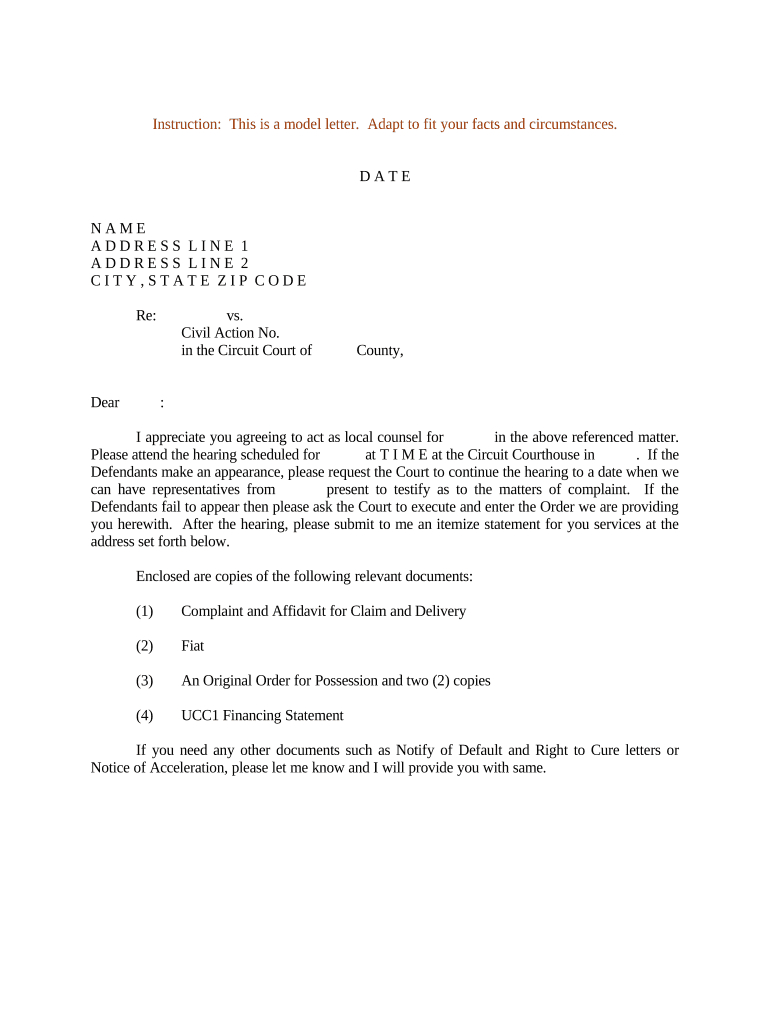
Letter to Local Counsel Regarding Hearing
What a Letter to Local Counsel Regarding Hearing Is
Why a Clear Letter Matters
Use a concise, signed letter to document authorization, avoid last-minute conflicts, and clarify tasks for local counsel. A written instruction helps ensure compliance with local rules, supports billing transparency, and preserves evidence of delegation and responsibilities for audits or disputes.
Who Typically Prepares and Receives This Letter
Lead counsel, in-house counsel, and litigation coordinators use this letter when delegating courtroom duties to a locally licensed attorney.
- Lead counsel assigning appearance and litigation tasks to a locally licensed attorney.
- In-house counsel requesting local courtroom filings, exhibits, or service coordination.
- Litigation support teams arranging delivery, evidence handling, and on-the-ground logistics.
Step-by-Step: Preparing and Sending the Letter
-
01Prepare Letter: State case info, hearing date/time, and scope of authority.
-
02Attach Exhibits: Include key exhibits or exhibit list to be used at hearing.
-
03Confirm Licensing: Verify local counsel bar status and conflict checks.
-
04Send & Track: Deliver via secure email or eSignature and request confirmation.
Typical Routing from Lead Counsel to Local Counsel
-
Draft Letter: Prepare signed letter with required case details.
-
Select Delivery: Choose secure email or certified courier per court rules.
-
Receive Acknowledgement: Obtain written acceptance and confirm scope and fees.
-
Calendar & File: Add hearing to calendars and file copies in matter file.
Digital Workflow Settings for Sending and Documenting Acceptance
| Field | Configuration |
|---|---|
| Consent Disclosure | Include ESIGN consumer disclosure if consumer-facing. |
| Authentication Level | Email link or SMS code; increase strength if sensitive. |
| Attach Exhibits | Upload PDFs and label exhibits clearly for court use. |
| Retention | Store executed letter and audit trail for recordkeeping. |
Choosing the Right Delivery Method
Choose secure delivery compatible with recipient preferences and the court's local rules; confirm whether electronic service or physical filing is permitted.
- File Types: PDF, DOCX accepted.
- Authentication: Email link or SMS code.
- Audit Trail: Timestamps, signer IP, actions.
Common Timelines and Deadlines to Track
Acceptance Deadline:
Local counsel should confirm availability within 48 to 72 hours of request.
Exhibit Delivery:
Provide exhibit list and files at least five business days before hearing.
Motion Filing:
File any necessary motions per local rule deadlines, often 7 to 14 days prior.
Service:
Serve opposing parties and court per local rules; proof of service required.
Billing Notice:
Confirm billing rate and retainers before substantive work begins.
Milestone Timeline from Request to Post-Hearing
Request Sent
Lead counsel sends letter and required case materials.
Local Acceptance
Local counsel accepts in writing and confirms scope and fees.
Pre-Hearing Prep
Local counsel prepares exhibits, witness lists, and courtroom logistics.
Post-Hearing Report
Local counsel provides appearance report, filings, and billing statement.
Key Risks and Consequences of Errors
eSignature Pricing and Feature Comparison for Letter Delivery
| signNow | DocuSign | Adobe Sign | PandaDoc | HelloSign | |
|---|---|---|---|---|---|
| Starting Price | $8/user/mo | $15/user/mo | $14/user/mo | $19/user/mo | $15/user/mo |
| Free Trial | Yes, 7-day trial | Yes, trial | Yes, trial | Yes, trial | Yes, trial |
| Bulk Send | Yes | Yes | Yes | Yes | No |
| Audit Trail | Yes | Yes | Yes | Yes | Yes |
| HIPAA Compliant | Yes | Yes | Yes | No | No |
| Envelope Cap | No cap | 100 envelopes/user/year | Varies by plan | Varies by plan | Varies by plan |
Real-World Examples of Letter Use
Case Example 1
A midwest firm asked local counsel in New York to appear for a contested evidentiary hearing and manage exhibits.
- Local counsel accepted and confirmed representation.
- The written letter specified scope, required filings, and billing, which prevented last-minute disputes, ensured compliance with local practice, and produced a clear invoice trail for the client and lead firm.
Case Example 2
An out-of-state lead counsel arranged for local counsel to cover an emergency status conference and file a short written submission.
- Local counsel coordinated service and appeared.
- Because the letter named the precise responsibilities and included contact information, the local attorney obtained quick court acceptance, preserved the hearing record, and submitted a concise billing statement aligned with the engagement terms.
Who Signs and Who Receives the Letter
Lead Counsel, Partner
The lead counsel prepares and signs the letter, coordinates with the client, and defines the scope and billing. They complete conflicts checks, provide exhibits and supporting filings, and remain the primary contact for strategy and post-hearing matters.
Local Counsel, Managing Attorney
Local counsel accepts the engagement, confirms licensure and availability, performs filings and courtroom tasks, and reports outcomes. They must document acceptance in writing and maintain the matter file and billing records consistent with the engagement terms.
Practical Best Practices to Reduce Risk
Frequently Asked Questions About Letters to Local Counsel Regarding Hearing
-
Is notarization required for the letter?
Not typically. A Letter to Local Counsel Regarding Hearing is usually a firm-to-firm engagement letter and does not require notarization, but some courts or parties may request notarized signatures or a supporting affidavit; verify local court rules and consider RON if an acknowledgment is needed.
-
Are electronic signatures legally acceptable for this letter?
Generally yes. Electronic signatures satisfy ESIGN and UETA when intent, consent, attribution, and retention are demonstrable. For consumer-facing matters or where court rules exclude e-signatures, obtain written consent or use a method meeting local court authentication requirements.
-
What should the letter include?
Include the case caption and docket number, hearing date and location, scope of authority and specific tasks, exhibit list or delivery instructions, lead counsel contact and emergency numbers, fee arrangements, and a dated signature block from the authorized signatory.
-
Who is authorized to sign the letter?
An authorized attorney from the lead firm or an in-house counsel with delegated authority should sign. Signatory must have authority to retain local counsel; include printed name, bar number, and firm to avoid disputes about authorization.
-
How to handle conflicts of interest?
Conduct a pre-engagement conflict check and disclose any potential conflicts to the client and local counsel. If a conflict exists, do not proceed until resolved; document the clearance in writing to avoid later disqualification or ethical complaints.
-
How should the letter be retained?
Retain the executed letter and related audit trail in the matter file per record retention policies. For tax, financial, or healthcare matters follow applicable retention laws such as IRC §6501(a) and 45 CFR §164.530(j).