Establishing secure connection…Loading editor…Preparing document…

Letter Requesting Retraction of Obituary

This template is fully customizable. Edit the text, fill out the fields, and send it for signature. Give it a try!
Letter Requesting Retraction of Obituary

What a Letter Requesting Retraction of Obituary Is

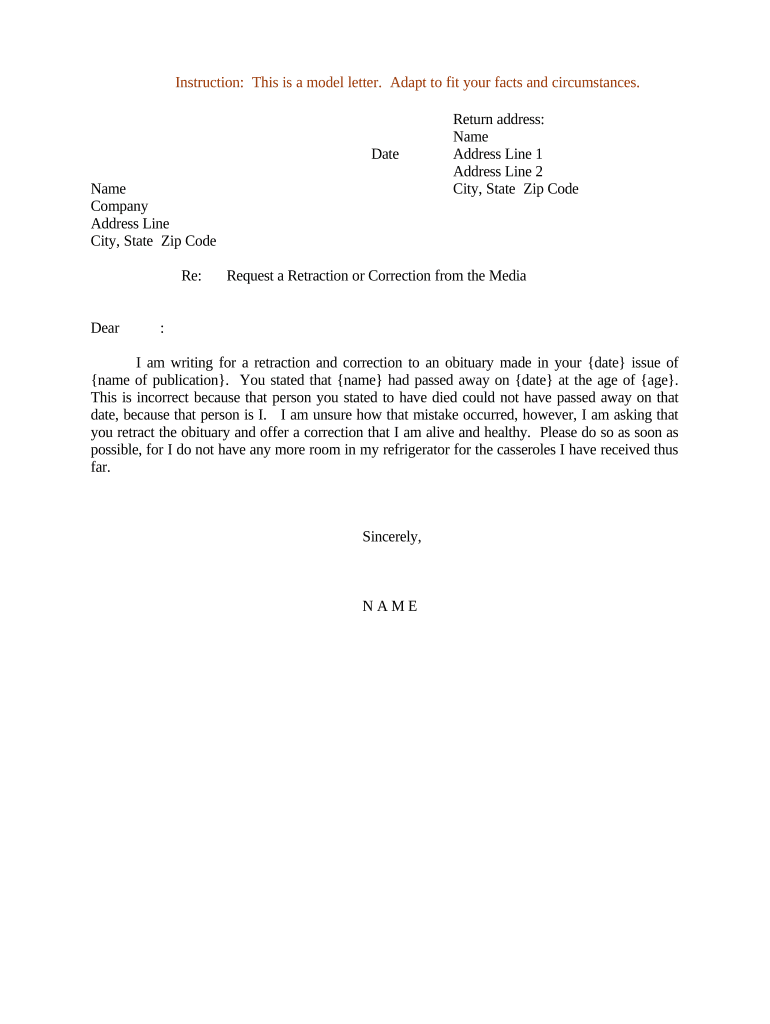
A Letter Requesting Retraction of Obituary is a formal written request submitted to a publisher, newspaper, or website asking for removal or correction of an obituary that contains inaccurate, misleading, or unauthorized information. The letter identifies the specific obituary, explains the factual errors, supplies supporting evidence or corrections, and requests a defined remedy such as correction, removal, or a retraction statement. While often civil and fact-focused, the letter can preserve legal options if the publisher refuses to correct defamatory or materially false statements.

Why a Clear Retraction Letter Matters

A concise, documented request helps correct public records, protect reputation, and create an evidentiary trail for later disputes under state defamation law and related remedies.

Why a Clear Retraction Letter Matters

Who Typically Prepares and Sends These Letters

Common senders include immediate family members, estate representatives, or legal counsel acting on behalf of the deceased's estate.

  • Immediate family or next of kin — Directly affected parties requesting correction or removal of inaccuracies.
  • Estate executor or administrator — Authorized to act for the decedent's estate and preserve legal remedies.
  • Attorney or PR representative — Professional representative handling legal claims or public statements when facts are disputed.

Essential Parts of a Professional Retraction Letter

A well-structured letter presents identity, precise error details, evidence, requested remedy, a deadline for response, and a clear signature line showing authority to request the change.

Sender Identity

Full name, relationship to the deceased, and contact information establishing authority to request the correction.
Recipient Info

Name of the editor or corrections department, publication name, and a clear delivery address or email for documented receipt.

Obituary Details

Exact headline, publication date, and URL or clipping to precisely identify the item that contains incorrect information.

Factual Corrections

Line-by-line identification of incorrect statements followed immediately by the corrected text to minimize interpretation errors.

Requested Remedy

Specify retraction, correction, or removal and a reasonable response deadline; indicate whether a published correction is requested.

Authority & Signature

Signature block with printed name, title (executor, next of kin), date, and any power-of-attorney or probate documentation reference.

Step-by-Step: Preparing and Sending the Letter

Follow an orderly process to assemble facts, create a concise letter, and deliver it using a verifiable method.

  • 01
    Gather Evidence: Collect items that demonstrate the error and support the corrected statement.
  • 02
    Draft Letter: Write a courteous, factual letter identifying the item and the requested remedy.
  • 03
    Attach Documents: Include photocopies or PDFs of supporting records; do not send originals.
  • 04
    Send & Log: Deliver by certified mail or verified email and retain proof of delivery and message content.

How to Configure a Digital Retraction Workflow

Set up a repeatable workflow that captures proof of delivery, attachments, and an audit trail for each request.

Field Configuration
Upload Template Save a standardized letter template for reuse and rapid population.
Add Signer Assign the requester as signer and add legal representatives as secondary signers.
Authentication Require email verification or SMS code to confirm signer identity.
Delivery Method Select certified mail option or platform-tracked email for verifiable receipt.

Where to Send or File a Retraction Request

Choose the correct recipient and use methods that preserve proof of delivery and the full message content.

  • Editorial Office: Address the newspaper or website editorial corrections department with publication details.
  • Author Contact: If an author is listed and reachable, include them copied for transparency.
  • Platform Support: For online-only outlets, submit through their corrections portal or verified support email.
  • Certified Notice: Send a certified mail copy to secure a dated receipt and tracking record.

Digital Delivery and File Formats to Use

Retain sent files and delivery receipts in a secure folder; these records support verification and any future legal follow-up.

  • Document Formats: PDF preferred to preserve layout and attachments.
  • Email Records: Send from an account tied to the requester; retain sent-message headers.
  • Audit Trail: Use a system that records timestamps and access events.

Timing: Recommended Follow-up and Escalation

While publishers vary, use a short documented timeline for follow-up and escalation to maintain momentum and preserve rights.

Initial Response Window:

Request an acknowledgement within 48–72 hours when possible to confirm receipt.

First Follow-up:

If no acknowledgement, follow up in 7 days by certified mail or tracked email.

Escalation:

After 14–30 days, escalate to an editor-in-chief or legal contact if unresolved.

Preserve Evidence:

Log all contacts and retain the original published content immediately upon discovery.

Legal Consideration:

Statute-of-limitations and remedies vary by state; consult counsel before filing claims.

Key Milestones from Draft to Resolution

A compact milestone list helps coordinate evidence, delivery, and follow-up while recording dates for legal preservation.

01

Draft Complete

Compose letter and attach supporting documents before sending.

02

Send & Verify

Deliver via tracked method and confirm receipt.

03

Follow-up Notice

Send a polite follow-up if acknowledgement not received within the requested window.

04

Escalate or Counsel

If publisher refuses, consult an attorney about legal options.

Common Preparation Pitfalls to Avoid

  • Requesting a vague or broad correction rather than pinpointing the exact inaccurate sentence often delays publisher action and increases follow-up.
  • Failing to attach verifiable supporting documents leads publishers to demand more proof or decline to act on the request.
  • Using an aggressive or accusatory tone can prompt defensive responses; keep the letter factual and courteous to encourage cooperation.
  • Sending to the wrong department or a generic inbox without a named contact frequently results in no tracked acknowledgement.

Risks if the Letter Is Incorrect or Mishandled

Defamation Claims: Possible civil action if false statements harm reputation.
Delayed Correction: Longer public exposure increases reputational damage.
Evidence Loss: Failure to preserve original content can weaken legal remedies.
Unauthorized Signer: Requests sent by persons without authority may be rejected.
Escalation Costs: Attorney fees and formal notices increase overall cost.
Recordkeeping Gaps: Poor documentation undermines later claims or negotiations.

eSignature Pricing Overview for Retraction Letter Workflows

Comparison of typical eSignature providers and features relevant to preparing, signing, and tracking retraction letters; signNow is listed first per vendor ordering rules.

signNow DocuSign Adobe Sign PandaDoc HelloSign
Starting Price $8/user/mo $15/user/mo $14/user/mo $19/user/mo $15/user/mo
Free Trial 7-day free trial Varies by vendor Varies by vendor Varies by vendor Varies by vendor
Bulk Send Yes Yes Yes Yes No
Audit Trail Yes Yes Yes Yes Yes
HIPAA Compliant Yes Yes Yes No No
Envelope Cap No cap 100 envelopes/user/year Varies Varies Varies

Practical Tips for a Faster, Cleaner Retraction Process

Follow these practical steps to minimize delays and strengthen the publisher's ability to act on your request.

Be Precise and Concise
Cite the exact sentence and location to be corrected, provide the exact substitute text, and avoid editorializing — concise requests are processed faster.
Include Verifiable Documents
Attach clear, relevant copies of birth/death certificates, legal documents, or official records to substantiate the correction.
Keep Communication Civil
Maintain a neutral, fact-based tone; adversarial language can prompt defensive responses and slow correction.
Log Everything
Retain sent messages, delivery receipts, and screenshots of the original content to preserve proof for future use.

Typical Signers and Their Authority

Next of Kin

A spouse, adult child, or parent often has standing to request corrections. Include your relationship, contact information, and any probate or identification reference to establish authority when requested by the publisher.

Estate Representative

An executor or administrator acting under a will or court appointment can request corrections on behalf of the estate; attach documentation of appointment to avoid delays.

Illustrative Scenarios: How Retraction Letters Are Used

Two brief scenarios show common situations and effective resolution approaches.

Family Correction

A published obituary listed the wrong birthplace and survivor list

  • The family provided a copy of the death certificate and corrected text
  • The editor posted a correction within days and appended a correction notice naming the precise changes and thanking the family for clarifying the record.

Medical Detail Dispute

An obituary included inaccurate medical information about cause of death

  • The hospital privacy officer supplied redacted records and the family requested a factual correction
  • The outlet removed the incorrect paragraph and republished the obituary with the corrected medical phrasing agreed with the family.

FAQs — Common Questions About Retraction Letters

Answers to frequent questions about authority, proof, timelines, and electronic filing for obituary retraction requests.


Need help? Contact support

be ready to get more
Join over 28 million airSlate SignNow users