Entity Identification
Full legal name, DBA (if applicable), and Employer Identification Number (EIN) so the taxing authority can match records without ambiguity or additional requests.
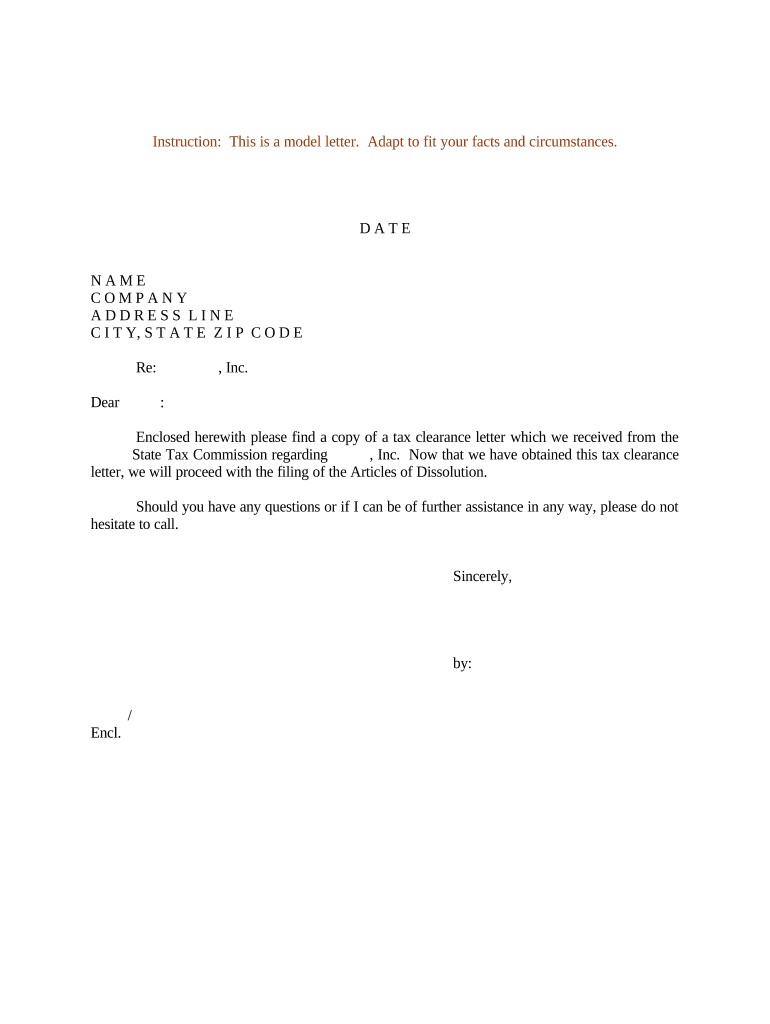
A tax clearance letter reduces the risk of administrative rejection and personal liability for officers by proving tax compliance before Articles of Dissolution are filed. It provides an auditable record for state agencies and third parties that tax obligations tied to the entity have been addressed, supporting a cleaner legal and financial closeout.

Entities and professionals involved in company dissolution commonly prepare or request a tax clearance letter before filing Articles of Dissolution.
In many cases, a tax advisor will request a formal clearance from the state department of revenue or the IRS (if federal issues exist) to attach to dissolution filings.
An officer or authorized member signs to attest the business satisfied taxes and that statements are accurate; their signature creates legal attribution for the dissolution filing and disclosure statements.
A CPA or tax attorney may sign or submit supporting statements confirming final returns and payments, and often communicates directly with taxing authorities to obtain an official clearance or certificate.
Full legal name, DBA (if applicable), and Employer Identification Number (EIN) so the taxing authority can match records without ambiguity or additional requests.
A concise declaration that all specified state and federal taxes have been paid, final returns filed, and no outstanding balances remain for the periods identified.
List the tax years or reporting periods covered by the clearance letter to prevent scope disputes during agency review or audit follow-up.
Attach payment receipts, final return confirmations, IRS transcripts where applicable, and any formal clearance certificates issued by taxing authorities for verification.
Include printed name, title, contact information, date, and, if required, notarization or witness lines to confirm signer authority and attribution.
Specify where the letter should be filed, a point of contact at the taxing authority, and whether an electronic copy is acceptable in lieu of original paperwork.
| Field | Configuration |
|---|---|
| Document upload | Allow attachments for returns, receipts, and clearance docs |
| Signer roles | Define officer, tax advisor, and registered agent roles |
| Auth method | Select email link, SMS code, or KBA for signer verification |
| Retention | Set automatic archival and export to secure storage |
Ensure the chosen platform supports required file types, signer authentication, and secure storage before completing the letter and related dissolution filings.
Confirm the receiving state or agency accepts electronic submissions and preserves proof of receipt; if not, retain printed copies and certified mail receipts for the record.
No statutory deadline; provide upon payer request to avoid backup withholding
Recipient and IRS deadlines: January 31 for tax year reporting
Form 1040 due April 15 (extension to Oct 15 with Form 4868)
Varies by state; some agencies issue electronic clearances within days, others take weeks
Plan 2–6 weeks for coordinated final payments and agency responses
Finalize returns, compute liabilities, and record payments.
Submit applications or requests to state revenue or taxing agencies.
Prepare the clearance letter, include attachments, and obtain signatures.
Submit Articles of Dissolution with the clearance letter attached, and confirm agency acceptance.
| signNow | DocuSign | Adobe Sign | PandaDoc | HelloSign | |
|---|---|---|---|---|---|
| Starting Price | $8/user/mo | $15/user/mo | $14/user/mo | $19/user/mo | $15/user/mo |
| Free Trial | 7-day free trial | Varies by vendor | Varies by vendor | Varies by vendor | Varies by vendor |
| Bulk Send | Yes | Yes | Yes | Yes | No |
| Audit Trail | Yes | Yes | Yes | Yes | Yes |
| HIPAA Compliant | Yes | Yes | Yes | No | No |
| Envelope Cap | No envelope cap | 100 envelopes/user/year limit | Varies | Varies | Varies |