Caption
Start with the agency name, case caption, claim or docket number, and the judge’s name so the letter is filed under the correct matter.
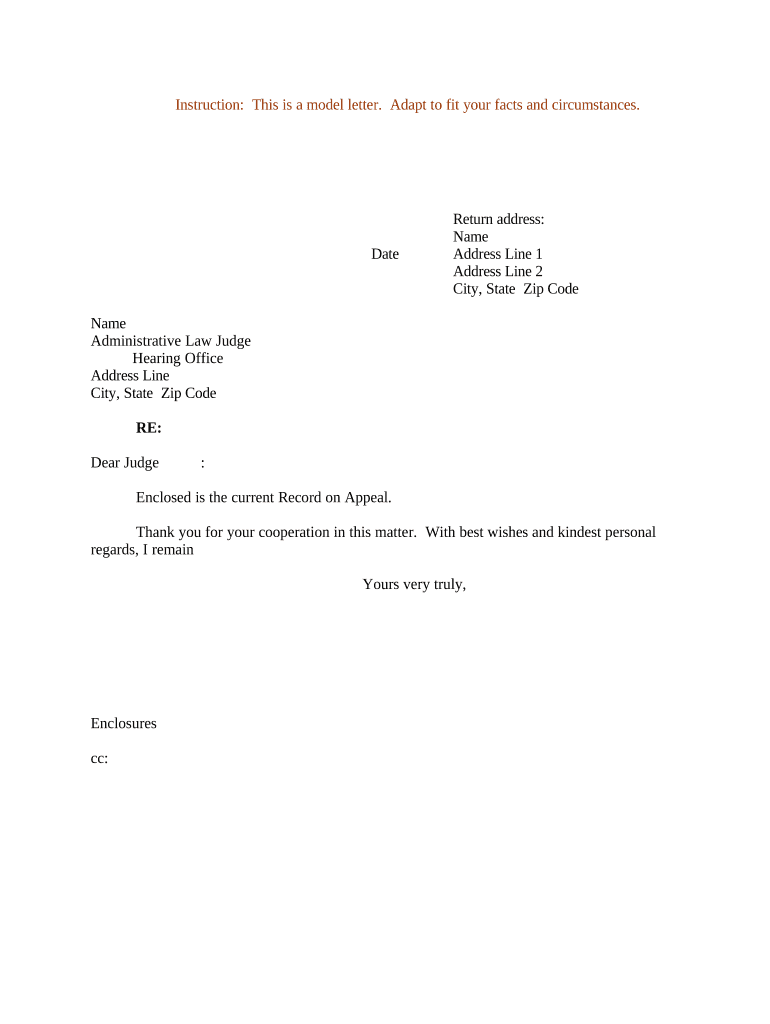
A clear, correctly formatted letter ensures your arguments and evidence are part of the official record, helps the judge understand your position, and can influence case outcomes when hearing time is limited.

Letters are commonly prepared by claimants, attorneys, advocates, and authorized representatives before an administrative hearing.
Choose the writer based on complexity: use counsel for legal argumentation and a claimant or representative for straightforward factual summaries.
An individual directly affected by the agency decision who may sign and submit the letter personally; the claimant should identify themselves by name, claim number, and contact information and attest to the truth of factual statements.
A person or attorney authorized in writing to act for the claimant; include a written designation or power of attorney if required by the agency and provide contact information and signature for authentication.
Start with the agency name, case caption, claim or docket number, and the judge’s name so the letter is filed under the correct matter.
State who you are, your relationship to the case, and the specific purpose of the letter in one or two sentences to set context for the reader.
Provide a concise factual timeline with dates and key events tied to exhibits; avoid lengthy narrative and focus on material facts the judge needs.
Briefly identify the legal standard or agency rule that supports your request and explain how the facts meet that standard.
Number and describe attached documents or evidence (exhibit A, B, etc.) and indicate which pages or sections are most relevant.
Include printed name, signature, title (if applicable), mailing address, phone number, and date; denote if signed under penalty of perjury when required.
| Field | Configuration |
|---|---|
| Recipient Authentication | Email link or SMS code to confirm signer identity. |
| Required Fields | Mark caption, case number, signature, and date as mandatory. |
| Attach Exhibits | Allow PDF uploads and enforce file naming conventions. |
| Audit Trail | Enable timestamps, IP capture, and download logs. |
Verify the agency’s e-filing rules, acceptable file formats, and authentication methods before uploading.
Keep local copies of submitted files, audit logs, and proof of service. Platforms that provide tamper-evident PDFs and audit trails reduce administrative risk.
Many agencies require documents several days before the hearing; verify the notice for the exact cutoff.
Opposing parties often receive a fixed number of days to respond; this varies by rule.
Proof of service or certificate may be required at filing time.
Requests to supplement the record are often tightly limited and may need leave from the judge.
Agencies may allow extensions only for good cause and with prior approval.
| signNow | DocuSign | Adobe Sign | PandaDoc | HelloSign | |
|---|---|---|---|---|---|
| Starting Price | $8/user/mo | $15/user/mo | $14/user/mo | $19/user/mo | $15/user/mo |
| Free Trial | 7-day trial | Varies | Varies | Varies | Varies |
| Bulk Send | Yes | Yes | Yes | Yes | No |
| Audit Trail | Yes | Yes | Yes | Yes | Yes |
| HIPAA Compliant | Yes | Yes | Yes | No | No |