Establishing secure connection…Loading editor…Preparing document…

Louisiana Agreement for Forfeiture of Items

This template is fully customizable. Edit the text, fill out the fields, and send it for signature. Give it a try!
Louisiana Agreement for Forfeiture of Items

What the Louisiana Agreement for Forfeiture of Items Is

A Louisiana Agreement for Forfeiture of Items is a written contract used to document the voluntary transfer or formal disposition of property that is subject to forfeiture or claim. It records the parties, a clear description of the items, the circumstances of transfer or release, and any consideration or releases of liability. In Louisiana this form often accompanies law enforcement seizure procedures, civil remedies, or negotiated settlements and should reflect local procedural rules, chain-of-custody details, and signatures to create a durable record.

Why a Clear Forfeiture Agreement Matters

A precise, well-drafted forfeiture agreement clarifies ownership transfer, protects parties from future claims, and creates an evidentiary record for courts or administrative review. It reduces litigation risk by documenting consent, item descriptions, and the conditions under which items change hands.

Why a Clear Forfeiture Agreement Matters

Who Typically Uses This Agreement

Use by the right combination of agency staff, counsel, and the affected property owner helps ensure enforceability and reduces disputes.

  • Law enforcement agencies and evidence custodians processing seized items and documenting chain of custody.
  • Property owners or claimants consenting to transfer, settlement, or voluntary relinquishment of items.
  • Legal counsel, prosecutors, and defense attorneys preparing or reviewing settlement language and releases.

Key Signer Roles

Jane Martin, Property Owner

Owner or claimant who must confirm identity, describe possession history, and sign to acknowledge transfer, consideration, and any release of claims; inaccurate identity details risk challenges to the agreement.

Luis Benoit, Law Enforcement

Officer or evidence custodian who documents seizure circumstances, certifies chain-of-custody, and records inventory information; the officer’s signature supports administrative or judicial review.

Essential Data to Record

Item Description: Make, model, serial
Date/Time: MM/DD/YYYY format
Location: City, parish
Chain of Custody: Handler names, dates
Consideration: Dollar amount or terms
Signatures: Printed name, date

Step-by-Step: Completing the Agreement

Follow these steps in order to prepare, review, and finalize a defensible forfeiture agreement.

  • 01
    Gather Facts: Collect seizure reports and evidence inventory.
  • 02
    Describe Items: Record serial numbers and identifying details.
  • 03
    Declare Consideration: Specify payment or surrender terms.
  • 04
    Sign and Record: Obtain signatures, notarize if required, and file with appropriate custodian.

Where to Submit or File This Agreement

After execution, the agreement should be directed to the record custodian and any agency or court handling the forfeiture; routing depends on local procedure.

  • Parish Sheriff: File an executed copy with the evidence custodian for property records.
  • Clerk of Court: If tied to a judicial matter, lodge agreement with the court file.
  • Prosecutor’s Office: Provide copy when agreement resolves or affects pending charges.
  • Property Owner: Give the owner a signed copy for their records.

How to Set Up an Online Completion Workflow

Configure a simple digital workflow to collect signatures, preserve the audit trail, and attach supporting documents.

Field Configuration
Document Upload Upload a PDF or DOCX of the agreement
Fields Placement Add signature, date, and text fields where required
Recipient Roles Assign primary signer and witness or custodian
Authentication Choose email link, SMS code, or KBA

Digital Delivery and Integration Options

Ensure the platform you choose supports necessary compliance (audit trail, storage encryption) and can deliver signed copies to all stakeholders.

  • File Formats: PDF and DOCX supported
  • Integrations: Salesforce, NetSuite, Box
  • Authentication: Email, SMS, or KBA

Timelines and Typical Timeframes to Expect

Timelines for filing, contesting, or recording a forfeiture agreement vary by jurisdiction; confirm local rules and any court deadlines before finalizing the form.

Execution Date Requirement:

Sign and date at execution to establish effective date

Contest Period:

Local statutes set challenge windows; check parish rules

Filing with Court:

If judgment involved, file per court schedule

Evidence Retention:

Retain related proof while appeals are possible

Notary/Recording:

Complete notarization or recording promptly if required

Key Milestones from Seizure to Final Disposition

A typical milestone sequence shows the major events from seizure through final disposition; adapt timing to local procedures and any judicial schedule.

01

Seizure Recorded

Document initial custody and inventory details.

02

Notice Issued

Notify claimant per statutory requirement.

03

Negotiation or Hearing

Resolve by agreement or set court date.

04

Final Order/Release

Complete transfer, retention, or destruction steps.

Common Preparation Errors to Avoid

  • Using vague item descriptions that later create disputes about which property was transferred.
  • Failing to verify signer identity, which undermines the evidence of consent or releases.
  • Omitting consideration or relying on ambiguous language that invites litigation over value.
  • Not preserving chain-of-custody documentation and supporting reports for court review.

Legal Risks and Potential Consequences

Wrongful Transfer: Civil claims for return or damages
Constitutional Challenge: Due process arguments may arise
Evidence Issues: Chain-of-custody gaps weaken prosecution
Tax Implications: Possible taxable event for transferred property
Contract Ambiguity: Unclear releases lead to litigation
Administrative Sanctions: Agency rules may impose penalties

Core Elements of a Professional Forfeiture Agreement

A complete agreement should include precise language covering identity, items, timing, transfer terms, releases, and documentation to reduce future disputes and demonstrate consent.

Parties

Full legal names and capacities of each signing party, including agency identification for law enforcement and printed names for individuals.
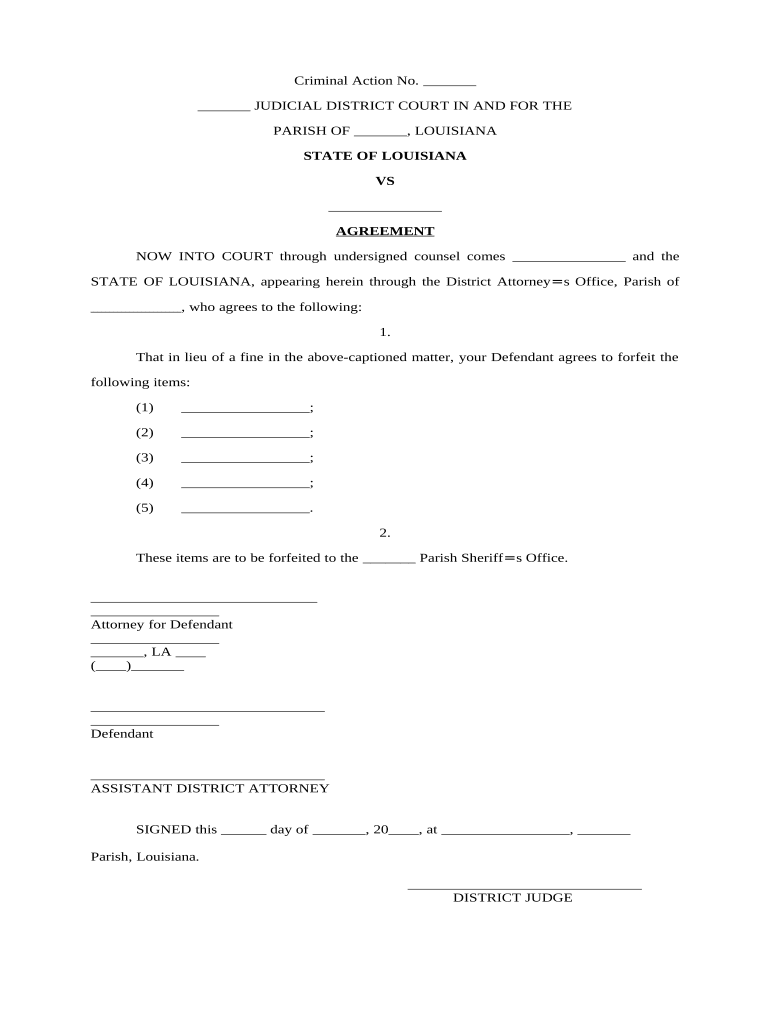
Item List

Detailed descriptions, serial numbers, and item condition to uniquely identify each surrendered or forfeited item.

Consideration

Exact monetary amounts or defined nonmonetary terms exchanged in return for release or transfer of property.

Release Clause

Clear waiver or limitation of claims, specifying scope, duration, and any carve-outs for fraud or misrepresentation.

Representations

Statements by parties about authority to sign, absence of liens, and accuracy of item descriptions and histories.

Execution

Signature blocks with printed names, dates, titles, and notarization or witness lines if required by local law.

Practical Scenarios Where the Agreement Applies

Two concise scenarios illustrate how a Louisiana forfeiture agreement is used in practice and what outcomes it documents.

Law Enforcement Settlement

An officer documents seized electronics and offers a settlement to the claimant for return of non-evidentiary items

  • Agreement records serial numbers and payment terms
  • The signed agreement, evidence report, and receipt are filed with the agency and the court to conclude the matter and avoid further litigation.

Voluntary Relinquishment

A property owner agrees to surrender abandoned equipment to avoid storage fees

  • Agreement lists items and releases the agency from future claims
  • The executed form becomes the custodian’s authorization to dispose of items and the owner’s proof of settlement for tax or insurance purposes.

Typical eSignature Pricing and Feature Snapshot

Comparison of entry-level pricing and common capabilities for eSignature vendors. signNow is shown first in the table per vendor ordering rules.

signNow DocuSign Adobe Sign PandaDoc HelloSign
Starting Price $8/user/mo $15/user/mo $14/user/mo $19/user/mo $15/user/mo
Free Trial 7-day free trial Varies by vendor Varies by vendor Varies by vendor Varies by vendor
Bulk Send Yes Yes Yes Yes No
Audit Trail Yes Yes Yes Yes Yes
HIPAA Compliant Yes Yes Yes No No
Envelope Cap No envelope cap 100 envelopes/user/year Varies by plan Varies by plan Varies by plan

Practical Tips for Accurate and Efficient Completion

Adopt these best practices to reduce errors, preserve evidence, and streamline processing for forfeiture agreements.

Use Precise Identifiers
Record serial numbers, VINs, and other unique identifiers to eliminate ambiguity about which items are affected.
Confirm Identity
Verify signer identity with ID checks and record the verifier’s name and date to strengthen the consent record.
Preserve Supporting Documents
Attach incident reports, chain-of-custody logs, and receipts to the agreement for a complete evidentiary package.
Choose Appropriate Authentication
Select a signer authentication level proportional to risk; use SMS, KBA, or government ID checks when necessary.

Frequently Asked Questions and Troubleshooting

Answers to common questions about completing, signing, and storing a Louisiana Agreement for Forfeiture of Items.


Need help? Contact support

be ready to get more
Join over 28 million airSlate SignNow users