Establishing secure connection…Loading editor…Preparing document…

License Agreement

This template is fully customizable. Edit the text, fill out the fields, and send it for signature. Give it a try!
License Agreement

What a License Agreement Is and When You Use One

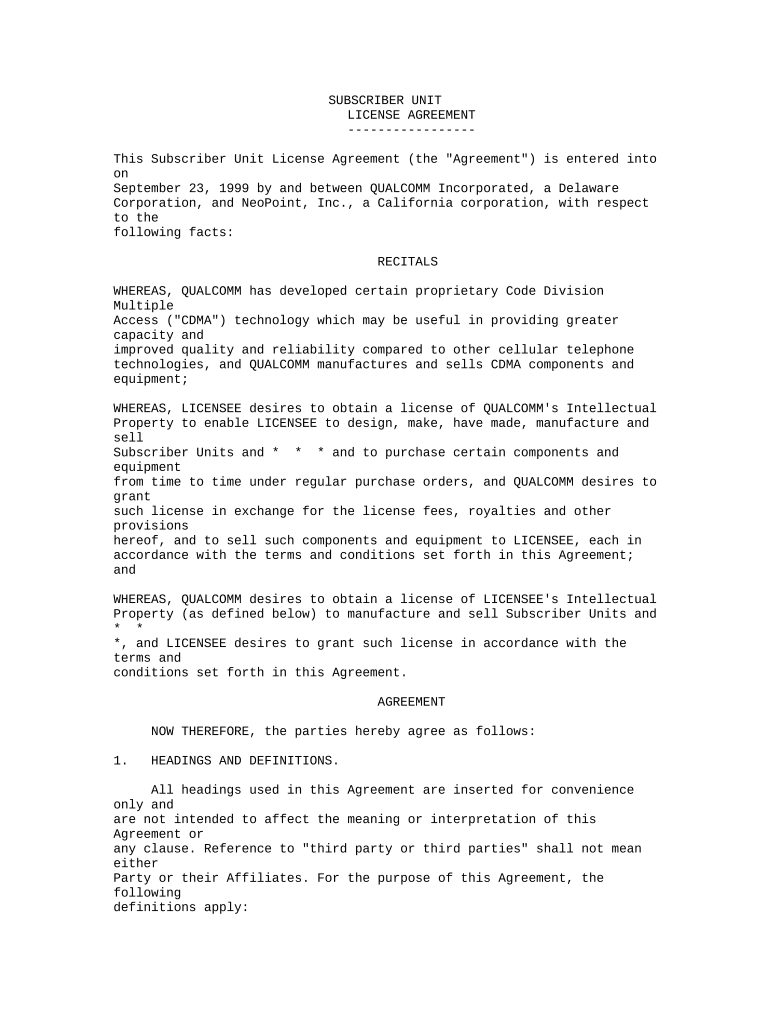
A License Agreement is a legally binding contract that grants permission to use intellectual property, software, trademarks, or other proprietary rights under defined terms. It specifies the scope of the license, territory, duration, financial consideration, performance obligations, warranties, and termination rights. Parties should record the exact legal names, the effective date, and a clear description of the licensed subject matter. Well-drafted license agreements reduce ambiguity about permitted uses, protect owner rights, and establish remedies for breach while aligning commercial expectations between licensor and licensee.

Why a Clear License Agreement Matters

A clear License Agreement allocates rights and obligations, reduces litigation risk, and preserves the value of intellectual property. It also establishes payment terms, enforcement mechanisms, and choice of law to streamline dispute resolution and operational compliance.

Why a Clear License Agreement Matters

Who Typically Drafts and Signs License Agreements

License Agreements are used by IP owners, licensors, licensees, counsel, and commercial teams to document permissions and payments.

  • Independent creators and small business licensees for product or content distribution.
  • Technology companies licensing software modules or APIs to customers and partners.
  • Universities and research institutions licensing patents to commercial developers.

Who Signs and What Their Roles Mean

Licensor — Owner

The licensor is the rights holder or authorized representative (CEO, IP manager, or counsel). They must confirm ownership, authority to license, and any outstanding encumbrances to avoid later invalidation or claims from third parties.

Licensee — Recipient

The licensee is the individual or business acquiring rights to use the subject matter. The signer should have contracting authority (procurement officer or corporate officer) and confirm operational and payment obligations before executing.

Essential Elements to Include in a Professional License Agreement

A complete License Agreement addresses allocation of rights, financial terms, compliance obligations, and end-of-term mechanics. Cover these components explicitly to avoid disputes.

Grant of Rights

Specify precisely what is licensed (patents, copyrights, software), the rights granted (exclusive, nonexclusive, sublicensing), and any permitted uses to avoid over-broad interpretations.
Term and Renewal

State the initial term, renewal mechanics (automatic or opt-in), and notice periods for nonrenewal so parties know how and when rights end or extend.

Territory and Field

Define geographic scope and field of use (industry or product lines). Narrow fields limit competition and clarify enforcement boundaries.

Consideration

Describe payments: upfront fees, royalties, minimum guarantees, audit rights, payment schedule, currency, and late-payment remedies.

Warranties and Indemnities

Include ownership warranties, third-party claims handling, and indemnification clauses to allocate legal and financial risk between parties.

Termination and Remedies

Set out termination for breach, insolvency, or convenience, and specify post-termination obligations such as return or destruction of licensed materials.

Key Data Points Required in the Agreement

Party Names: Full legal entity names
Effective Date: MM/DD/YYYY format
Contact Addresses: Street, city, state, ZIP
Licensed Subject: Clear description of IP or asset
Payment Terms: Fees, schedule, currency
Signature Blocks: Signer name, title, date

Step-by-Step: How to Complete a License Agreement

Follow these steps to populate and execute a typical License Agreement accurately and consistently.

  • 01
    Gather Parties: Confirm legal names and signatory authority
  • 02
    Define Scope: Describe the exact rights, territory, and field of use
  • 03
    Set Payment Terms: Enter fees, royalty rates, and reporting cadence
  • 04
    Sign and Date: All authorized signers must sign and date

How to Configure the Agreement for Online Completion

Set up fields and authentication to match your legal and operational requirements before sending for signature.

Field Configuration
Signature Fields Assign by role; require full name and date
Date Fields Auto-fill MM/DD/YYYY and lock after signing
Conditional Clauses Show/hide sections based on checkbox selections
Audit Trail Enable IP, timestamp, and action logging

Technical and Integration Considerations for eSigning

Choose file formats, authentication, and integrations that meet legal and business requirements before distribution.

  • File Formats: PDF, DOCX supported
  • Integrations: Salesforce, NetSuite, Google Workspace
  • Authentication: Email, SMS code, or KBA

Where to Send the Executed Agreement

After execution, distribute copies to each party, retain a signed record, and file or record the agreement only where required by local law or commercial practice.

  • To Counterparty: Provide fully executed PDF to all parties
  • Legal Counsel: Send a final copy to in-house or outside counsel
  • Accounting: Deliver payment terms for invoice setup
  • Record Filing: Record with county or agency when legally required

Common Timeframes and Notice Periods to Track

Track key dates in the agreement and set calendar reminders for renewal, termination, reporting, and payment obligations to avoid default.

Effective Date:

Date when rights and obligations begin

Payment Terms Due:

Net terms or scheduled royalty dates

Royalty Reporting:

Quarterly or annual reports due as specified

Renewal Notice:

Typically 30–90 days before term expiration

Termination Cure Period:

Commonly 30 days to remedy breaches

Common Preparation Mistakes to Avoid

  • Using informal or trade names instead of full legal entity names, which can invalidate enforcement or complicate tax reporting.
  • Leaving the scope vague (e.g., permitting undefined 'use') so that disputes later hinge on differing interpretations.
  • Failing to specify payment mechanics, currency, or audit rights, causing collection and reconciliation problems.
  • Overlooking signatory authority or corporate approvals, producing agreements that counter-parties can later challenge as unauthorized.

Potential Consequences of an Incorrect or Incomplete Agreement

Breach Damages: Monetary awards
Injunctions: Court-ordered stop to use
Lost Royalties: Unrecoverable income
Tax Issues: Incorrect reporting consequences
unenforceability: Invalid contract terms
Reputational Risk: Business relationship harm

Real-World Examples of License Agreement Use

These customer scenarios illustrate typical outcomes when organizations use structured, signed license agreements for IP and commercial deals.

Optica Ventures

The interface is simple and easy-to-use for our team; more importantly, it is just as easy for our customers.

  • Operational simplicity enabled remote execution across multiple counterparties.
  • Brian Fitzgibbons, COO, reported fewer manual follow-ups and faster deal closure after standardizing license templates and signature workflows.

Fertility Centers of Illinois

The airSlate SignNow team has been exceptional, responsive, the API has been great, and we're extremely happy that we chose airSlate SignNow as a company.

  • API integration allowed automated distribution and archiving of signed agreements.
  • John Butler, Founder, noted improved recordkeeping and consistent access to signed license files for audits and compliance.

eSignature Pricing Comparison — signNow and Major Competitors

Compare baseline pricing and compliance posture for common eSignature providers. signNow appears first per platform comparison guidance.

signNow DocuSign Adobe Sign PandaDoc HelloSign
Starting Price $8/user/mo $15/user/mo $14/user/mo $19/user/mo $15/user/mo
Free Trial 7-day free trial Varies by vendor Varies by vendor Varies by vendor Varies by vendor
Bulk Send Yes Yes Yes Yes No
Audit Trail Yes Yes Yes Yes Yes
HIPAA Compliant Yes Yes Yes No No

Frequently Asked Questions About License Agreements

Answers to common questions about execution, enforceability, notarization, and revisions for License Agreements.


Need help? Contact support

be ready to get more
Join over 28 million airSlate SignNow users