Establishing secure connection…Loading editor…Preparing document…

Lien on Real Property

This template is fully customizable. Edit the text, fill out the fields, and send it for signature. Give it a try!
Lien on Real Property

What a Lien on Real Property Is and When It Applies

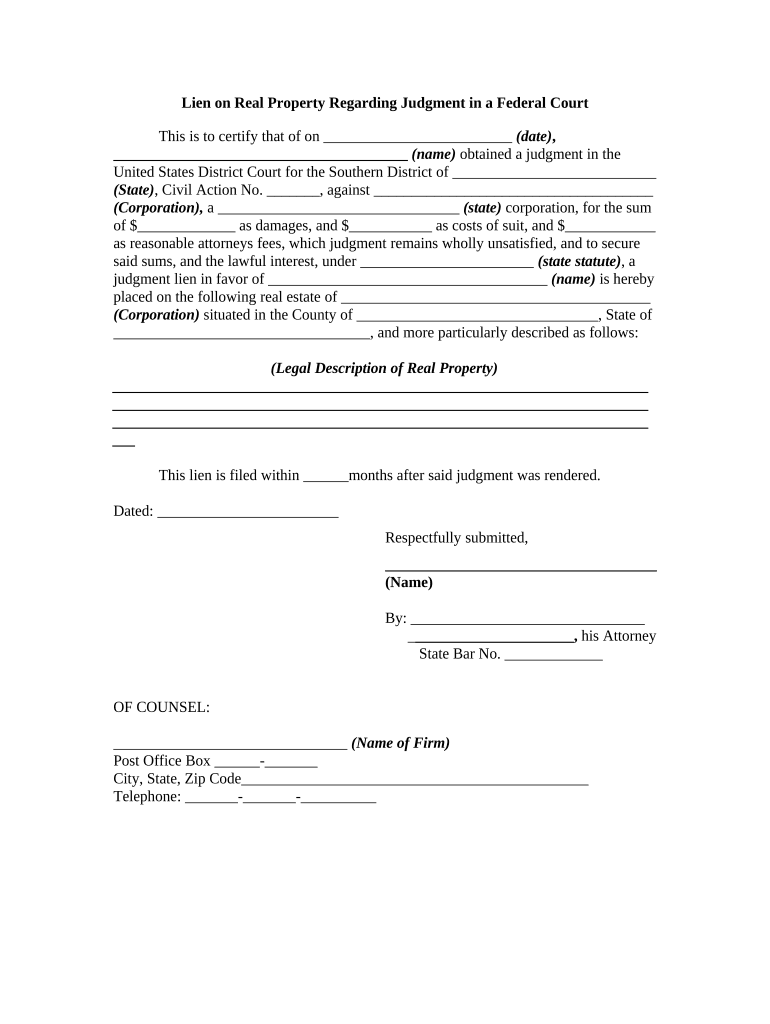
A Lien on Real Property is a recorded legal claim a creditor places against real estate to secure repayment of a debt or performance of an obligation. Liens may arise by contract (mortgages, security deeds), statute (tax liens, mechanic’s liens), or court judgment. A recorded lien encumbers title and can restrict sale, refinancing, or clear transfer until satisfied or released. Recording, priority, and release procedures vary by state; liens are typically filed with the county recorder or land records office in the county where the property is located.

Why a Carefully Prepared Lien Matters

A clear, correctly completed lien protects creditor rights and preserves priority in the title record while giving notice to subsequent purchasers and lenders.

Why a Carefully Prepared Lien Matters

Who Uses a Lien on Real Property and When to Involve Them

Typical users include lenders, contractors, tax authorities, and judgment creditors who need to protect or enforce monetary claims against real estate.

  • Lenders and mortgagees: prepare security language and legal description for recording.
  • Contractors and suppliers: file mechanic’s or construction liens to secure payment on projects.
  • Judgment creditors and taxing authorities: record judgment or tax liens to preserve enforcement rights.

Step-by-Step: Completing and Recording a Lien

Follow these sequential steps to prepare, sign, and record a lien so it provides enforceable notice and priority in the land records.

  • 01
    Prepare: Draft lien statement with exact parties and full legal property description.
  • 02
    Authenticate: Have signer execute with notarization or remote notarization if allowed.
  • 03
    Record: Submit to the county recorder with required fees and copies.
  • 04
    Serve: Provide copies to debtor and relevant parties per statute.

Configuring an Online Lien Filing Workflow

Set up an eSigning workflow that matches your legal and recording requirements before sending documents for signature and submission.

Field Configuration
Signer Order Sequential or parallel; choose based on approval needs
Authentication Email plus SMS or ID verification for higher assurance
Required Fields Lock legal description, party names, and amount fields
Retention Settings Enable audit trail and long-term storage

How Electronic Signing and eSubmission Typically Flow

An eSubmission workflow reduces turnaround and preserves an audit trail when signing liens and preparing them for recording.

  • Upload Document: Upload the lien form and supporting exhibits to the signing platform.
  • Place Fields: Insert signature, date, and notarization fields on the document.
  • Authenticate Signer: Require email, SMS, or identity verification as needed.
  • Record and Store: Download the signed package and submit to the county recorder; retain audit trail.

Technical Considerations for eSigning and Recording

Choose a platform and integrations that support required authentication, audit trails, and export formats for county recorders.

  • Integrations: Salesforce, NetSuite, Microsoft 365 support
  • Formats: PDF and DOCX export for recorders
  • Authentication: Email, SMS, KBA, or ID verification

Core Components of a Professional Lien on Real Property

A complete lien form combines clear identity, precise property description, enforceable obligation details, witness or notary authentication, and recording instructions.

Parties

Names of creditor and debtor, with mailing addresses and contact details to enable service and notice.
Property Description

Full legal description from the deed or plat; include parcel/tax ID if required by county.

Obligation Details

Specify principal amount, interest terms, and events of default that trigger enforcement.

Priority Statement

Language describing priority relative to other encumbrances and any agreed subordination.

Recording Instructions

Name of county recorder, number of originals, and cover sheet requirements for submission.

Authentication

Signature block, date, and notarization or remote notarization per state law.

Required Information and Standard Fields

Debtor Name: Full legal name
Creditor Name: Full legal name
Property Address: Street, city, state, ZIP
Legal Description: Deed-based description
Amount Secured: Currency amount
Recording County: County name

Common Filing Errors and Their Consequences

Invalid Description: Recording rejection risk
Incorrect Party: Priority disputes and challenges
Missed Notarization: Document may be ineffective
Late Recording: Loss of priority to intervening liens
Forgery Risk: Criminal exposure and voiding risk
Unreleased Liens: Encumbrance remains on title

Frequent Preparation Pitfalls to Avoid

  • Using an informal property address instead of the recorded legal description often causes county rejections and delays in establishing priority.
  • Omitting or misspelling party names creates ambiguity that can be exploited in title disputes and complicates lien enforcement.
  • Failing to notarize or meeting the wrong notarization standard for the state prevents recording and may render the lien unenforceable.
  • Relying on scanned handwritten notes without a clear signature block or audit trail increases the risk of challenge and loss of priority.

Timing and Deadlines for Filing and Maintaining a Lien

Timely filing and statutory compliance determine a lien’s priority and enforceability; observe recording windows and retention obligations.

Prompt Recording:

Record as soon as practicable to preserve priority.

Statute of Limitations:

Varies by claim type and state; check local law.

Tax Lien Timeline:

State tax lien procedures include notice and redemption periods.

Notary Record Retention:

RON may require multi-year audio-video retention.

Release Requests:

Respond to lien release demand per statute to avoid penalties.

Key Milestones from Draft to Release

Track these sequential milestones to monitor progress from lien creation through final release and record closure.

01

Draft Completion

Verify parties, legal description, and amounts before execution.

02

Execution and Notarization

Signer executes and notary or RON completes authentication.

03

Recording

Submit to county recorder and pay required fees.

04

Release or Satisfaction

File release instrument when obligation is satisfied.

Real-World Examples and Customer Experience

Example implementations show how electronic workflows and careful drafting reduce delays in lien filings and releases.

Martin Properties

Tim Martin explains streamlined processing

  • Rapid online execution reduced time spent managing documents
  • He reports reliable compliance and faster turnaround for property-related filings across mobile and offline workflows, improving operational efficiency.

Optica Ventures

Brian Fitzgibbons highlights ease of use

  • Team and customers find interfaces intuitive
  • The result: fewer errors during signing, more consistent completion of recording packages, and clearer audit trails for property claims.

eSignature Vendor Pricing and Key Feature Snapshot

Compare starting prices and key feature differences for common eSignature vendors; signNow is listed first per platform comparisons.

signNow DocuSign Adobe Sign PandaDoc HelloSign
Starting Price $8/user/mo $15/user/mo $14/user/mo $19/user/mo $15/user/mo
Free Trial 7-day free trial Trial available Trial available Trial available Trial available
Bulk Send Yes (Business Premium) Yes Yes Yes No
Audit Trail Yes Yes Yes Yes Yes
HIPAA Compliant Yes Yes Yes No No
Envelope Cap No cap 100 envelopes/user/year Varies by plan Varies by plan Varies by plan

Frequently Asked Questions About Liens on Real Property

Answers to common questions about drafting, signing, recording, and releasing a Lien on Real Property.


Need help? Contact support

be ready to get more
Join over 28 million airSlate SignNow users