Establishing secure connection…Loading editor…Preparing document…

Life Estate Deed

This template is fully customizable. Edit the text, fill out the fields, and send it for signature. Give it a try!
Life Estate Deed

What a Life Estate Deed Is and when it’s used

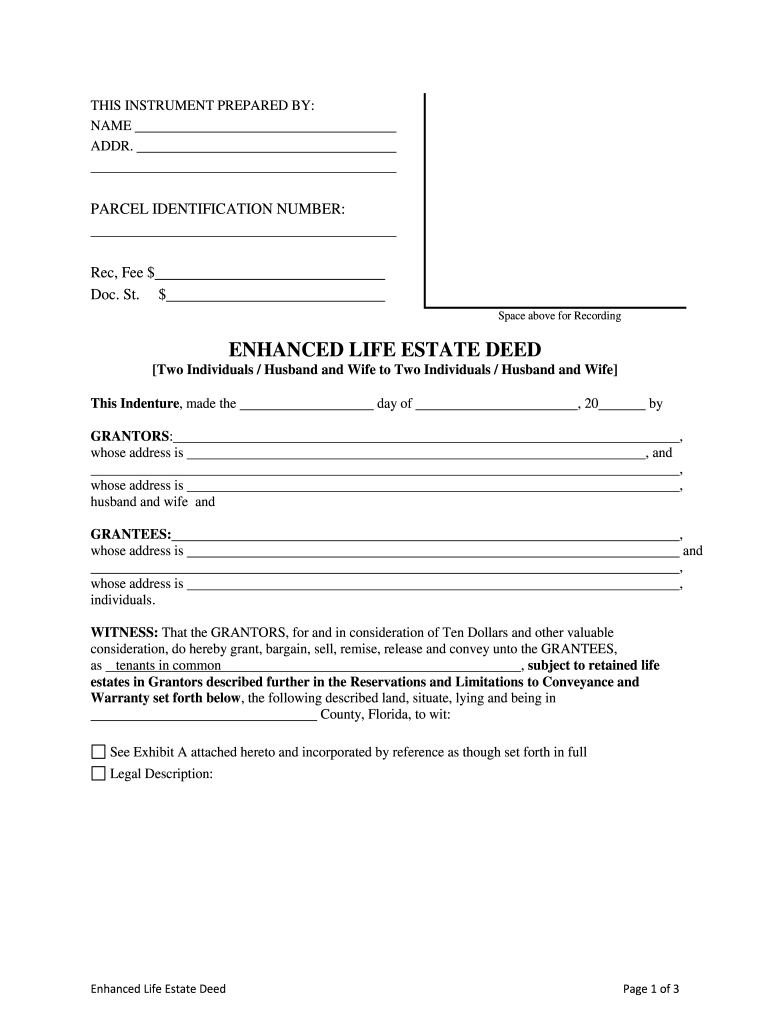
A Life Estate Deed is a real estate conveyance that grants a person (the life tenant) the right to use and occupy property for the duration of their life while naming one or more remaindermen to receive full ownership when that life ends. The deed transfers present possessory rights to the life tenant but reserves the future interest for the remainderman, creating property interests that affect taxation, Medicaid eligibility, and probate avoidance. Because the deed alters title, accurate legal descriptions, proper execution, and timely recording with the county recorder are essential for effectiveness.

Why a Life Estate Deed matters for estate planning

A Life Estate Deed lets property owners pass future ownership outside probate while retaining lifetime use; it clarifies succession but creates irrevocable interests with tax and Medicaid implications that deserve advance review by counsel.

Why a Life Estate Deed matters for estate planning

Who commonly prepares and signs a Life Estate Deed

Typical users include property owners planning to avoid probate, family members managing intergenerational transfers, attorneys preparing estate plans, and real estate professionals advising clients.

  • Property owners transferring residence while retaining life use
  • Attorneys preparing nonprobate transfer strategies
  • Real estate agents or title officers facilitating recording

Core elements included in a professional Life Estate Deed

A complete Life Estate Deed clearly identifies parties, contains an unambiguous legal description, sets the life tenancy terms, names remaindermen, states consideration if any, and includes required execution and notarization language for recordation.

Parties

Full legal names for grantor(s), life tenant(s), and remainderman(s); identical names reduce rejection risk.
Legal Description

Complete metes-and-bounds or recorded lot/block reference matching county records and tax parcel ID.

Grant Clause

Language that conveys a life estate to the life tenant and reserves remainder to named remaindermen.

Term

Specify that the estate lasts for the measured life (e.g., 'for the lifetime of [name]').

Execution

Signature blocks for all grantors, dated and accompanied by proper notary acknowledgment.

Recording Instructions

County recorder filing details and any recording fee allocation.

Step-by-step: preparing and recording a Life Estate Deed

Follow these sequential steps to prepare, execute, and record a Life Estate Deed with minimal errors.

  • 01
    Gather title info: Obtain current deed and tax parcel ID from county records.
  • 02
    Draft deed language: Use clear grant and remainder clauses tailored to your state.
  • 03
    Execute before notary: Sign in presence of required witnesses and notary or use an approved RON process if available.
  • 04
    Record with county: Submit executed deed to the county recorder and pay applicable fees.

How the execution and recording workflow typically flows

A reliable workflow prevents title defects and ensures the life estate takes effect as intended.

  • Prepare Document: Draft deed and attach current recorded deed and legal description.
  • Sign & Notarize: Execute in presence of notary and required witnesses per state law.
  • Submit to Recorder: File the deed with the county recorder and remit recording fee.
  • Update Title: Request an updated title commitment or certificate of title.

Configuring a digital workflow for a Life Estate Deed

When completing the deed online, configure fields and authentication to match recording and notarization requirements.

Field Configuration
Signature Block Require signer authentication and date; allow signature only when notary block is blank.
Notary Acknowledgment Lock until notarization step; include RON audio-video link if state permits.
Legal Description Attachment Attach PDF of prior recorded deed to verify description consistency.
Routing Order Set grantor signing first, then notary, then remainderman notification.

Digital signing and notarization considerations

Electronic completion must align with state notary rules and the recorder's acceptance policies; not all counties accept RON or e-signed deeds.

  • Authentication: Use verifiable signer authentication steps for legal attribution.
  • RON Availability: Confirm the state permits remote online notarization and meets audio/video retention rules.
  • PDF Output: Produce a tamper-evident PDF with audit trail and notary certificate.

Verify county recorder guidance before eSubmission, and retain originals or recorded copies per title company and lender requirements.

eSignature vendor comparison for executing and notarizing deeds

Compare basic pricing and feature availability for common eSignature vendors used to prepare, sign, or notarize deeds; signNow is listed first per table rules.

signNow DocuSign Adobe Sign PandaDoc HelloSign
Starting Price $8/user/mo $15/user/mo $14/user/mo $19/user/mo $15/user/mo
Free Trial Yes, 7-day trial Yes, trial available Yes, trial available Yes, trial available Yes, trial available
Bulk Send Yes Yes Yes Yes No
Audit Trail Yes Yes Yes Yes Yes
HIPAA Compliant Yes Yes Yes No No

Key identity and data elements to verify before signing

Full Names: Match government ID
Property ID: Include tax parcel number
Legal Description: Exact recorded text
Signatures: Original signatures recommended
Notary Details: Include commission info
Recording County: Specify correct county

Common legal and financial risks from incorrect deeds

Invalid Transfer: Conveys no clear title
Gift Tax: Possible IRS gift implications
Medicaid Impact: May affect eligibility
Recording Rejection: County may refuse to file
Unintended Interests: Creates encumbrances
Future Litigation: Risk of contested ownership

Frequent preparation errors to avoid

  • Using an incomplete legal description that doesn't match county records leads to recording rejection or ambiguous title attempts.
  • Failing to include the required notary acknowledgement or using the wrong notary form can void the recorder's acceptance.
  • Naming remaindermen imprecisely (nicknames, initials) creates disputes and delays in title transfer to heirs.
  • Not confirming state-specific witness or RON requirements causes defective execution and potential later litigation.

Representative scenarios where a Life Estate Deed is used

Two concise examples show how life estate deeds function in common planning contexts and what parties typically expect.

Family Residence Transfer

An elderly homeowner grants a life estate to retain residence use

  • The homeowner remains responsible for maintenance and taxes
  • At death the child named as remainderman receives full title without probate, but gift-tax and Medicaid consequences were reviewed in advance by counsel.

Asset Simplification

A landowner with multiple heirs names remaindermen by equal shares

  • The life tenant avoids moving during lifetime
  • After the life tenant's death, title transfer proceeds through recording, simplifying administration and reducing probate costs for the estate.

Common questions and answers about Life Estate Deeds

These FAQs address execution, eSigning, revocation, and recording issues frequently encountered with Life Estate Deeds.


Need help? Contact support

be ready to get more
Join over 28 million airSlate SignNow users