Establishing secure connection…Loading editor…Preparing document…

Ohio Limited Liability Company Packet for Licensed Professionals

This template is fully customizable. Edit the text, fill out the fields, and send it for signature. Give it a try!
Ohio Limited Liability Company Packet for Licensed Professionals

What the Ohio Limited Liability Company Packet for Licensed Professionals Is

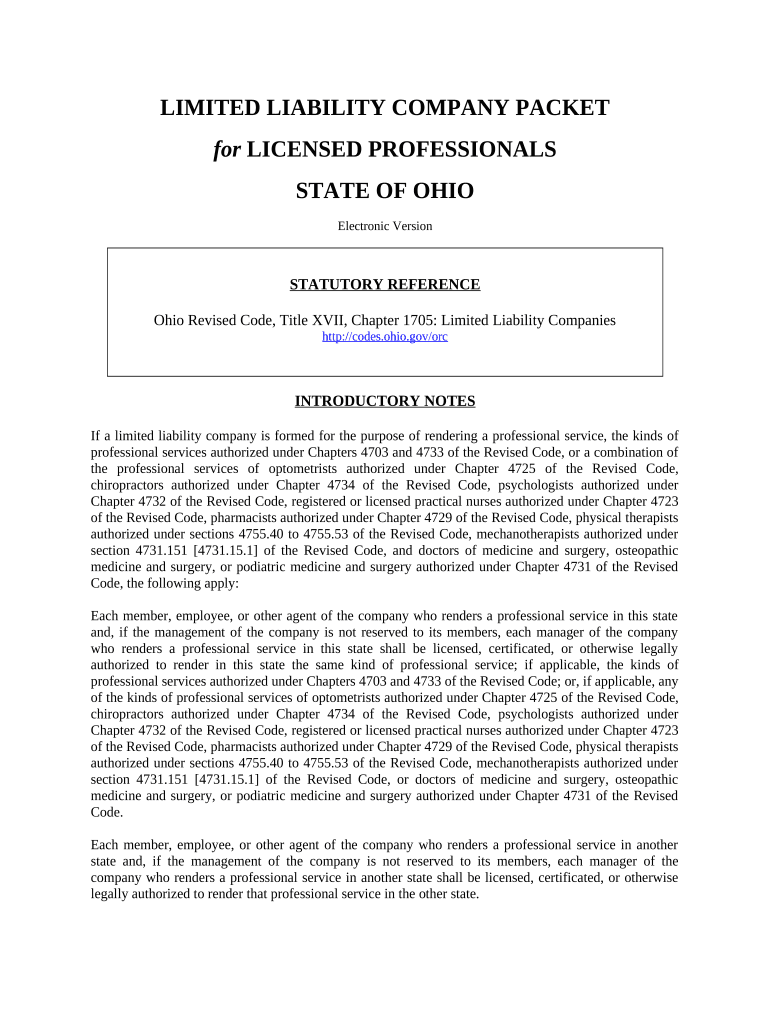
The Ohio Limited Liability Company Packet for Licensed Professionals is a structured set of formation and registration documents tailored to licensed practitioners who wish to form a professional limited liability company (PLLC) or operate an LLC that includes licensed services. The packet typically combines articles or an operating agreement, licensing statements, proof of individual professional credentials, and required attestations so the business entity meets Ohio Secretary of State rules and applicable licensing board standards. It coordinates business formation mechanics with professional compliance elements to help licensed professionals meet both corporate and licensing obligations.

Why a Professionally Prepared Packet Matters

A focused packet aligns state formation requirements with professional licensure obligations, reducing administrative rejections and clarifying roles, signatory authority, and regulatory compliance for practicing professionals.

Why a Professionally Prepared Packet Matters

Who Typically Prepares or Uses This Packet

Licensed professionals and their advisers prepare this packet when forming a practice or reorganizing an existing business to meet Ohio’s professional entity expectations.

  • Licensed practitioners such as architects, engineers, accountants, attorneys, and medical providers forming a PLLC or professional firm.
  • Registered agents and compliance staff ensuring filings meet Secretary of State and licensing board rules.
  • Attorneys and accountants drafting operating agreements, professional certification attachments, and practitioner attestations.

Typical Signers and Their Roles

Managing Member

A licensed professional who controls daily operations and signs on behalf of the entity. This person must ensure their individual license is current and that signing authority is consistent with the operating agreement and any board rules.

Registered Agent

A natural person or business designated to receive legal process and official mail. The agent must maintain a fixed Ohio address and accept service during regular business hours per Secretary of State guidance.

Key Components Included in a Complete Packet

A professional LLC packet for licensed professionals centralizes formation documents and compliance proofs so the entity can be created and recognized by both state and professional regulators.

Articles of Organization

Formal state filing that establishes the LLC/PLLC and names the registered agent, principal office, and statutory organizer information.
Operating Agreement

Internal governance document that defines membership, management structure, capital contributions, distributions, and signatory authority for licensed members.

License Verification

Copies or verification statements for each licensed professional demonstrating active licensure in Ohio or authorized jurisdictions.

Professional Attestation

Signed statement by qualified members confirming the entity will provide only authorized professional services and comply with licensing board rules.

Consent & Authorization

Statements by members consenting to the entity structure, appointment of managers, and designation of who may sign regulatory submissions.

Supporting Exhibits

Attachments such as educational credentials, malpractice insurance certificates, and any required professional bonding or background checks.

Step-by-Step: Complete the Packet in Order

Work methodically: gather licenses, complete entity forms, add governance documents, obtain signatures, then file with state authorities.

  • 01
    Gather Credentials: Collect current license copies and insurance documentation.
  • 02
    Draft Documents: Prepare articles, operating agreement, and attestations.
  • 03
    Execute Signatures: Have all required members sign and date paperwork.
  • 04
    File with State: Submit the packet and pay required filing fees to the Secretary of State.

Configuring an Online Filing Workflow

Design an online workflow that reduces manual steps and preserves audit evidence for licensure checks and state filing.

Field Configuration
Authentication Email link plus optional SMS code for signer verification.
Conditional Fields Show license fields only when role = licensed professional.
Template Use Save packet as a template to reuse across matters.
Audit Trail Capture timestamps, IP, and signer actions for compliance.

How Electronic Completion and Submission Typically Flow

A straightforward online flow simplifies completion, preserves signer intent, and creates a reproducible record for regulatory review.

  • Prepare Document: Upload and place fields for signers and dates.
  • Assign Signers: Add emails and define signing order.
  • Authenticate: Use email link or stronger authentication as required.
  • File and Archive: Submit to the Secretary of State and store a signed copy.

Digital Signing: Platform and Integration Considerations

Choose an eSignature solution that supports required authentication, audit trails, and archival export for regulator review.

  • File Formats: PDF and DOCX support required.
  • Integrations: CRM and cloud storage compatibility useful.
  • Authentication: Email, SMS, and optional KBA available.

Comparing eSignature Pricing and Feature Basics for Packet Completion

Basic pricing and feature availability across common eSignature providers relevant to completing and signing formation packets. signNow is listed first in the comparison.

signNow DocuSign Adobe Sign PandaDoc HelloSign
Starting Price $8/user/mo $15/user/mo $14/user/mo $19/user/mo $15/user/mo
Free Trial 7-day free trial Varies by plan Varies by plan Varies by plan Varies by plan
Bulk Send Yes Yes Yes Yes No
Audit Trail Yes Yes Yes Yes Yes
HIPAA Compliant Yes Yes Yes No No

Security and Compliance Features to Look For

Encryption: TLS 1.2/1.3 in transit; AES-256 at rest
Certifications: SOC 2 Type II and ISO 27001 available
HIPAA Support: BAA available for protected health information
Audit Trail: Detailed timestamps, IP, and action logs
21 CFR Part 11: Support for FDA-regulated record controls
ESIGN / UETA: Legal frameworks supported for eSignature validity

Time-Sensitive Steps and Typical Deadlines

Plan filings and license verifications early to allow for board processing and any corrective steps before practice begins.

Prepare Documents:

Gather licenses and operating agreement well before planned service start

File with State:

Submit formation documents when members approve entity terms

License Notifications:

Notify relevant licensing boards per their reporting timelines

Tax Registrations:

Register for EIN and state tax accounts promptly after formation

Annual / Periodic Filings:

Track state renewal or report dates to avoid late fees

Key Milestones from Draft to Active Status

Sequence these milestones as a checklist to move from draft packet to an active, compliant Ohio professional entity.

01

Draft and Review

Complete initial drafts and internal review by members or counsel

02

Signatures Collected

Obtain all member signatures, attestations, and agent consents

03

State Filing

File articles and required attachments with the Secretary of State

04

Record and Confirm

Receive filed confirmation and archive signed packet

Common Preparation Pitfalls to Avoid

  • Missing or expired professional licenses included in the packet lead to delays and refiling requirements by the state or licensing board.
  • Using inconsistent names between individual license records and entity documents causes verification failures and may trigger corrective filings.
  • Failing to designate an Ohio-based registered agent with a physical address risks service defaults and late notice of legal actions.
  • Neglecting to include required attestations or insurance documentation can prompt licensing boards to block entity recognition or impose sanctions.

Risks and Potential Consequences of Incorrect Packets

Filing Rejection: State may refuse or return submission
Licensing Sanctions: Board penalties or practice restrictions
Financial Penalties: Late fees or fines may apply
Professional Liability: Coverage gaps if insurance not listed correctly
Operational Delay: Business activity may be paused
Data Errors: Name/TIN mismatch triggers tax withholding issues

Real-World Examples: How Firms Use the Packet

Practical examples illustrate how licensed professionals convert forms into practice-ready entities with clear signatory and compliance controls.

Optica Ventures LLC — COO

A small professional services owner centralized formation documents into a reusable packet to speed new practice rollouts.

  • The interface simplified client signings and intake.
  • The result was consistent documentation, faster client onboarding, and fewer state rejections because licenses and attestations were captured at the start.

Martin Properties — Founder

A small owner used a standardized packet to manage licensed real estate professionals and affiliated LLCs.

  • The approach ensured required disclosures and proof of coverage were attached.
  • Centralizing forms reduced administrative back-and-forth and made it easier to reproduce compliant packets for additional offices.

Frequently Asked Questions and Practical Answers

Answers to common questions about completing, signing, and filing the Ohio packet for licensed professionals are provided below to resolve typical issues.


Need help? Contact support

be ready to get more
Join over 28 million airSlate SignNow users